
Fat Gripz Pro converts any standard 28mm barbell, dumbbell, pull-up bar, or cable attachment into a 2.25-inch diameter axle bar equivalent using a military-grade high-density compound sleeve that clamps without hardware, compresses without deformation, and fits into a gym bag. The mechanism is simple: increase bar diameter, force greater motor unit recruitment across the elbow flexors, forearm musculature, and upper arm, and drive grip and arm development that standard-diameter bars cannot replicate.
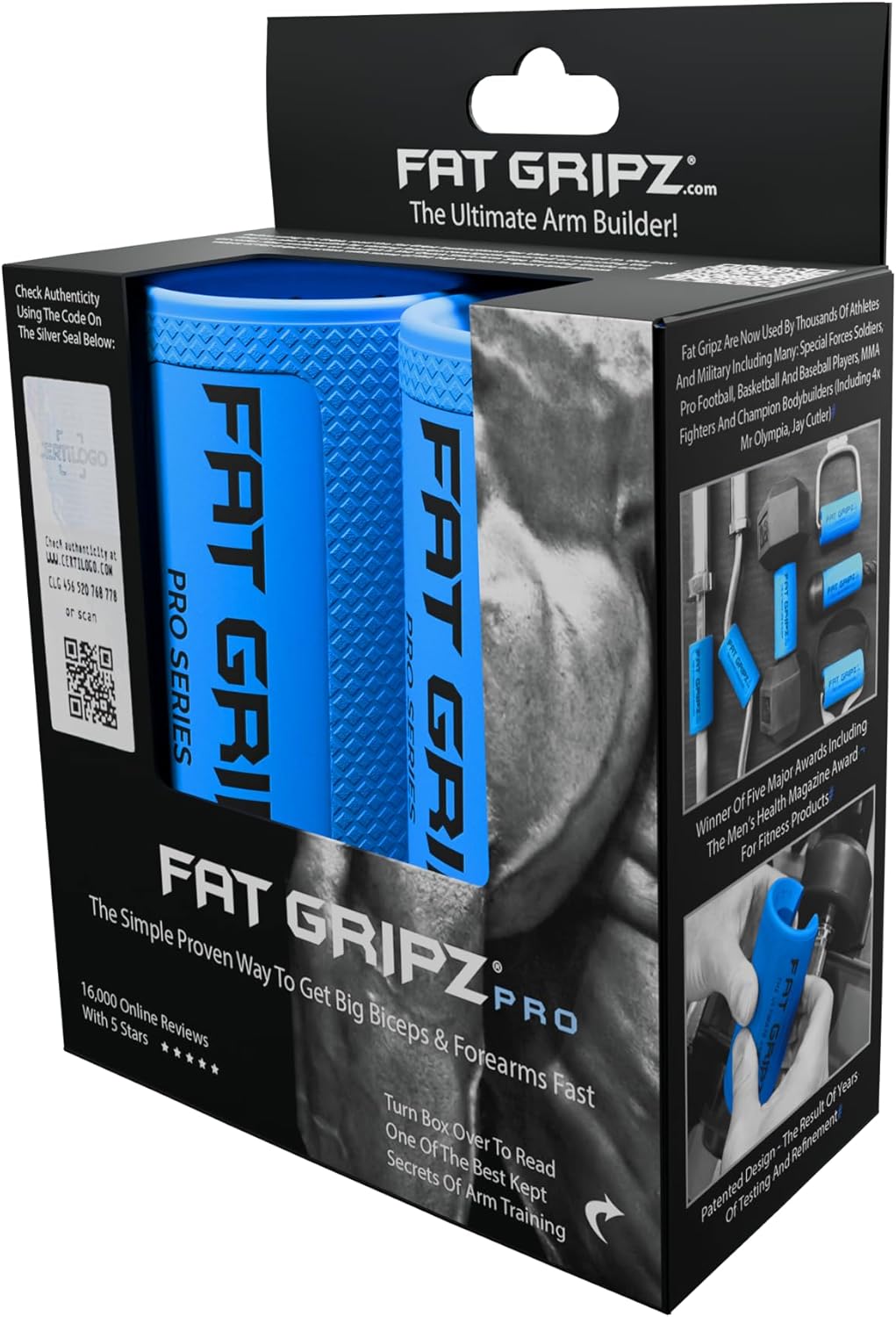
Fat Gripz Pro Construction Profile: Military-Grade Compound, 2.25″ Diameter, Clamp Fit
Military-grade high-density compound material, a 2.25-inch outer diameter, and a self-clamping split-sleeve design are the three structural facts that define the Fat Gripz Pro. No hardware. No straps. No adhesive. The sleeve wraps around the bar and holds via material compression alone — firm enough to not shift under deadlift loads, flexible enough to open and re-seat in seconds.
The military-grade high-density compound is the material claim that matters most for long-term value. Cheap rubber sleeves compress and lose shape under heavy loading, which defeats the purpose — a deformed sleeve no longer holds the target diameter. Fat Gripz compound is formulated to maintain its 2.25-inch outer diameter under sustained compressive force, including at deadlift and heavy pull loads. The bevelled ends allow fitment on angled EZ-curl bars, which most competitor thick grip adapters cannot accommodate.
| Spec | Fat Gripz Pro Detail |
|---|---|
| Outer Diameter | 2.25 inches (57mm) |
| Length | 4.75 inches per grip |
| Inner Diameter (fits) | Standard 28mm barbells, dumbbells, pull-up bars, cable attachments |
| Material | Military-grade high-density compound (non-compressible under load) |
| Attachment Method | Self-clamping split sleeve — no hardware |
| EZ Bar Compatible | Yes (bevelled ends) |
| Weight | Approx. 1 lb per pair |
| Sold As | Pair (2 grips) |
The 2.25-inch outer diameter is the defining specification and the number to compare against the broader Fat Gripz lineup. The Fat Gripz One runs 1.75 inches — entry-level, recommended for smaller hands or beginners. The Fat Gripz Pro (this product) runs 2.25 inches — the primary training diameter for most athletes. The Fat Gripz Extreme runs 2.75 inches — the advanced variant for grip specialists, strongmen, and larger-handed athletes who have already adapted to the Pro. Choosing the wrong diameter is the most common purchase mistake. See our Fat Gripz Full Review for diameter selection guidance.
The Thick Bar Mechanism: Motor Unit Recruitment and Effective Bar Diameter
Increasing bar diameter from the standard 28mm to 57mm forces the hand into a wider grip aperture, which directly increases motor unit recruitment across the flexor digitorum superficialis, brachioradialis, biceps brachii, and brachialis. This is the biomechanical basis of thick bar training — and it is not a marketing claim. It is established exercise science.
A standard Olympic barbell is 28mm in diameter. The human hand can close fully around it with grip reserves to spare. That surplus grip capacity means a significant portion of available motor units never fire. Increasing the diameter to 2.25 inches removes that surplus. The hand must work at or near maximum aperture to maintain contact with the bar, forcing full motor unit recruitment throughout the set — not just at the point of grip failure.
The downstream effects are cumulative:
- Greater forearm and bicep activation per rep on pulling movements like curls, rows, and pull-ups.
- Increased grip endurance demand on pressing and pushing movements where grip is normally passive.
- Joint load distribution — wider diameter spreads compressive force across a larger palm surface, which can reduce wrist and elbow joint stress on pressing movements for some athletes.
“A standard bar is like a garden hose — your hand closes around it and half the muscles go on holiday. Fat Gripz are the fire hose. Every motor unit in the forearm and upper arm has to show up to work because there’s no slack left in the grip.”
— Charles Damiano, B.S. Clinical Nutrition
Best Applications: Movement-by-Movement Breakdown
Barbell curls, dumbbell rows, pull-ups, cable pull-downs, and deadlift variations are the five movement categories where the 2.25-inch thick bar diameter produces the most measurable grip and arm development stimulus. Not every lift benefits equally. Here is the honest breakdown.
Pulling Movements: Highest Return
Barbell and dumbbell rows, cable pull-downs, and pull-ups generate the highest return on thick bar investment because grip is the direct limiting factor on these movements for most intermediate lifters. Adding Fat Gripz forces the grip to become the training target, not just the delivery mechanism. See our Pull-Up Progression Guide and Barbell Row Technique Guide.
Bicep Curls: Direct Arm Size Driver
Barbell and dumbbell bicep curls with Fat Gripz increase brachialis and brachioradialis activation alongside the biceps brachii, producing thicker overall arm development than standard-diameter curl training alone. The brachialis sits beneath the bicep — developing it pushes the bicep peak upward visually. It is undertrained on standard bars. The thick grip forces its activation every rep. See our Dumbbell Bicep Curls Mechanical Audit.
Deadlifts: Grip Tax, Not Grip Training
Adding Fat Gripz to conventional or Romanian deadlifts significantly increases the grip tax and should be approached as an advanced grip conditioning tool, not a standard deadlift accessory. At submaximal loads this works well. At near-maximal loads the grip becomes the limiting factor before the posterior chain — which compromises the primary training stimulus of the movement. Use on lighter accessory deadlifts or deficit pulls, not on working max sets. See our Deadlift Form Guide.
Pressing Movements: Joint Distribution Benefit
Bench press and overhead press variations with Fat Gripz shift wrist and elbow compressive load distribution across a wider palm surface, which can reduce joint stress for athletes with chronic pressing discomfort. This is a secondary benefit, not the primary training stimulus. The arm activation increase on pressing is real but smaller than on pulling movements. See our Barbell Bench Press Setup Guide and Overhead Press Guide.
Selection Matrix: Who Actually Needs Fat Gripz Pro?
A 2.25-inch high-density compound thick bar adapter fits specific training goals and athlete profiles — and actively works against others. Match the tool to the actual problem.
- The Arm Development Plateau: You have been curling and rowing for months with diminishing arm size returns. Fat Gripz forces the brachialis and brachioradialis into primary activation positions they never reach on standard bars. See our Arm Growth Hacks.
- The Grip-Limited Puller: Your grip fails before your back on deadlifts and rows. The thick bar diameter taxes the grip under every training load, building the crush grip endurance and flexor strength that strap-dependent lifting avoids. Pair with our FitBeast Grip Strengthener Review.
- The Combat Sports Athlete: MMA, BJJ, wrestling, and rugby demand sustained grip force against resistance that approximates human limb diameter — much closer to 2.25 inches than 28mm. Thick bar training builds sport-specific grip endurance.
- The Chronic Elbow or Wrist Pain Presser: The load distribution benefit of wider diameter pressing is worth trialling under submaximal load before committing to standard-bar pressing. Talk to a medical professional first about the underlying cause.
The anti-fit list is equally important.
- The Max-Strength Competitor: Any thick grip adapter reduces the load you can move on a given lift. If absolute strength numbers are the competitive metric, Fat Gripz work against you on max-effort days. Relegate them to accessory work.
- The Small-Handed Beginner: The 2.25-inch Pro diameter is the mid-tier option. If your hands are small or grip strength is genuinely undeveloped, the Fat Gripz One (1.75 inch) is the correct starting point. Oversizing the diameter defeats the adaptation purpose.
- The Dedicated Axle Bar Owner: If you already have a dedicated 2-inch or 2.25-inch axle bar, Fat Gripz replicate what you already own. The value here is portability and versatility across standard equipment — not a function you need if you have an axle.
Fat Gripz Pro Pros and Cons: Motor Unit Stimulus vs. Load Reduction Trade
The Advantage (Pros)
- Immediate Motor Unit Recruitment Increase: No programming change required. Attach to any bar and every rep of every set instantly demands greater forearm, brachialis, and bicep activation.
- Non-Compressible Military-Grade Compound: Holds 2.25-inch diameter under load. Does not deform, flatten, or lose shape like budget rubber alternatives.
- Universal Compatibility: Fits barbells, dumbbells, pull-up bars, cable attachments, and EZ bars. One purchase converts an entire gym’s equipment.
- Portable Axle Bar Equivalent: Replicates thick bar training without owning a dedicated axle bar. Fits in a gym bag.
- Joint Load Distribution on Pressing: Wider diameter spreads palm contact area, potentially reducing wrist and elbow compressive stress on pressing movements.
The Trade-off (Cons)
- Reduces Absolute Load: Thick diameter means lower working weights on every movement. Not appropriate for max-strength testing sessions.
- Grip Becomes the Limiting Factor: On pulling movements, the grip fails before the target muscle group is fully fatigued. This is the point — but it requires adjusting training expectations.
- Wrong Diameter Negates Benefits: The Pro’s 2.25-inch diameter is not universal. Small hands or undeveloped grip should start with the One (1.75 inch). Poor diameter choice reduces adaptation stimulus.
- No Load Feedback: Unlike a dedicated axle bar with calibrated knurling, Fat Gripz provide no tactile knurling feedback through the compound sleeve. Bar feel is significantly altered.
Fat Gripz Lineup: Choosing the Right Diameter
Fat Gripz One, Fat Gripz Pro, and Fat Gripz Extreme represent three distinct effective bar diameter targets calibrated to hand size and grip development stage. Buying the wrong tier is the most common mistake in the category.
| Model | Outer Diameter | Best For | Not For |
|---|---|---|---|
| Fat Gripz One | 1.75 inches | Small hands, beginners, grip introduction | Athletes with developed grip strength |
| Fat Gripz Pro | 2.25 inches | Most athletes — the primary training diameter | Very small hands or grip beginners |
| Fat Gripz Extreme | 2.75 inches | Grip specialists, strongmen, large hands | Anyone who hasn’t mastered the Pro first |
Fat Gripz Pro Verdict: The Portable Axle Bar for Every Rack
Fat Gripz Pro is a non-compressible, military-grade compound thick bar adapter that converts standard 28mm equipment to a 2.25-inch axle bar equivalent in seconds, forcing greater motor unit recruitment across the forearm, brachialis, and bicep on every rep of every set. The mechanism is proven. The material holds diameter under load. The universal compatibility across barbells, dumbbells, cables, and pull-up bars makes it the most versatile grip training investment per dollar in the category.
The trade-offs are load reduction and the knurling feedback loss through the compound sleeve. You will move less weight. The bar will feel different. Both are known and acceptable costs for the adaptation stimulus you are buying. Choose the Pro diameter for most hand sizes. Start with the One if grip strength is undeveloped. Graduate to the Extreme when the Pro no longer challenges you. Pair with our Forearm Training Guide and FitBeast Grip Strengthener Review for a complete grip development stack.
Verdict: 2.25 Inches. Military Compound. Every Bar in the Gym.
If arm development has plateaued or grip is the limiting factor on pulling work, Fat Gripz Pro is the single most efficient equipment addition to fix both. Clip on. Train harder. Graduate to the Extreme when ready.
The Thick Bar Lexicon: Key Terms
- Effective Bar Diameter
- The actual grip circumference presented to the hand, inclusive of any thick bar adapter. Increasing from 28mm to 57mm (2.25 inches) removes grip surplus and forces full motor unit recruitment across the hand and forearm musculature.
- Motor Unit Recruitment
- The nervous system’s activation of muscle fiber groups during a contraction. Thick bar training forces recruitment of motor units that standard-diameter bars allow to remain dormant — particularly in the brachialis, brachioradialis, and flexor digitorum muscles.
- Axle Bar
- A non-rotating, thick-diameter barbell — typically 2 inches or greater — used in strongman and grip sport training. Fat Gripz Pro replicates the effective diameter of an axle bar on standard equipment without the cost or space requirement of a dedicated thick bar.
- Brachialis
- A muscle that lies beneath the biceps brachii and is the primary elbow flexor. Undertrained on standard diameter bars, it responds strongly to thick bar curls and pulling movements because the wider grip forces it into primary recruitment position. Developing it pushes the bicep peak visually upward.
- Military-Grade High-Density Compound
- Fat Gripz’s proprietary material descriptor for a non-compressible rubber-like compound engineered to maintain its 2.25-inch outer diameter under sustained heavy loading without deforming. The key differentiator from generic foam or low-density rubber grip sleeves that collapse under load and lose their calibrated diameter.
- Brachioradialis
- The forearm muscle running from the lateral epicondyle of the humerus to the distal radius. A primary elbow flexor in the neutral grip position and a major visual contributor to forearm thickness. Maximally recruited under thick bar loading due to the neutral wrist position the wider grip naturally promotes.
Related Grip & Training Guides
- Fat Gripz Full Review and Diameter Guide
- Forearm Training Guide
- FitBeast Grip Strengthener 5-Pack Review
- Gymreapers Lifting Hooks Review
- Pull-Up Progression Guide
- Deadlift Form Guide
- Barbell Row Technique Guide
- Dumbbell Bicep Curls Mechanical Audit
- Arm Growth Hacks
- Elbow Pain Training Tips
- Best Workout Gloves Guide