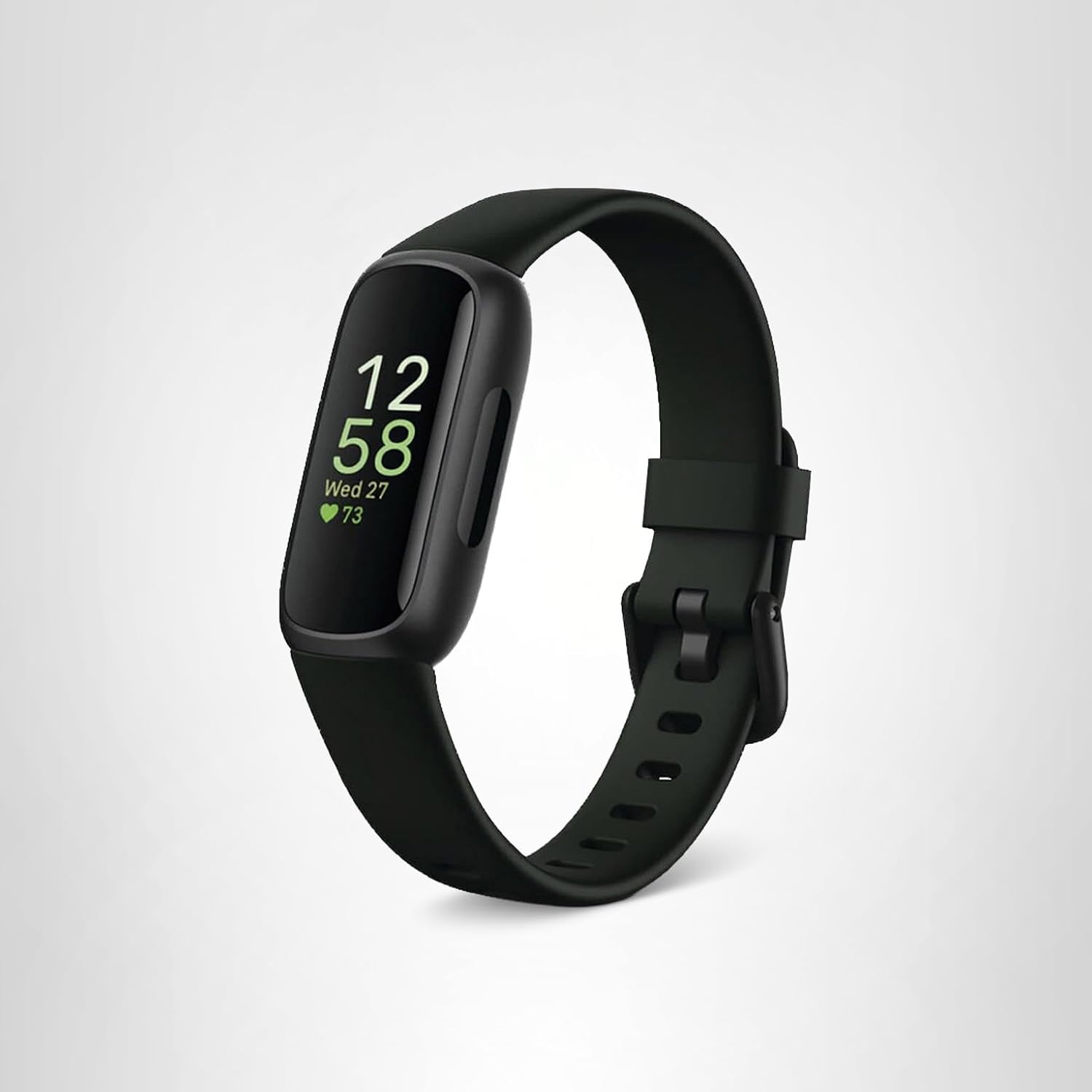
Fitbit Inspire 3 is a 24/7 wrist-based health tracker built around optical heart rate monitoring, stress management scoring, and sleep stage tracking, shipping with a 3-month Google Health Premium Membership. It is the entry-level Fitbit. No GPS. No Google Wallet. No ECG. Just the core health metrics on a color AMOLED screen in a band that weighs 18 grams and disappears under a shirt cuff.
Hardware Specs: AMOLED, Optical Sensor, and What Is Missing
Fitbit Inspire 3 runs a color AMOLED touchscreen paired with a single-path optical heart rate sensor, a 3-axis accelerometer, and Bluetooth 5.2 in a 39.4 x 18.5 x 12.4 mm case weighing 18 grams. No GPS. No altimeter. No NFC. No multi-path heart rate sensor. No electrodermal activity scanner. What is present is the minimum viable sensor set. What is absent is everything that adds cost, weight, or thickness.
- Color AMOLED Touchscreen: A 0.72-inch AMOLED display at 206 x 124 pixels. Colors are saturated. Blacks are true black because AMOLED pixels switch off individually. Readable in direct sunlight at max brightness. Actually readable. Not squint-readable. Readable. The always-on display option cuts battery life roughly in half but means time and stats are visible without a wrist raise. The gesture wake works reliably. The touch response does not lag.
- Optical Heart Rate Sensor (Single-Path): Uses green LED photoplethysmography to measure blood volume changes through the skin. Single-path means one LED wavelength. One photodiode path. Fewer data channels. More motion artifact at intensity. At walking pace and during sleep, accuracy is within acceptable consumer tracker tolerances. At running pace above 6 MPH, during weightlifting, or any activity with rapid wrist articulation, accuracy degrades measurably compared to multi-path sensors found in the Charge 6 or chest-strap ECG references.
- 3-Axis Accelerometer: Tracks step count, distance estimation, sleep movement, and activity classification. The accelerometer distinguishes walking from running from stationary through cadence and vertical oscillation algorithms. Step counting at normal walking cadence is accurate within 2 to 5 percent of manual count in most published validation studies. Accuracy drops during very slow walking, arm-restrained walking (pushing a cart), and non-ambulatory motion.
- Battery and Charging: Up to 10 days per charge under typical use with always-on display disabled. Drops to roughly 4 to 5 days with always-on display enabled. Proprietary magnetic charging cable. No wireless charging. No USB-C port. Charges from zero to full in approximately 2 hours. The cable is unique to Fitbit. Lose it and you are buying a replacement.
- What Is Missing (Hardware): No GPS antenna. No accelerometer-based altimeter for stair counting. No NFC chip for contactless payments. No microphone. No speaker. No multi-path heart rate sensor. No SpO2 sensor. No skin temperature sensor. No ECG electrodes. Each omission reduces component cost, reduces unit weight, and extends battery life. Whether those omissions matter depends on what the user demands from a tracker.
“The Inspire 3 heart rate sensor is like a door with one peephole. You can see who is outside. You cannot see the whole porch. A multi-path sensor has two peepholes. You miss fewer visitors. At walking pace, the single peephole works fine. At a sprint, people are knocking and you are still adjusting the lens cover. The data is directionally useful. It is not beat-to-beat reliable at intensity.”
Eugene Thong, CSCS
Health Tracking: Stress, Sleep, and the Premium Paywall
Fitbit Inspire 3 tracks stress management score, sleep stages, 24/7 heart rate, workout intensity, active zone minutes, and menstrual health. Some of it is free. Some of it requires Premium. The line between the two defines the real cost.
- Stress Management Score (free): A daily score from 1 to 100 built from heart rate variability, sleep patterns, and exertion load. Lower scores suggest higher stress. Higher scores suggest lower stress. The Inspire 3 cannot run on-demand EDA scans. It lacks the necessary electrodes. It calculates the stress score passively from overnight HRV and activity data. No two-minute palm-cover session. Less granular data input. Still directionally useful over weeks of consistent wear.
- Sleep Tracking (free): Estimates light sleep, deep sleep, REM, and awake time using accelerometer movement patterns and heart rate fluctuations. Each morning delivers a sleep score from 1 to 100. Sleep stage estimation from wrist movement and optical heart rate is not polysomnography. It is a trend tool. Directional accuracy improves with consistent nightly wear over multiple weeks. The Premium tier adds Sleep Profile, a monthly report comparing sleep architecture against baseline.
- 24/7 Heart Rate (free): Continuous optical heart rate sampling. Resting heart rate trends. Heart rate zones during exercise. Resting heart rate trends over months are the most valuable cardiovascular metric the Inspire 3 produces. A rising resting heart rate often signals accumulated fatigue or illness before subjective symptoms appear. The raw heart rate graph is available. The interpretation requires the user.
- Active Zone Minutes (free): Tracks time spent in fat burn, cardio, and peak heart rate zones based on age-predicted maximum heart rate. The weekly target is 150 Active Zone Minutes, aligned with WHO and AHA physical activity guidelines. This is a compliance metric, not a performance metric. It tells you whether you moved enough. Not whether you moved well.
- Workout Intensity Map (free): Plots heart rate data against GPS-connected activity routes (phone GPS required). Shows where heart rate climbed and where it dropped during an outdoor walk, run, or ride. Useful for route planning and pacing. Useless without a phone in Bluetooth range.
- 3-Month Premium Trial (included): Unlocks Daily Readiness Score, Sleep Profile, Wellness Report, and deeper trend analytics. After 90 days, Premium costs approximately $10 per month. The trial is a feature audition. The subscription is the real price of full functionality.
“Your resting heart rate is the closest thing a consumer wearable has to a check engine light. It trends down when your cardiovascular system is adapting. It creeps up when you are overreaching, undersleeping, or fighting something off. The Inspire 3 gives you that number every morning. It does not tell you what to do with it. That part is on you. But the data is there, and the data is directionally sound.”
Charles Damiano, B.S. Clinical Nutrition
Selection Matrix: Who the Inspire 3 Fits and Who It Does Not
Minimalist sensor array, 10-day battery life, sub-$100 price point, 18-gram weight, and no onboard GPS are the five variables that determine fit. This is the entry lane. The feature set is narrow by design.
- The First-Time Tracker Buyer: Never owned a wearable. Wants steps, sleep, and heart rate without spending smartwatch money. The Inspire 3 delivers the three core metrics on a color screen for under $100. No feature overwhelm. No buyer’s remorse at the price. A clean on-ramp.
- The Minimalist Health Monitor: Resting heart rate trends. Step count accountability. Sleep duration awareness. The Inspire 3 covers these three without push notifications, app ecosystems, or a screen bright enough to wake a partner at 3 AM. The feature ceiling is low. For the user who does not want more, that is the advantage.
- The Discreet Daily Wearer: 18 grams. 12.4 mm thick. Slides under a dress shirt cuff. Disappears under a jacket sleeve. No smartwatch bulk. No rubber strap callout. The Midnight Zen colorway in black reads as a bracelet, not a device. See our Home Gym Equipment Guide.
- The Long-Battery Buyer: 10 days between charges. Charge it once. Forget about it for a week and a half. The always-on display cuts that window. The trade-off is visible time versus charging frequency. The user chooses.
- The Premium Trial Tester: 90 days of full Premium access included. Time enough to evaluate whether Daily Readiness Score and Sleep Profile add enough value to justify the ongoing subscription. 90 days is a fair audition window. Most subscriptions give you 7.
The mismatch list.
- The Runner Who Wants GPS: No onboard GNSS. Phone GPS required for route mapping. No phone, no route. A Garmin Forerunner or Coros Pace is the product for standalone GPS running data.
- The Gym User Wanting Equipment Heart Rate Sync: The Inspire 3 cannot broadcast heart rate to Bluetooth Smart fitness equipment. No gym machine connection. The Charge 6 does this. The Inspire 3 does not.
- The Contactless Payment User: No NFC chip. No Fitbit Pay. No Google Wallet. Your wrist cannot buy your post-workout smoothie. You need a wallet or a phone or a Charge 6.
- The Advanced Sleep Analyst: Sleep stages from accelerometry and single-path optical heart rate have known accuracy limitations. Users who want deeper sleep architecture data with SpO2 trending need a device with an SpO2 sensor. The Inspire 3 does not carry one.
- The Athlete Training at High Intensity: Single-path optical heart rate loses accuracy during intervals, heavy lifts, and rapid wrist movement. A chest-strap ECG is the correct tool for high-fidelity heart rate data during intense training. The Inspire 3 is the correct tool for resting heart rate trends and all-day step tracking.
Advantages and Limitations
Advantages
- Color AMOLED Display: Upgrade from the Inspire 2’s monochrome OLED. Saturated color. True black. Readable outdoors. A real screen improvement at the entry-level price point.
- 10-Day Battery Life: Longest in the current Fitbit lineup. Twice the Charge 6. Nearly 30 times the Apple Watch. The always-on display halves it. The trade-off is clear and configurable.
- 18-Gram Weight: Light enough to forget it is on. No sleep disruption. No shower removal impulse. No wrist fatigue.
- Sub-roughly $100 Entry Price: The lowest entry point for the current Fitbit ecosystem. Color screen. Core metrics. Premium trial included. The value proposition is legible at this price.
- Stress Management Score (Free): A daily stress indicator derived from overnight HRV and activity data. No subscription required. No on-demand scan needed. Passively collected. Passively delivered.
Limitations
- No Onboard GPS: Phone-dependent location tracking. No phone on the run, no route on the map. A hard constraint for phone-free exercisers.
- Single-Path Heart Rate Sensor: More motion artifact at high intensity than multi-path sensors. Fine for steps and sleep. Less fine for intervals and heavy lifts.
- No SpO2 Sensor: No overnight oxygen saturation trending. Users tracking respiratory wellness or sleep apnea indicators need a device with this sensor.
- No Gym Equipment Heart Rate Broadcast: Cannot sync heart rate to NordicTrack, Peloton, or other Bluetooth Smart machines. Charge 6 only. This is not that device.
- Proprietary Charging Cable: Unique to Fitbit. Not USB-C. Not Qi wireless. Lose it and you are paying for a replacement before you can use the device again.
- Premium Subscription for Full Analytics: Daily Readiness Score, Sleep Profile, and deeper trend reports require the ongoing subscription after the 90-day trial. $10 per month adds $120 per year to the real cost of ownership if the user stays on Premium.
Market Contrast: Inspire 3 vs. the Entry Tracker Field
Display quality, sensor depth, battery duration, price point, and subscription dependency are the five axes that differentiate entry-level fitness trackers. No single device leads all five.
| Device | Primary Strength | Primary Trade-off |
|---|---|---|
| Fitbit Inspire 3 | Color AMOLED, 10-day battery, 18g weight, sub-$100 price | No GPS, single-path HR, no SpO2, Premium subscription |
| Fitbit Charge 6 | Multi-path HR, Google apps, ECG, gym equipment broadcast | Higher price, shorter battery, Premium subscription |
| Garmin Vivosmart 5 | Garmin Connect ecosystem, no subscription, SpO2 sensor | Smaller monochrome display, higher price, bulkier band |
| Xiaomi Mi Band 9 | Lowest price point, SpO2 sensor, AMOLED display | Weaker app ecosystem, less validated sleep algorithms, no Premium trial |
| Amazon Halo View (discontinued) | Was the budget AMOLED option | Discontinued product line. No longer supported. |
Charge 6 adds sensors. Garmin Vivosmart 5 removes the subscription. Xiaomi Mi Band 9 slashes the price. The Inspire 3 occupies the narrow slot of AMOLED color display, longest-in-class battery, and Fitbit app ecosystem at the lowest Fitbit entry price. It is not the most capable tracker. It is the most capable Fitbit under $100. That distinction matters for buyers already committed to the Fitbit platform.
Frequently Asked Questions
- Does the Inspire 3 have GPS?
- No. The Inspire 3 does not have a built-in GPS antenna. It can record GPS-connected routes using the paired smartphone’s location data. That requires the phone to be within Bluetooth range during the activity. No phone. No route map. Phone-free runners and cyclists need a device with onboard GPS.
- How long does the battery actually last?
- Up to 10 days under typical use with always-on display disabled. Always-on display reduces battery life to roughly 4 to 5 days. Continuous connected-GPS activity tracking draws more heavily. Full charge takes approximately 2 hours using the included proprietary magnetic charging cable.
- Is the Premium subscription required?
- No, but the feature gap is real. Free features include step counting, sleep stages, sleep score, heart rate tracking, stress management score, Active Zone Minutes, and workout intensity maps. Premium adds Daily Readiness Score, Sleep Profile, Wellness Report, and deeper trend analytics. The 3-month trial is included. After that, Premium costs approximately $10 per month.
- Can the Inspire 3 track blood oxygen (SpO2)?
- No. The Inspire 3 does not have an SpO2 sensor. Overnight blood oxygen saturation trending requires a device with red and infrared LED oximetry hardware. The Charge 6, Garmin Vivosmart 5, and Xiaomi Mi Band 9 include this sensor. The Inspire 3 does not.
- Does the Inspire 3 work with iPhone?
- Yes. Compatible with iOS and Android via the Fitbit app. Functionality is symmetrical across platforms. Unlike the Charge 6, the Inspire 3 does not have Google Maps, Google Wallet, or YouTube Music integration. No platform-dependent features means no platform-dependent feature loss.
Final Analysis
Fitbit Inspire 3 is a sub-roughly $100 wrist-based health tracker with a color AMOLED display, 10-day battery life, 18-gram weight, and single-path optical heart rate. It is not a GPS watch. It is not a gym equipment heart rate broadcaster. It is not an SpO2 monitor. It is not a contactless payment device. It is an entry-level health tracker that covers steps, sleep, stress, and heart rate on a color screen at a price that leaves room for the Premium subscription without breaching $200 in year one.
The case for it: The best display ever put in a Fitbit at this price. 10 days between charges. Light enough to forget you are wearing it. The Fitbit app ecosystem with 90 days of Premium included. Stress management and resting heart rate trends that require no user effort beyond wearing the device. The cleanest on-ramp to health tracking that Fitbit currently sells.
The case against it: No GPS. No SpO2. No gym equipment sync. Single-path heart rate that falters at high intensity. A proprietary charger that costs real money to replace. A subscription paywall that gates the most interesting analytics after month three. None of these are mistakes. All are the omissions required to hit a sub-roughly $100 price point with a color AMOLED screen and 10-day battery life.
The market offers more sensors at a higher price with the Charge 6. No subscription with the Garmin Vivosmart 5. A lower price with the Xiaomi Mi Band 9. What the Inspire 3 offers that none of those combine is a color AMOLED display, 10-day battery life, the Fitbit app and community infrastructure, and an 18-gram form factor at under $100. Whether that specific combination is worth the sensor omissions is the question. The answer depends on what the user wants the tracker to do. And what they are willing to pay after the trial ends.
See our Home Gym Equipment Guide, Walking for Fat Loss Guide, and Sleep Optimization Guide.
Summary: Color AMOLED. 10-Day Battery. 18 Grams. Sub-roughly $100. The Fitbit Entry Lane.
Color screen. Steps, sleep, stress, heart rate. No GPS. No SpO2. No gym equipment sync. Premium trial included. $10 per month after. An entry-level health tracker for the buyer who wants the Fitbit ecosystem at the lowest price of entry.
Fitness Tracker Lexicon: Key Terms
- AMOLED Display
- Active Matrix Organic Light Emitting Diode. A display technology in which each pixel generates its own light. Black pixels switch off completely. True black. Lower power consumption when displaying dark interfaces. Superior contrast to LCD. The reason the Inspire 3 screen looks better than the Inspire 2 monochrome OLED.
- Single-Path Optical Heart Rate Sensor
- A photoplethysmography sensor using one LED wavelength and one photodiode receiver. Measures blood volume changes under the skin to estimate pulse rate. One channel of data. Works well at rest and during steady-state low-motion activity. Accuracy degrades when the wrist articulates rapidly or perfusion drops, because there is no secondary data channel to cross-reference against motion artifact.
- Active Zone Minutes
- A Fitbit metric tracking time spent in personalized heart rate zones during physical activity. Based on age-predicted maximum heart rate (220 minus age). Fat burn zone is 50 to 69 percent of max. Cardio zone is 70 to 84 percent. Peak zone is 85 percent and above. Aligned with the 150-minute weekly physical activity guideline from the WHO and American Heart Association. A compliance metric. Not a performance metric.
- Stress Management Score
- A daily numerical score from 1 to 100 derived from heart rate variability, sleep quality, and recent exertion load. Lower numbers indicate higher physiological stress. On the Inspire 3, this score is calculated passively from overnight data. No on-demand EDA scan is available. Same output. Fewer data inputs than the Charge 6 or Sense 2.
- Heart Rate Variability (HRV)
- The variation in time between consecutive heartbeats, measured in milliseconds. Higher HRV generally indicates a more responsive autonomic nervous system and better recovery status. Lower HRV can indicate accumulated stress, overtraining, or illness onset. The Inspire 3 tracks HRV passively during sleep and feeds it into the stress management score. The raw HRV value is not displayed on the device. It appears in the Fitbit app under Health Metrics.
- Sleep Score
- A single-number representation of sleep quality from 1 to 100, combining sleep duration, sleep stage distribution (light, deep, REM), and restoration metrics (heart rate below resting baseline during sleep). Estimated from wrist movement and heart rate patterns. Not a clinical sleep study. A directional trend indicator that improves in accuracy with consistent nightly wear.
Related guides:
- Home Gym Equipment Guide
- Walking for Fat Loss Guide
- Sleep Optimization Guide
- Classic Strength Training Guide
- Post-Workout Nutrition Guide
- Best Protein for Muscle Soreness Recovery
- Best Omega-3 for Inflammation
- Foods That Boost Testosterone and Build Muscle
- Sandbag Training Guide
- Gymreapers Dip Belt Review