Rowing technique is the ultimate force multiplier on the Concept2 RowErg.
Clean mechanics make every stroke smoother, faster, and more efficient — whether you’re building endurance, chasing PRs, or training for CrossFit benchmarks. This 2026 guide breaks down the stroke step‑by‑step so you can row with power and precision.
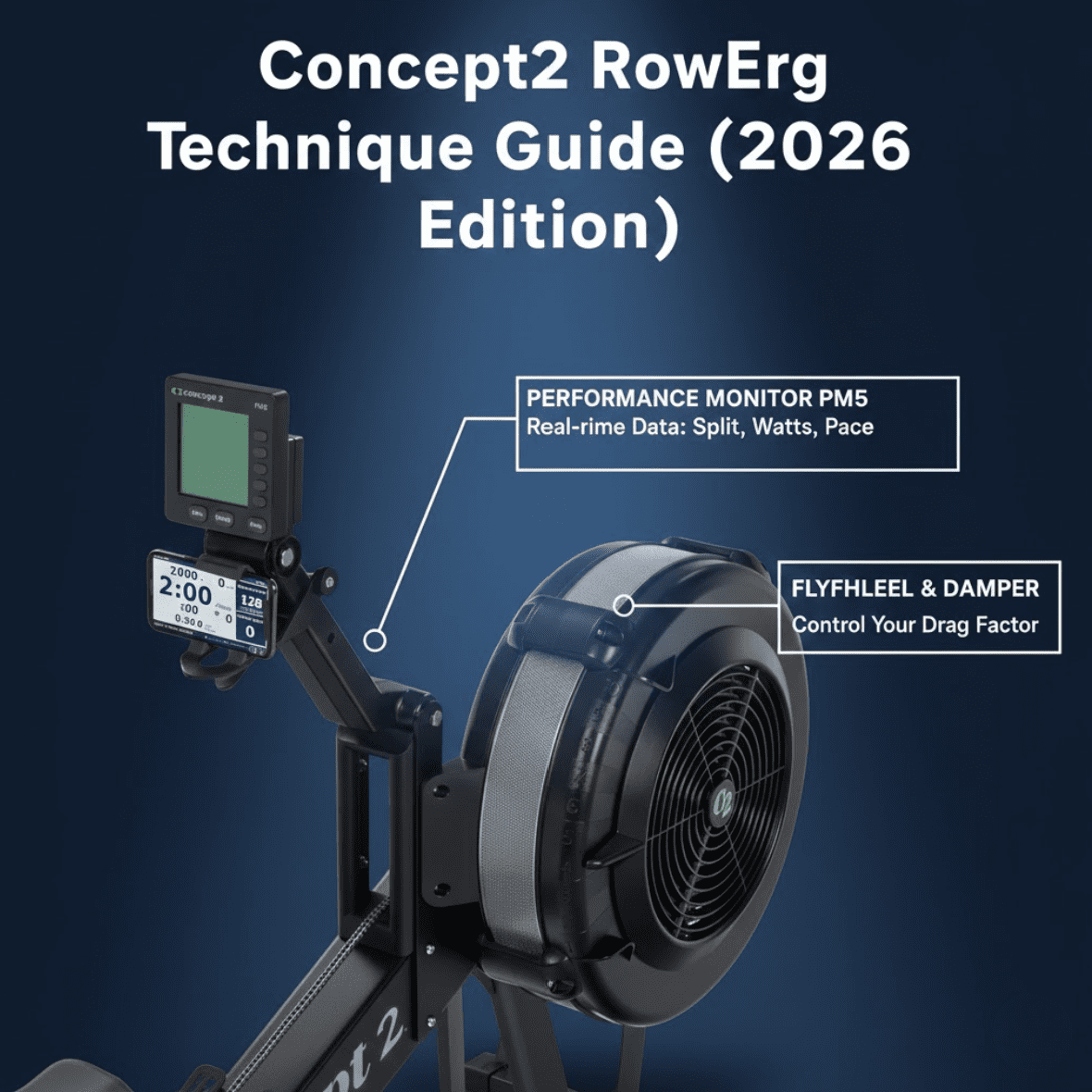
If you’re still getting comfortable with the machine itself, the Setup & Assembly Guide will help you dial in footrest height, damper settings, and monitor position before focusing on technique.
The Stroke Sequence (Legs → Body → Arms)
Every efficient rowing stroke follows the same order. Mastering this sequence is the foundation of good technique.
The Drive
- Legs push first
- Body swings open second
- Arms pull last
The Recovery
- Arms extend first
- Body pivots forward second
- Legs slide last
This creates a smooth, efficient rhythm that protects your back and maximizes power.
The Drive Phase (Power)
The drive is where you generate speed. Think of it as a powerful leg press followed by a clean pull.
1. The Catch
- Shins vertical
- Arms straight
- Core braced
- Shoulders slightly in front of hips
2. Leg Drive
- Push through your heels
- Keep arms long
- Maintain a strong torso angle
3. Body Swing
- Open the hips once legs are nearly straight
- Keep the chain level
4. Arm Pull
- Pull handle to lower ribs
- Elbows travel straight back
- Wrists stay flat
The Recovery Phase (Control)
The recovery sets up your next stroke. It should feel smooth, controlled, and unhurried.
1. Arms Away
- Extend arms fully before moving your torso
2. Body Over
- Pivot forward from the hips
- Maintain a neutral spine
3. Slide Forward
- Let the seat glide forward
- Keep shoulders relaxed
- Arrive at the catch ready to drive
Recovery should take twice as long as the drive — a 1:2 rhythm.
Common Technique Mistakes
These errors waste energy and increase injury risk. Fix them early.
Mistake 1 — Pulling Early With the Arms
Fix: Keep arms straight until legs are nearly extended.
Mistake 2 — Over‑Reaching at the Catch
Fix: Shins vertical, torso slightly forward, no collapsing.
Mistake 3 — Rushing the Slide
Fix: Slow down the recovery; let the flywheel decelerate.
Mistake 4 — Leaning Back Too Far
Fix: Finish with a slight layback, not a full recline.
Technique Drills (Daily Practice)
Use these drills to reinforce clean mechanics and sequencing.
Drill 1 — Legs‑Only Rowing
- Arms straight, torso still
- Focus on leg drive
Drill 2 — Legs + Body
- Add hip swing after leg drive
- Arms stay straight
Drill 3 — Pause at the Finish
- Row normally, pause for 1 second at the finish
- Builds control and posture
Drill 4 — Pick‑Ups
- 10 hard strokes every 30 seconds
- Great for warm‑ups and rhythm
Stroke Rate (SPM): How Fast Should You Row?
Stroke rate controls rhythm and intensity. Use these guidelines:
- 18–20 SPM: technique work, steady state
- 22–24 SPM: moderate efforts
- 26–30 SPM: intervals and threshold work
- 30–36+ SPM: sprints and HIIT
For structured interval sessions, see the HIIT & Conditioning Workouts.
Related Concept2 Guides
The Iron Lexicon: Technique Edition
- Catch
- The starting position of the stroke where the legs are compressed and the handle is forward.
- Drive
- The power phase of the stroke: legs → body → arms.
- Recovery
- The controlled return to the catch: arms → body → legs.
- SPM (Strokes Per Minute)
- Your stroke rate — a key variable for pacing and rhythm.