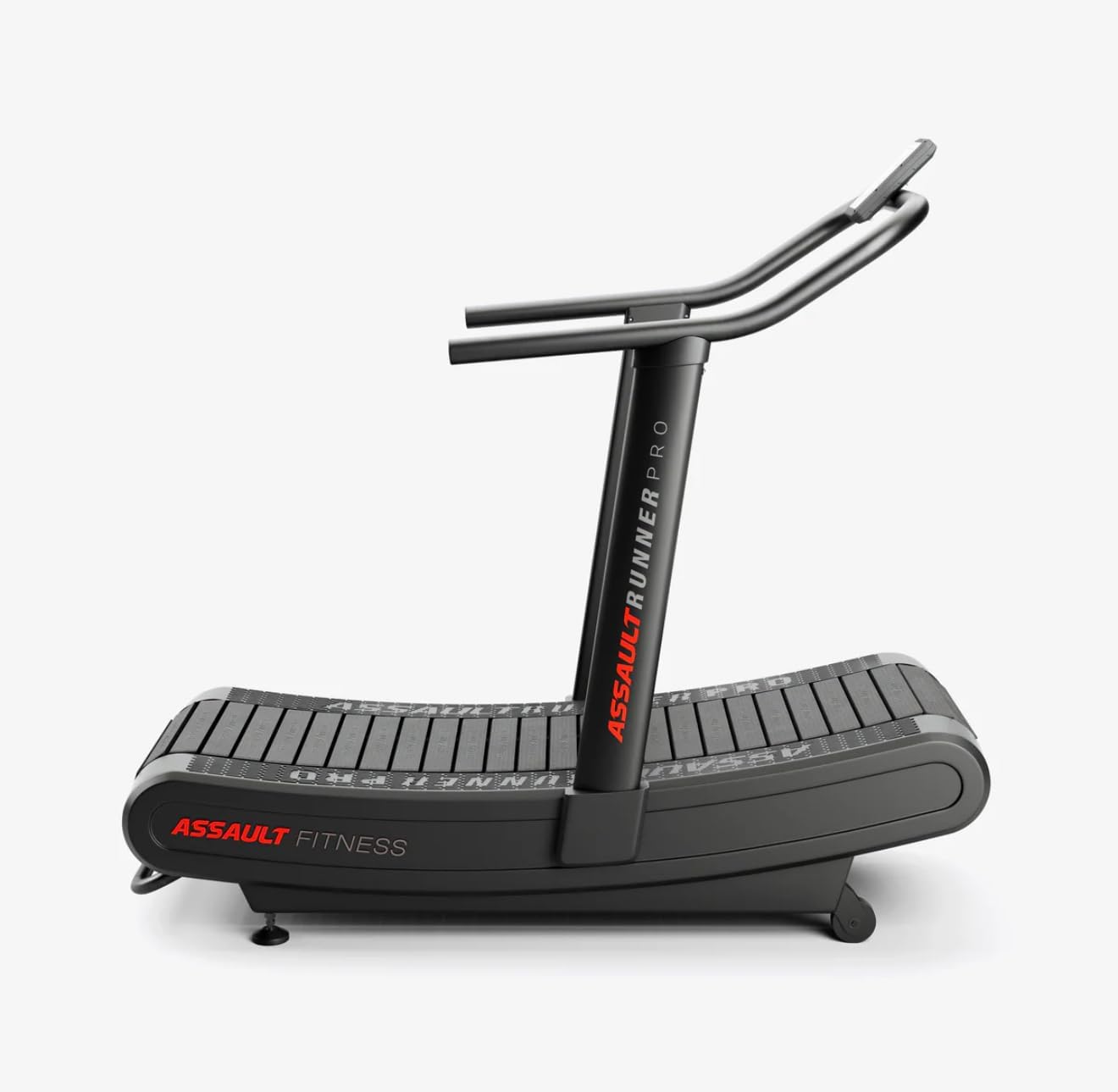
The AssaultRunner Pro is a motorless curved treadmill built on a welded steel frame with a segmented rubber-slat running belt, a battery-powered LCD performance console, and an operational weight north of 280 pounds, meaning the machine absorbs sprint force instead of scooting across the floor. No motor. No plug. No max speed setting. The belt moves when you move it, at exactly the speed you produce. That is the entire value proposition in one sentence. You are the engine. The machine is a precision governor, a force meter, and a punishment delivery system wrapped in powder-coated steel.
Affiliate Disclosure: This article contains affiliate links. As an Amazon Associate, I earn from qualifying purchases at no extra cost to you. We analyze products based on published specifications, materials, and build quality, not hype.
Health & Safety Disclaimer: Sprint training and high-intensity running carry inherent risk of injury. Consult a qualified healthcare professional before beginning any high-intensity training program. Always ensure proper warm-up, maintain control of your pace on the curved belt, and use the emergency stop features as directed by the manufacturer.
Price Disclaimer: Prices shown are approximate and may vary. Check current pricing and availability on Amazon.
The Spec Sheet: Welded Steel, Rubber Slats, Zero Horsepower
The AssaultRunner Pro is anchored by a welded steel frame supporting a curved, segmented rubber-slat running belt over a precision bearing track, measuring roughly 65 to 70 inches long, 33 inches wide, 64 inches tall, with a total operational weight near 300 pounds and a user weight capacity north of 350 pounds. The absence of a motor is not a cost-cutting measure. It is the defining engineering decision. A motorized treadmill limits you to its top speed setting and its acceleration curve. The AssaultRunner Pro has neither. If you can produce 15 miles per hour, the belt spins at 15 miles per hour. The machine does not govern you. Gravity and friction do.
- Curved Running Surface With Segmented Rubber Slats: The belt is not a single continuous loop of PVC laminate. It is individual rubber slats mounted on bearings riding a curved track. Each slat articulates independently as it moves through the curve. The result is a running surface that absorbs impact better than a flat motorized deck and naturally promotes a forefoot-to-midfoot strike pattern instead of the heel-striking gait that flat treadmills encourage. The curve does the coaching. Your body responds to the geometry without conscious adjustment.
- Welded Steel Frame: The chassis is heavy-gauge, arc-welded steel with a powder-coated finish. This is not an extruded aluminum frame with plastic shrouds. The machine weighs nearly 300 pounds because it is built to absorb the lateral and horizontal forces produced by a 200-plus-pound athlete sprinting at maximal effort. A lightweight treadmill walks across the floor when you sprint on it. This one stays planted because physics does not argue with 300 pounds of steel.
- Battery-Powered LCD Performance Console: The display runs on AA or similar batteries. No outlet required. The console tracks time, distance, speed, pace, calories, watts, and heart rate when paired with a compatible chest strap. The data is basic. The data is sufficient. You do not need Netflix on a sprint treadmill.
- Self-Powered Friction Drive: The belt moves on a set of precision bearings with a calculated coefficient of friction. Push with your feet. The belt accelerates. Stop pushing. The belt decelerates. The resistance curve is determined by bearing quality, belt tension, and your body weight. Heavier runners experience more resistance. Lighter runners experience less. The machine self-adjusts to body mass.
- Transport Wheels and Front Handle: Despite weighing nearly 300 pounds, the integrated front transport wheels and handle allow a single person to tilt and roll the machine across a flat floor. You are not carrying it upstairs. You are tilting it 45 degrees and rolling it into position like a heavy-duty hand truck.
- No Ceiling on Output: There is no maximum speed dial. No top-end governor. The belt matches whatever leg speed the user produces. The only speed limiter is the athlete standing on the deck.
The physics analogy: A motorized treadmill is a conveyor belt. You match its speed or you fall off. The AssaultRunner Pro is a horizontal acceleration sled with a curved track. Every stride produces a spike of force that must overcome the belt’s inertia, the bearing friction, and the curved geometry. Once the belt is moving, maintaining speed requires continuous force output. Stop producing force and the belt stops. There is no coasting on a curved manual treadmill. There is only work.
Who It’s For, and Who Should Buy a Motorized Treadmill Instead
A motorless, 300-pound curved treadmill is purpose-built for a narrow category of athlete. Outside that lane, it is the wrong tool. Find your row.
- The Sprint and HIIT Athlete: The AssaultRunner Pro was designed for short-duration, high-intensity interval work. Sprint 30 seconds. Rest 30 seconds. Repeat until you are horizontal on the floor. The machine’s instant acceleration response means the belt hits sprint speed the moment you do, with zero lag. Motorized treadmills have an acceleration curve. You press a button and wait one to two seconds for the belt to reach speed. On a curved manual treadmill, the belt is already at speed because you put it there with your first stride.
- The Home Gym Owner With Floor Space and No Ceiling: This machine is not compact. It occupies a roughly 6-foot by 3-foot footprint and stands nearly 5.5 feet tall. It weighs 300 pounds. Home gym equipment that cannot be folded or stowed demands commitment. If your training space doubles as a guest bedroom, measure twice before ordering.
- The Athlete Who Hates Motorized Treadmill Lag: Every motorized treadmill introduces a perceptible delay between the user’s intention to accelerate and the belt’s response. For steady-state jogging, this is irrelevant. For high-intensity interval training sprints where every second of the work interval counts, the lag is a dealbreaker. The AssaultRunner Pro has zero lag. The belt speed is your speed. No translation layer. No motor controller. No delay.
- The CrossFit or Functional Fitness Athlete: The AssaultRunner Pro shares DNA with the AssaultBike and AssaultRower in the Assault Fitness ecosystem. All three machines use a self-powered, athlete-driven resistance model. If your training methodology revolves around work-output metrics measured in watts and calories, the AssaultRunner Pro feeds directly into that data-driven training loop.
Skip it if you are:
- A steady-state distance runner: Running 5 to 10 miles at a consistent 8-minute pace on a curved manual treadmill is far more physically demanding than the same run on a motorized treadmill. The curve eliminates the belt-assist effect present on flat treadmills. A 10-mile training run on an AssaultRunner Pro is not a jog. It is an event.
- Living in an apartment or shared space: The rubber slat belt generates significant mechanical noise during operation. Not motor hum. Slat-on-bearing impact noise. The neighbors below will hear every sprint interval. This machine is for garages, basements, and ground-floor home gyms. It is not for third-floor apartments with thin floors.
- Looking for entertainment features: The AssaultRunner Pro has a single LCD screen that displays numbers. No touchscreen. No Netflix. No virtual running paths through New Zealand. You stare at your metrics or the wall. That is the entire entertainment package.
- On a tight budget: This is a $2,500-to-roughly $3,000 treadmill. You can buy a very good motorized treadmill with incline, decline, and a touchscreen for the same price. The AssaultRunner Pro competes on mechanical simplicity and sprint specialization, not feature-per-dollar value.
Pros and Cons: The Steel-Frame Truth
The Advantages
- Instant speed response: The belt matches your leg speed in real time. No motor lag. No button pressing. Sprint when you sprint. Stop when you stop. The machine disappears between you and your output.
- No motor, no electrical dependency: Zero electricity cost. Zero motor burnout risk. Zero outlet proximity requirements. The thing runs as long as you run.
- Curved deck promotes midfoot strike: The geometry of the curve naturally shifts the runner’s foot strike forward, reducing heel impact forces that flat treadmills amplify. The deck coaches gait mechanics without a single cue.
- Welded steel frame, built like industrial equipment: 300-pound operational weight. No plastic shrouds covering critical joints. No frame flex under sprint load. This is a piece of training infrastructure, not a piece of consumer electronics.
- Rubber slat belt absorbs impact: The individual slats flex under foot strike, creating a compliant running surface that dissipates impact force better than a flat, single-layer PVC belt on a hard deck board. Less joint punishment per stride than a standard motorized treadmill at equivalent pace.
- Mechanical simplicity equals longevity: No motor controller board to fry. No incline motor to strip. No belt tension sensor to fail. The machine has bearings, a steel frame, and rubber slats. Fewer failure points than a motorized treadmill by a factor of roughly ten.
The Trade-offs
- Extremely heavy and difficult to relocate: 300 pounds with transport wheels means it rolls. It does not lift. Change your mind about its location after setup and you will need a friend and a strong back.
- Significant operational noise: The slat belt is loud. Louder than a motorized treadmill. Louder than a Concept2 RowErg at sprint pace. Anyone in the same room, and possibly the room below, will know you are sprinting.
- No incline, no decline, no programming: The curved deck is the surface. It does not adjust. You cannot simulate hills. You cannot do a pre-programmed interval workout with automatic speed changes. Every interval change is manual. You accelerate yourself. You decelerate yourself. The machine is a passive surface.
- Steady-state running is harder than on a motorized treadmill: The curved deck and self-powered belt eliminate the mechanical advantage motorized treadmills provide. A 6-mile run at marathon pace on an AssaultRunner feels like running 6 miles on pavement. On a motorized treadmill, the belt assists the return phase of each stride. The difference is not subtle.
- Basic console, no entertainment ecosystem: Numbers on a screen. That is all. No Bluetooth music. No guided workouts. No scenic runs. If staring at watts and distance for 20 minutes sounds like a prison sentence, this is not your treadmill.
The Field: Curved Manual Treadmills Compared
The curved manual treadmill category is small, dominated by three or four serious contenders separated by bearing quality, belt feel, console sophistication, and price.
| Product | Belt Type | Weight | Capacity | Core Edge |
|---|---|---|---|---|
| AssaultRunner Pro | Rubber Slats | ~300 lbs | 350+ lbs | Best sprint specialist, steel frame, CrossFit-standard |
| Woodway Curve | Vulcanized Rubber Slats | ~350 lbs | 400 lbs | Original curved treadmill, smoothest belt, 2-3x the price |
| TrueForm Runner | Rubber Slats | ~320 lbs | 400 lbs | Deeper curve, firmer belt feel, premium price |
| Technogym Skillmill | Rubber Slats | ~280 lbs | 350 lbs | Magnetic resistance, connected console, top-tier price |
| AssaultRunner Classic | Rubber Slats | ~280 lbs | 350 lbs | Same platform, fewer console features, lower price |
The Woodway Curve is the original. Smoother belt, higher-quality bearings, vulcanized rubber slat construction, and a price tag that can exceed roughly $7,000. The TrueForm Runner uses a deeper curve profile that some runners prefer for the more aggressive foot-strike coaching. The Technogym Skillmill adds magnetic resistance to the self-powered formula, creating an adjustable resistance curve that neither the AssaultRunner nor the Woodway offer, at a price near roughly $10,000. The AssaultRunner Pro is the value play in the category without being cheap. It delivers the core curved-treadmill experience at roughly one-third the cost of the Woodway. The belt is not as smooth. The build quality is not as refined. But the fundamental training stimulus, the instant acceleration, the self-powered sprint capacity, is identical.
FAQ
- How is resistance adjusted on a motorless treadmill?
- It is not. There is no resistance adjustment on the AssaultRunner Pro. The belt’s resistance is determined by three fixed variables: your body weight, the bearing friction, and the curved deck geometry. Heavier runners encounter more resistance. Lighter runners encounter less. The machine self-scales. You cannot make it harder or easier. You can only run faster or slower.
- Can I walk on the AssaultRunner Pro?
- Yes, but walking on a curved manual treadmill is mechanically different from walking on a motorized treadmill. The curve requires forward pressure on the front portion of the belt to initiate and maintain movement. Walking feels like a slight uphill march. It is not a casual stroll. You are working to move the belt at walking pace.
- How loud is it compared to a motorized treadmill?
- The slat belt generates impact noise that motorized treadmills with continuous PVC belts do not. At a jog, it is comparable to a loud motorized treadmill. At a sprint, it is significantly louder. The noise is mechanical and percussive. Slats hitting bearings. Feet hitting slats. No motor hum to mask it.
- Does the console require an outlet?
- No. The LCD console runs on batteries. The entire machine is self-contained with zero electrical dependency. Place it anywhere. The power grid is irrelevant to its operation.
- What maintenance does a motorless treadmill require?
- The bearing track and slat connections should be cleaned periodically to remove dust and debris. The belt may require occasional tensioning. There is no motor to service, no deck to lubricate, no belt to replace on a wear schedule. Maintenance is cleaning and inspection, not repair and replacement. The failure points are mechanical bearings, not electronic components.
Final Verdict: The Sprint Specialist That Demands Your Floor Space and Output
The AssaultRunner Pro is a single-purpose machine built for athletes who sprint, not jog. Welded steel frame. Curved rubber-slat belt. Battery-powered console. Zero motor lag. A 300-pound operational weight that anchors the machine under maximal sprint force. The Woodway Curve is smoother. The TrueForm Runner has a deeper curve. The Technogym Skillmill adds magnetic resistance. All of them cost more, sometimes dramatically more. This is the curved manual treadmill for the home gym owner who wants the core sprint-training stimulus without paying for premium bearing refinement or connected-console ecosystems. If you do steady-state distance work, buy a motorized treadmill. If you do HIIT sprints, max-effort intervals, and want the treadmill equivalent of a Concept2 RowErg for running, the AssaultRunner Pro is your machine. It does exactly one thing. It does it without apology. It will not entertain you. It will make you faster.
No Motor. No Lag. No Speed Limit. Just You and 300 Pounds of Welded Steel.
The AssaultRunner Pro. The curved manual treadmill built for sprint athletes who need instant acceleration and zero excuses. Check the live price at the link below.
*Price, specifications, and included accessories subject to change. Verify on the live listing. This article is for informational purposes only and does not constitute medical or fitness advice. Consult a qualified professional before beginning any high-intensity sprint training program.
The Lexicon: Curved Manual Treadmill Edition
- Segmented Rubber Slat Belt
- A running surface composed of individual vulcanized rubber slats mounted transversely across the belt width, each slat riding on precision bearings. Unlike a continuous PVC laminate belt, the segmented design allows each slat to flex independently under foot strike, creating a compliant, impact-absorbing surface that also reduces the friction heat buildup that degrades single-piece belts. The slats move. They breathe. They do not stretch. They do not need lubricating.
- Curved Deck Geometry
- The concave running surface that dips in the middle and rises at the front and rear. This curvature naturally shifts the runner’s center of mass forward, encourages a forefoot-to-midfoot strike, and eliminates the heel-striking gait pattern that flat treadmill belts enable. The curve is the coach. Your ankles, knees, and hips adapt to the geometry automatically.
- Self-Powered Friction Drive
- A propulsion system where the belt moves exclusively from the force applied by the runner’s feet through friction contact and momentum transfer. There is no motor, no drive shaft, no electrical connection between the belt and an external power source. The athlete is the engine. The belt is the transmission. The force you produce is the only force that moves the machine.
- Bearing Track
- The precision roller-bearing system that the slat belt rides on. Bearing quality determines belt smoothness, noise level, and the coefficient of friction the runner must overcome to initiate and maintain belt movement. High-quality sealed bearings produce a smoother, quieter belt with less resistance variance over time. Cheap bearings rattle, wear, and make the belt feel gritty underfoot.
- Watts Output (on Manual Treadmills)
- A direct measurement of mechanical work produced by the runner, calculated from belt speed, acceleration rate, and user body weight. Unlike motorized treadmills that estimate calories from speed and incline tables, a manual treadmill with a wattage readout provides a real-time power output metric that is directly comparable to rowing ergometers and assault bikes. Watts do not lie. They cannot be faked. The number on the screen is exactly the power you are producing in that moment.
Keep Reading: Cardio Equipment & Training
- Concept2 RowErg Technique Guide — another self-powered machine, different movement pattern, same watts-based feedback loop.
- High-Intensity Interval Training — the training methodology the AssaultRunner Pro was built for.
- Home Workout Equipment Reviews — the gear that earns its footprint in your training space.
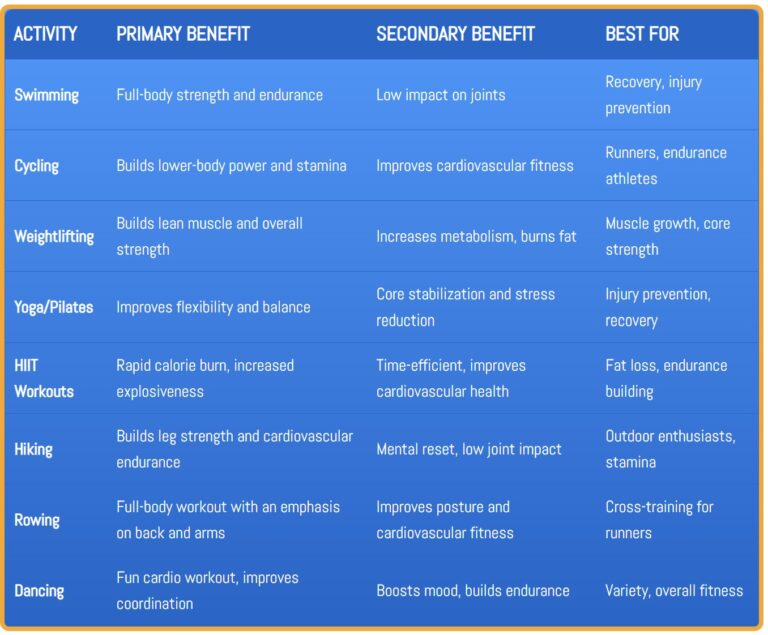
- Cardio Exercise Benefits — why sprint work and steady-state training are not interchangeable tools.
- Proven Strategies to Build Strength and Mass — pair the sprint work with the strength work for a complete power-output program.