You finish your last set, muscles screaming for oxygen. The pump fades, leaving behind fatigue and damage. But what if you could force-feed those muscles with the nutrients they crave? The bridge between workout damage and full recovery isn’t magic—it’s blood flow. Arginine isn’t just another supplement; it’s your vascular system’s traffic controller. Let’s open the floodgates.
Core Concepts
The science of vascular recovery:
Arginine Defined
A semi-essential amino acid that serves as the primary precursor for nitric oxide (NO). Not just a building block—it’s the key that unlocks your blood vessels.
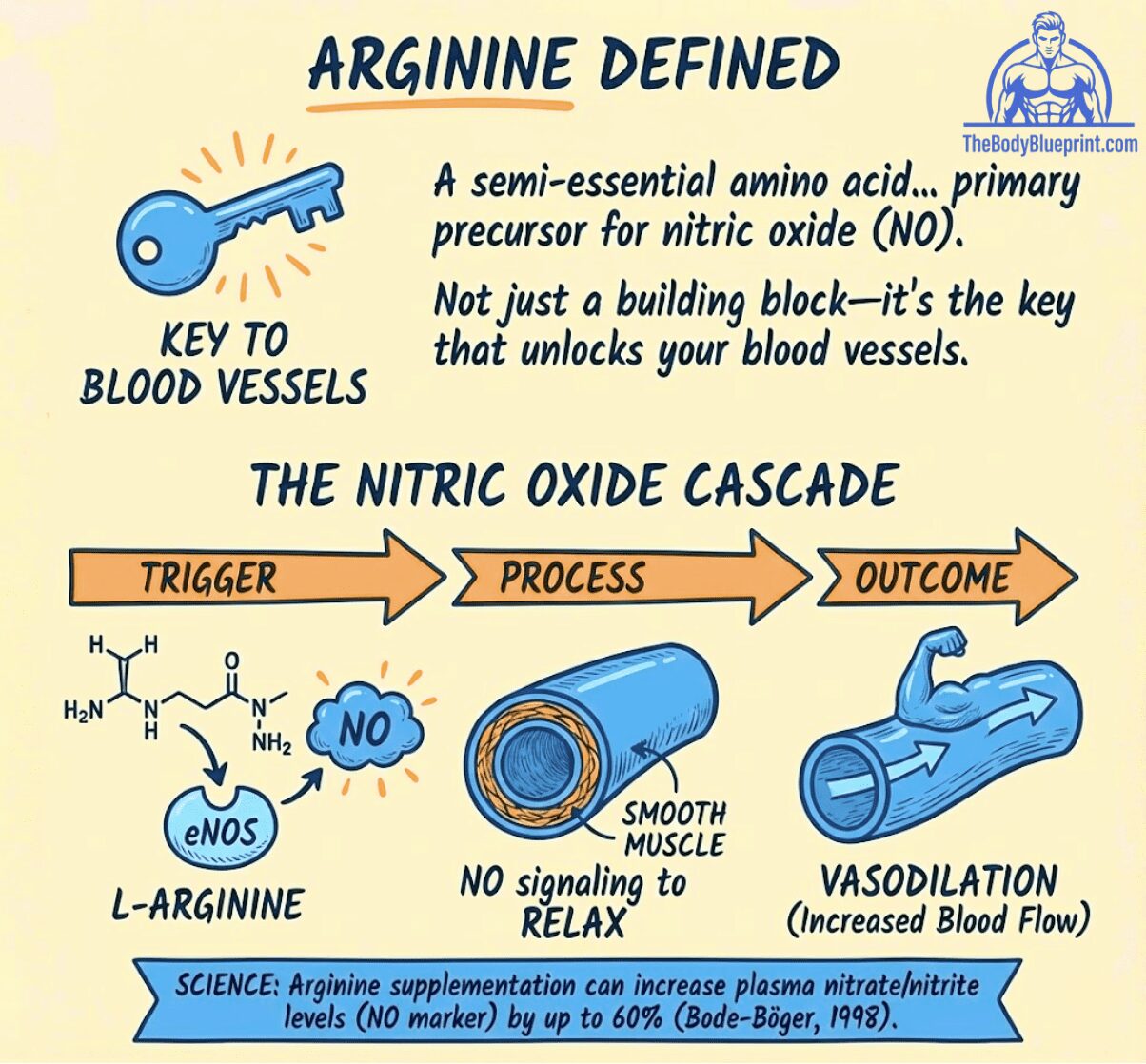
The Nitric Oxide Cascade
- Trigger: L-Arginine is converted into Nitric Oxide by enzymes (eNOS).
- Process: NO signals the smooth muscle in blood vessel walls to relax.
- Outcome: Vasodilation—a widening of blood vessels, leading to increased blood flow.
- Science: Arginine supplementation can increase plasma nitrate/nitrite levels (a marker of NO) by up to 60% (Bode-Böger, 1998).
The Nutrient Delivery Hypothesis
Reality: More blood flow means more oxygen, amino acids, and glucose delivered to working muscles—and more metabolic waste products removed. This is the foundation of enhanced recovery.
Recovery Impact Matrix
| Recovery Metric | Without Optimized Blood Flow | With Arginine-Induced Vasodilation |
|---|---|---|
| Nutrient Delivery | Standard Rate | Accelerated Delivery |
| Waste Removal | Slower Clearance | Enhanced Clearance (Lactate, Ammonia) |
| “The Pump” | Short-Lived | Prolonged, Functional Hyperemia |
What is Arginine?
Definition and Role in the Body
L-Arginine is a conditionally essential amino acid, meaning the body can produce it, but during periods of stress (like intense training), demand often exceeds supply. Its roles are critical:
- Nitric Oxide Precursor: Its most famous role in fitness.
- Ammonia Detoxification: Part of the urea cycle, helping remove ammonia, a fatigue-inducing byproduct of exercise.
- Protein Synthesis: A direct building block for muscle tissue.
- Hormone Secretion: Stimulates the release of insulin and growth hormone.
Natural Sources of Arginine
- Meats: Turkey, chicken, lean beef
- Seafood: Tuna, lobster, shrimp
- Nuts & Seeds: Pumpkin seeds, walnuts, peanuts
- Legumes: Soybeans, chickpeas, lentils
- Dairy: Milk, yogurt, cheese
Benefits of Arginine for Recovery
- Improved Blood Flow: The cornerstone benefit. Enhanced circulation delivers the raw materials for repair directly to the muscle cells.
- Enhanced Endurance: Better oxygen delivery can delay the onset of fatigue, allowing for longer, more productive training sessions.
- Faster Muscle Repair: With increased delivery of amino acids and other nutrients, the cellular machinery for Muscle Protein Synthesis (MPS) is better supplied.
- Reduced Fatigue: By aiding in the clearance of metabolic waste like lactate and ammonia, arginine can help reduce post-exercise fatigue and soreness.
- Nitric Oxide Production: Directly supports the vasodilation process, creating a more anabolic, recovery-conducive environment.
Arginine and Exercise Performance
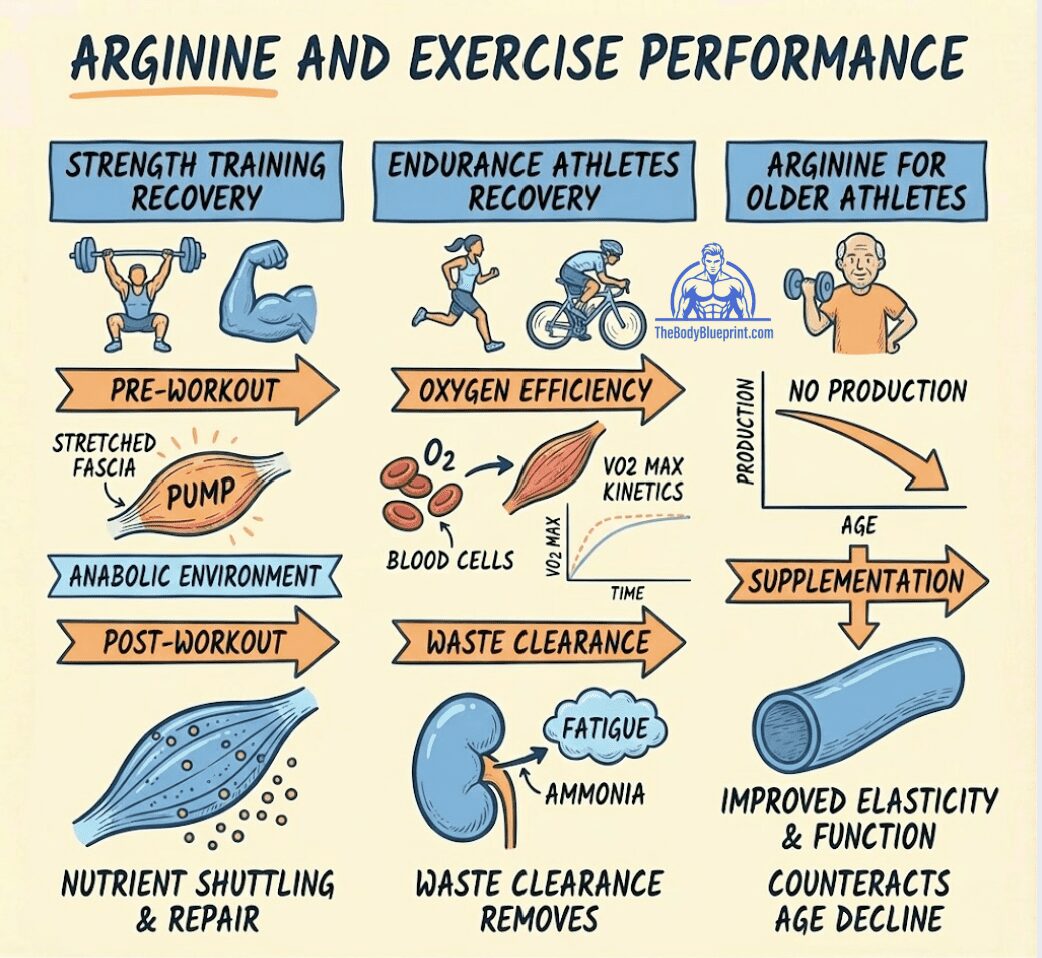
Strength Training Recovery
For lifters, the primary value is peri-workout nutrient shuttling. Taking arginine before training can enhance the “pump,” which isn’t just cosmetic—it signifies increased fluid delivery into the muscle cell, stretching the fascia and creating a more anabolic environment. Post-workout, it helps deliver amino acids for repair.
Endurance Athletes Recovery
Endurance athletes benefit from improved oxygen efficiency and waste clearance. Enhanced blood flow means more oxygen is delivered to working muscles, improving VO2 max kinetics. Simultaneously, it helps clear ammonia, a major contributor to central fatigue during long-duration events.
Arginine for Older Athletes
Nitric Oxide production naturally declines with age, contributing to endothelial dysfunction. For older athletes, arginine supplementation can be particularly effective for counteracting this age-related decline in blood vessel elasticity and function, directly supporting recovery and performance.
Timing and Dosage
Best Time to Take Arginine Pre and Post Workout
For maximum effect, split your dosage. Take 3-6 grams 30-60 minutes before training to prime blood flow. Follow up with another 3-6 grams immediately after to continue supporting nutrient delivery during the critical recovery window.
Arginine Before vs. After Exercise
| Timing | Primary Benefit | Secondary Benefit |
|---|---|---|
| Before Training | Maximizes workout performance & pump via increased blood flow. | Begins nutrient delivery process. |
| After Training | Supports repair by shuttling amino acids to muscles. | Accelerates clearance of metabolic waste. |
Recommended Dosage Ranges
- General Performance & Recovery: 3-6 grams, 1-2 times daily.
- Pre-Workout Focus: 5-10 grams 30-60 minutes pre-training.
- Clinical Doses (under doctor supervision): Can range from 10-20 grams daily.
Food Sources vs Supplements
Natural Food Sources of Arginine
| Food Source | Approximate Arginine (per 100g) |
|---|---|
| Pumpkin Seeds | 5.4g |
| Turkey Breast | 3.2g |
| Pork Loin | 2.4g |
| Chicken Breast | 2.2g |
| Peanuts | 3.1g |
Arginine Powders and Capsules
Supplements provide a concentrated, rapidly-absorbed dose of free-form L-Arginine or Arginine AKG (Alpha-Ketoglutarate). Powders are ideal for pre-workout drinks, while capsules offer convenience.
Pros and Cons of Supplementation
| Pros | Cons |
|---|---|
| Precise Dosing for therapeutic effects | Gastrointestinal distress at high doses |
| Rapid Absorption on an empty stomach | Can compete with other amino acids for absorption |
| Convenience for peri-workout timing | Purity concerns with low-quality brands |
Arginine and Nitric Oxide
Role in Vasodilation and Blood Flow
Nitric Oxide is a potent signaling molecule that tells the smooth muscle cells in your arterial walls to relax. This relaxation, called vasodilation, reduces vascular resistance and increases the diameter of blood vessels. The result: a dramatic increase in blood flow, much like opening a wider pipe for water to flow through.
Supporting Endurance and Recovery
This enhanced blood flow is a two-fold advantage. During exercise, it delivers more oxygen and fuel, directly combating fatigue. Post-exercise, it becomes a recovery superhighway, rushing in repair nutrients while flushing out the inflammatory byproducts of muscle damage that cause soreness.
Safety and Side Effects
Common Side Effects
At doses above 10 grams, some users may experience nausea, diarrhea, or abdominal cramping. Due to its vasodilatory effects, it can also cause a temporary drop in blood pressure.
Safe Usage Guidelines
- Start with a lower dose (3g) to assess tolerance.
- Avoid if you have herpes (cold sores), as arginine can potentially trigger outbreaks.
- Do not combine with blood pressure medications or PDE5 inhibitors (e.g., Viagra) without consulting a doctor.
- Choose reputable brands that provide third-party testing.
FAQs
A. Yes, primarily by improving blood flow. Enhanced circulation delivers more oxygen and nutrients to damaged muscles while simultaneously clearing out metabolic waste products like lactate and ammonia. This creates a more anabolic environment, accelerating the repair process.
A. For nitric oxide production, citrulline is often considered superior. Citrulline is converted into arginine in the kidneys, resulting in a more sustained and elevated increase in blood arginine levels. It’s also better absorbed and causes fewer stomach issues. For most, citrulline malate is the more effective choice for performance and recovery.
A. Yes, indirectly. By improving blood flow and oxygen delivery to working muscles, arginine can help delay the onset of fatigue. Its role in ammonia clearance also helps combat a major cause of central fatigue during prolonged exercise, potentially allowing you to sustain effort for longer.
A. Arginine can be taken consistently as part of your daily supplement regimen. There is no defined cycle for this amino acid. However, as with any supplement, it’s wise to periodically assess if it’s providing a noticeable benefit to your performance and recovery.
Conclusion
Arginine isn’t the sole answer to recovery—it’s the delivery system for all the other answers. That sluggish, beat-down feeling post-workout? It’s not just muscle damage; it’s a traffic jam in your circulatory system. Optimize the flow. Your muscles are waiting for their shipment.
Key Studies & Resources:
- Bode-Böger et al. (1998): L-arginine-induced vasodilation in healthy humans.
- Tang et al. (2011): Role of L-arginine in nitric oxide synthesis and health in humans.