You’ve seen them in the locker rooms of elite athletes, biohacker labs, and ancient Nordic rituals—saunas, the heat chambers that promise everything from detox to transcendence. But beneath the sweat and steam lies a precise cellular machinery, activated not by chance, but by deliberate stress. This is the domain of Heat Shock Proteins (HSPs), your body’s molecular repair crew. The question isn’t whether heat helps—it’s how do you hack the dose and duration to force adaptation, not just exhaustion?
Sauna use is not passive recovery; it’s active adaptation engineering. It leverages hormesis—the biological principle where a measured stressor triggers a compensatory over-response. This isn’t about “sweating out toxins”; it’s about upregulating cellular repair, boosting Growth Hormone, and expanding plasma volume for performance. Used by MMA fighters, endurance monsters, and longevity seekers, it’s a tool. But misuse it—wrong temperature, wrong timing, wrong context—and you drain recovery capital instead of investing it.
Let’s move beyond bro-science and into the protocol: the precise mechanism, the data-backed dosing, and the strategic integration that turns heat from a pleasant sweat into a growth catalyst.
The Mechanism: How Heat Shock Proteins Remodel You
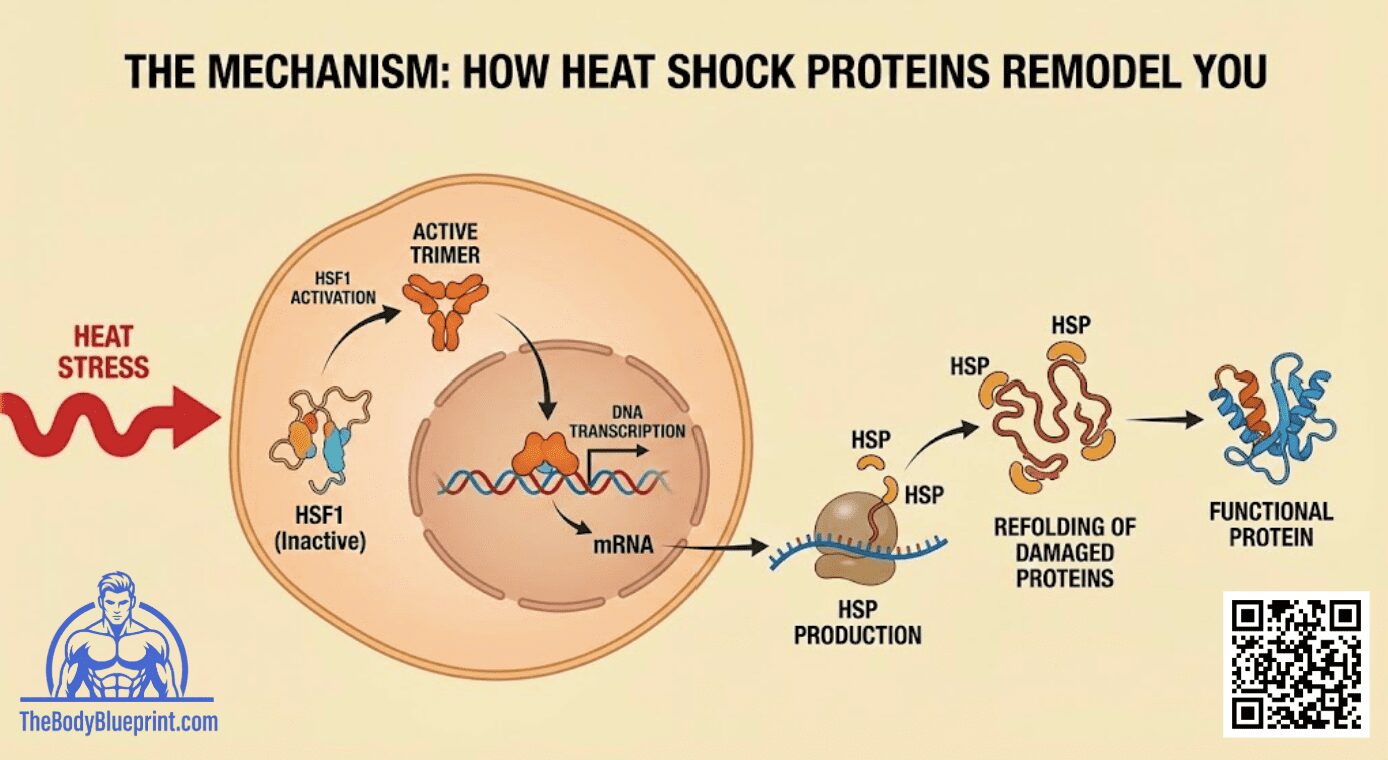
- Applied Stress: Core temperature rises 1-3 degrees Fahrenheit.
- Cellular Alarm: Heat Shock Factor 1 (HSF1) is activated, rushing to DNA.
- Genetic Signal: HSF1 triggers the expression of Heat Shock Proteins (HSP70, HSP90).
- Repair & Refold: HSPs seek out damaged, misfolded proteins from training, repair them, and prevent aggregation.
- Systemic Payoff: Enhanced protein synthesis, reduced inflammation, fortified cellular resilience.
“Think of HSPs not as a response to damage, but as a pre-emptive strike. They’re the cleanup crew you deploy after training to ensure the construction site is ready for the next day’s build.” — Eugene Thong, CSCS
The Physiological Payload: More Than Just “Feeling Good”
| System Impacted | Acute Response (During Session) | Chronic Adaptation (With Repeated Use) | Performance & Growth Implication |
|---|---|---|---|
| Cardiovascular | Heart rate ↑ (50-75% max), Peripheral vasodilation, Plasma volume ↓ (sweat loss) | Increased plasma volume, Lower resting heart rate, Improved endothelial function | Greater stroke volume, Enhanced endurance, Faster cooling during exercise |
| Endocrine | Growth Hormone release ↑ (2-5x baseline), Cortisol ↑, Beta-endorphins ↑ | Improved GH pulsatility, Enhanced insulin sensitivity, Elevated BDNF | Supports fat metabolism & tissue repair, Improves neural recovery & mood |
| Muscular & Cellular | Heat Shock Protein production ↑, mTOR pathway priming, Blood flow to muscles ↑ | Accumulated HSPs, Reduced inflammation (IL-6, TNF-α), Improved mitochondrial efficiency | Faster repair of micro-tears, Reduced DOMS, Increased anabolic signaling |
| Neurological | Parasympathetic activation (post-session), Transient fatigue | Increased cerebral blood flow, Upregulation of neuroprotective HSPs | Improved sleep onset, Potential cognitive resilience, Mental decompression |
This is not a relaxation hack. It’s a cardiovascular and cellular conditioning tool. The sauna is a classroom teaching your body to endure stress, and the lesson is resilience.
Who Should (and Shouldn’t) Engineer Heat Exposure?
Ideal User Profile:
✔ The Volume Lifter—manages inflammation and soreness from high frequency.
✔ The Endurance Athlete—acclimates to heat, expands plasma volume for performance.
✔ The Fat-Loss Phase Athlete—leverages GH spike and metabolic bump.
✔ The Injury-Prevention Focused—uses HSPs to maintain tissue integrity under load.
Contraindications:
✖ Uncontrolled Hypertension or Heart Conditions—the cardiovascular demand is real.
✖ Acute Illness or Fever—you’re adding stress to an already stressed system.
✖ Severe Hypohydration or Electrolyte Imbalance—risk of heat injury skyrockets.
✖ Pre-Competition (24-48 hours)—can blunt maximal neural output for strength/power.
The Protocol Matrix: Dosing Heat for Specific Results
Random sweating yields random results. You must match the stimulus to the goal. Below is the protocol matrix, based on Finnish sauna studies and modern athletic data.
| Primary Goal | Ideal Timing | Temperature & Type | Session Structure | Weekly Frequency |
|---|---|---|---|---|
| Muscle Recovery & HSP Boost | 1-3 hours after training, or on rest days | Dry Sauna: 170-190°F (76-88°C) / Infrared: 120-140°F (49-60°C) | 3-4 rounds of 10-15 minutes, with 2-3 min cool-down (cool shower) between rounds. | 2-4 sessions |
| Growth Hormone Elevation | Evening, separate from training (min. 6 hours post) | Dry Sauna: 176-194°F (80-90°C) | 2 rounds of 20 minutes, or 1 sustained 30-minute session. Maximize thermal load. | 2-3 sessions |
| Endurance & Plasma Volume Expansion | On rest days or after easy aerobic sessions | Any type, focus on humidity < 20% if possible | 4 rounds of 15-20 minutes. Aggressively rehydrate with electrolytes during. | 3-5 sessions |
| Neurological Recovery & Sleep | 90 minutes before bedtime | Infrared or lower-temp Dry (150-160°F / 65-71°C) | 1-2 rounds of 15-20 minutes. Slow, deliberate breathing. No cold plunge after. | Daily (if tolerated) |
| Metabolic / Fat Loss Aid | First thing in a fasted state, or post-cardio | Any type | 2-3 rounds of 10-12 minutes. Can pair with brief, mild cold exposure between rounds. | 3-4 sessions |
The Critical Non-Negotiables
❌ Neglecting Hydration & Electrolytes: You are losing plasma. Replenish with sodium, potassium, magnesium.
❌ Going Too Long Too Soon: Acclimate over weeks. Start with 5-10 minute rounds.
❌ Using It as a Crutch for Poor Recovery: It amplifies good habits, doesn’t replace sleep or nutrition.
“The sauna’s benefit is a tax on your hydration and electrolyte status. If you don’t pay that tax upfront with intention, the dividend—recovery—never arrives. It’s a precision tool, not a blunt instrument.” — Charles Damiano, B.S. Clinical Nutrition
Strategic Integration: Fitting Heat into Your Training Week
For the Strength Athlete (4x/week lifting):
- Schedule: Post-heavy lower body days (Mon, Thu). 3×15 min @ 180°F.
- Rationale: Directs HSP response to greatest muscular damage. Avoid on max effort upper body days to preserve neural freshness.
For the Hypertrophy Trainee (High Volume):
- Schedule: Rest days (Wed, Sun). 2×20 min @ 175°F for GH response.
- Rationale: Separates thermal stress from training stress, allowing full anabolic focus on each. Promotes hyperplasia signaling.
For the Performance Athlete (Mixed Modality):
- Schedule: Post-training, 2-3x week. 4×10 min @ 185°F with 30s cold shower between.
- Rationale: Builds cardiovascular strain tolerance and accelerates systemic recovery. The contrast enhances parasympathetic reactivation.
The Cumulative Edge
This isn’t about one magical session. It’s about the compound interest of cellular resilience:
✅ Reduced Inflammation Baseline: Chronic downregulation of inflammatory cytokines.
✅ Accelerated Skill Consolidation: Cleaner cellular environment may enhance neural pathway efficiency.
✅ Improved Body Composition: Synergistic effect of repeated GH spikes and improved insulin sensitivity.
✅ Training Longevity: By proactively managing micro-damage, you extend your prime.