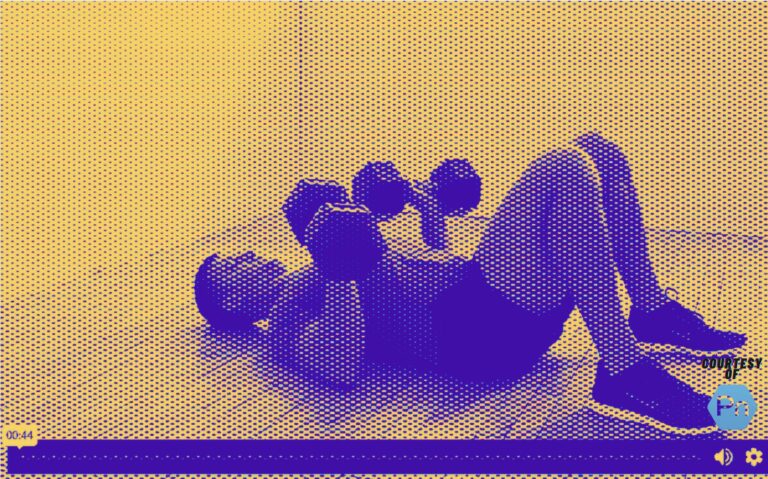
The Dumbbell Bench Press is the primary weapon for building a thick, symmetrical chest while bulletproofing your shoulders.
This is the 2026 blueprint for upper body dominance. If you’re only using the barbell, you’re leaving 20-30% of your gains on the table due to restricted range of motion and hidden muscular imbalances. We’re breaking down the mechanics, the metabolic advantages, and the variations that turn a standard press into a high-status physique builder. Master the bells or stay flat.
Disclaimer: Consult a physician or qualified trainer before starting any new exercise. This guide is built for performance and aesthetic optimization and is for educational purposes only.
Dumbbell Bench Press: The Superior Chest Builder
The Dumbbell Bench Press is a compound pressing movement that allows each arm to work independently. Unlike the Barbell Bench Press, which locks your wrists into a fixed position, dumbbells allow for a natural converging arc. This path of motion more closely follows the function of the pectoralis major: pulling the humerus across the midline of the body.
- Primary Muscles: Pectoralis Major (Chest), Anterior Deltoids (Shoulders), Triceps Brachii.
- Equipment Needed: Pair of Dumbbells, Flat Bench.
- Skill Level: Intermediate. Requires unilateral stability and motor control.
- Key Purpose: Correcting strength asymmetries, increasing hypertrophy through a greater range of motion, and improving shoulder stability.
Dumbbell Bench Press instructional video. Focus on the controlled descent and the slight “arrow” elbow position.
Why Dumbbells are Better for Aesthethics
If you want a chest that looks like it was carved out of granite, you need the freedom of dumbbells. While barbells are great for ego-lifting max numbers, dumbbells are the choice for “pixels” (aesthetic detail).
- Unilateral Strength: You can’t hide a weak side. Each pec has to pull its own weight, preventing the dominant side from taking over.
- Deep Range of Motion: You can lower the weights past the plane of your chest, creating a deep stretch that triggers massive myogenic response.
- Shoulder Freedom: The ability to use a neutral or semi-pronated grip reduces the “impingement” risk found in the fixed barbell path.
- Core Integration: Your abs and obliques have to work overtime to stabilize the independent loads. To prep your core for this, hit the Ab Wheel Iso before your heavy sets.
Step-by-Step Form: The 5-Point Checklist
- Setup: Sit on the bench with dumbbells on your knees. Kick them back as you lie down. Plant your feet hard into the floor. For better respiratory efficiency, prime your ribcage with 90/90 Wall Balloon-Breathing.
- The Arch: Maintain a slight arch in your lower back, but keep your glutes on the bench. Squeeze your shoulder blades together to create a stable “shelf.”
- The Descent: Lower the weights under control. Keep your elbows at a 45-degree angle from your body (the “arrow” shape). Do not flare them at 90 degrees.
- The Stretch: Go until the dumbbells are just outside your chest. Feel the pec fibers lengthen.
- The Drive: Press the weights up and slightly toward each other in a controlled arc. Do not let them clank together at the top.
“The dumbbell press is the ultimate diagnostic for shoulder health. If you can’t stabilize 80% of your barbell max in dumbbells, your rotator cuffs are failing you. We use this to bridge the gap between raw strength and functional longevity. If you want to bench into your 50s, master the dumbbells now.”
— Eugene Thong, CSCS
3 Common Form Mistakes & How to Fix Them
Sloppy pressing is how you end up in a physical therapy clinic. Own the weight.
1. Flaring the Elbows
The Mistake: Pressing with elbows out at 90 degrees, which places extreme stress on the shoulder capsule. The Fix: Tuck your elbows to roughly 45 degrees. This recruits more triceps and places the pecs in a stronger, safer mechanical position.
2. The “Clank”
The Mistake: Smashing the dumbbells together at the top of the rep. The Fix: Stop 2 inches before they touch. Banging weights together kills the tension and potentially damages the equipment. Keep the “pixels” on the muscle, not the iron.
3. Half-Reps
The Mistake: Cutting the range short because the weight is too heavy. The Fix: Lighten the load. The value of dumbbells is the deep stretch. If you aren’t getting the full range, you’re just doing a worse version of a Barbell Bench Press From Pins.
“From a metabolic perspective, the increased stabilization demand of dumbbells increases heart rate and caloric expenditure compared to the barbell. To support this demand, ensure your peri-workout nutrition is dialed in with high-quality amino acids to prevent catabolism during high-volume sessions.”
— Charles Damiano, B.S. Clinical Nutrition
Programming for Performance
Dumbbells thrive in the 8-12 rep range where time under tension is the priority.
- Mass Builder: 4 sets of 8-10 reps. 90s rest. Focus on a 3-second eccentric (lowering) phase.
- Corrective/Primer: 3 sets of 12 reps with moderate weight. Use this before a Barbell Floor Press to pre-fatigue the chest.
- The Finisher: Drop sets. Go to failure, drop the weight by 20%, and immediately go again.
Key Variations to Level Up
- Alternating Dumbbell Bench Press: Improves core stability and anti-rotation strength.
- Dumbbell Floor Press: Limits range of motion to build massive lockout strength and protect the shoulders.
- Single-Arm Dumbbell Press: The ultimate core-stability challenge. Try it to fix a lagging side.
The Verdict
The Dumbbell Bench Press is the superior choice for anyone prioritizing aesthetics, joint health, and symmetrical strength. It demands more from your core, more from your chest, and more from your mind. Stop hiding behind the barbell and pick up the bells.
Dumbbell Bench Press FAQ
How do I safely get the dumbbells into position?
Sit on the bench, place dumbbells on your thighs, and as you lie back, use your knees to “kick” the weights into your chest. Never “wing” them up from the floor once you’re lying down.
Is it better to use a flat or incline bench?
Both. Flat hits the mid-pec, while incline targets the upper fibers. For a complete physique, rotate both into your split.
Why do my shoulders hurt when I press?
Check your elbow angle. If you are flaring your elbows at 90 degrees, you are impinging the joint. Tuck them to 45 degrees and see if the pain vanishes.