Think of this as putting your engine under load while you drive.
It’s not about the weight on the bar; it’s about the accelerating tension. The band forces you to drive through the entire range of motion, eliminating the natural deceleration at the top.
Used by sprinters and jumpers to build explosive, athletic power. A simple band changes the entire physics of the lift.
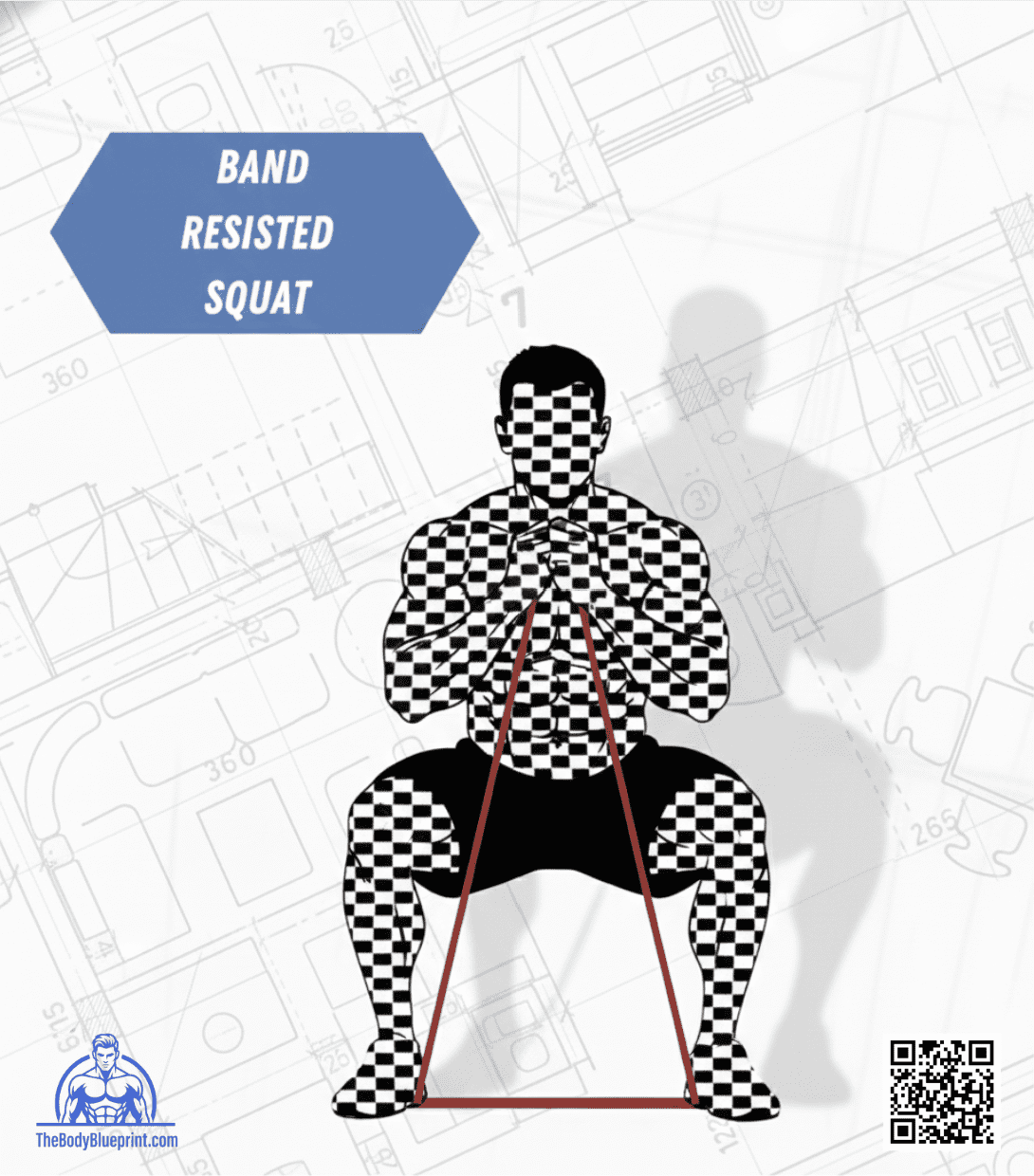
What it is: A squat with band resistance pulling you forward. Fights momentum.
Who it’s for: Athletes, powerlifters, guys stuck in a squat plateau.
When to do it: Warm-ups, speed work, accessory days.
Where it helps: Explosive hip drive, core anti-flexion, quad and glute power.
Why it works: Max tension at the top. Trains acceleration, not just lifting.
Band-Resisted Squat: Form Under Fire
“This isn’t just a squat with a rubber band. It’s teaching your body to overcome a forward-pulling force. If your form is weak, the band will expose it—immediately.” — Eugene Thong, CSCS
- Anchor the Band: Secure a heavy resistance band to a low, immovable anchor point in front of you. A squat rack post works perfectly.
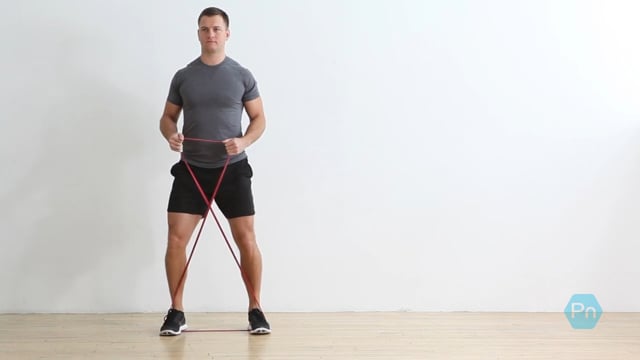
- Loop and Stance: Step into the band and loop it around your hips or torso. Walk back to create tension. Assume your normal squat stance.
- Brace and Fight: Brace your core like you’re about to be tackled from the front. The band will try to pull you forward. Fight it.
- The Controlled Descent: Initiate your squat. Resist the band’s pull the entire way down. Keep your torso upright. Don’t let it yank you into a forward lean.
- The Explosive Drive: At the bottom, reverse direction fast. Drive through your heels and explode up against the band’s resistance. This is where power is built.
- Finish Strong: Stand up fully, squeezing your glutes at the top. Control the band’s pull back to the start. Don’t get snapped forward.
Muscles Worked: The Power Circuit
| Phase | Primary Job | Muscles Firing |
|---|---|---|
| The Descent (Eccentric) | Fight the forward pull, control descent | Glutes, Hamstrings, Core (anti-flexion), Upper Back |
| The Drive (Concentric) | Explode upward against maximum tension | Quads, Glutes (max contraction), Calves, Spinal Erectors |
| The Difference vs. Barbell | Band = Max tension at the top. Barbell = Max tension at the bottom. This trains your acceleratory strength—the most athletic kind. | |
Who Is This For? (And Who Should Wait)
Do It If:
✔ Your squat feels slow or sticky at the top.
✔ You play field sports (football, rugby) and need explosive power.
✔ You’re a powerlifter looking to smash through a sticking point.
✔ You want glutes and quads that fire like pistons.
Skip It If:
✖ You can’t do a bodyweight squat with perfect form.
✖ You have major lower back issues. The anterior pull demands a strong core.
✖ You only have a flimsy physical therapy band. You need heavy resistance.
Band Hacks & Variations
| Variation | How To | Why It’s Killer |
|---|---|---|
| Banded Box Squat | Perform to a low box or bench. Pause, relax, then explode up. | Eliminates the stretch reflex. Builds pure starting strength from a dead stop. |
| Band + Barbell Combo | Use a band AND a barbell together. (Advanced) | Combines max tension at the top (band) with constant load (barbell). Brutally effective. |
| Forward-Step Initiation | Start with one foot forward. Step back into the squat against band tension. | Mimics athletic deceleration. Crazy for sports performance and single-leg stability. |
| Tempo Band Squat | 3 seconds down, pause, then explode up. | Builds insane eccentric control and tendon strength. Makes the explosive pop feel easier. |
Form Checks: Don’t Get Owned by the Band
❌ Letting the band round your back. Fight for a proud chest. Upper back tight.
❌ Diving forward on the descent. You control the band; it doesn’t control you. Sit back.
❌ Using knees to initiate. Break at the hips first. Push them back against the band.
❌ Using a band that’s too light. You should feel a legitimate fight at the top position.
“People think bands are for beginners. Wrong. Used correctly, they provide a unique strength curve that challenges the muscles where a barbell is weakest. It’s smart training, not easy training.” — Charles Damiano, B.S. Clinical Nutrition
Programming: Train for Speed & Strength
For Speed & Explosiveness (Athletes):
3-4 sets of 3-5 reps. Focus on max speed on the ascent. Rest 2-3 minutes. Do this before your heavy lifts.
For Breaking Plateaus (Powerlifters):
Use after your main work. 3 sets of 6-8 reps with a challenging band. Focus on perfect form under fatigue.
For Muscle Building (Hypertrophy):
Pair with goblet squats. 8-10 banded reps, immediately into 10-12 goblet squats. Rest 90s. Repeat 3 times. Leg annihilator.
The Bottom Line: Why Add Bands?
✅ Build explosive lockout power for bigger squats and cleans.
✅ Forge an iron core that resists folding under forward pressure.
✅ Improve athletic movement by teaching your body to produce force against resistance.
✅ Smash through strength plateaus with a new, brutal stimulus.
Bands aren’t a gimmick. They’re a tool. This is how you use them to build a more powerful engine.