Choosing a probiotic isn’t about finding the “best” — it’s about finding the right tool for your goals and budget. Sports Research and NOW Foods represent two dominant philosophies in the 2026 supplement game: one prioritizes advanced, potent formulas; the other delivers no-nonsense, rock-solid value.
This head-to-head breakdown cuts through the marketing to analyze formulation, survivability tech, and real-world cost. We’re here to answer one question: which brand’s strategy actually wins for your wallet and your gut?
Disclaimer: You’re here to find a product that’ll get you results, and I’m here to help. Just a heads-up: As an Amazon Associate, I earn from qualifying purchases. If you buy through my links, I get a small commission at no added cost to you. It’s like I get a little something for doing the heavy lifting on research. Fair deal? Now, let’s get into the good stuff.
Important: These statements have not been evaluated by the Food and Drug Administration. This information is for educational purposes and is not intended to diagnose, treat, cure, or prevent any disease. The product rankings and descriptions are based on label analysis, published scientific research on specific strains, and delivery technology. They are not a substitute for professional medical advice. Always consult with a healthcare provider before starting any new dietary supplement.
The 60-Second Verdict: Sports Research vs. NOW Foods
Don’t have time for the deep dive? Here’s the tactical breakdown.
- Sports Research Wins If: You want a high-potency, synbiotic formula (prebiotic + probiotic) and are willing to pay a premium for a delayed-release capsule and organic prebiotic fiber. It’s for the lifter or biohacker who wants a more advanced tool. → Check Sports Research Price
- NOW Foods Wins If: Your priority is maximum value and a reputable, straightforward probiotic for daily foundational support. You get proven strains at a cost that makes consistency easy. → Check NOW Foods Price
- The Bottom Line: This isn’t a battle of good vs. bad. It’s Advanced Tool vs. Foundational Value. Sports Research offers more bells and whistles; NOW Foods offers unbeatable efficiency per dollar.
“For the athlete focused on performance, the inclusion of a prebiotic in a formula like Sports Research’s isn’t just marketing—it’s functional. Feeding the bacteria you’re ingesting can support a more resilient gut environment, which is non-negotiable under heavy training stress.”
— Eugene Thong, CSCS
Round 1: Formulation & Strain Philosophy
This is where their strategies diverge completely. One goes for targeted potency, the other for broad, efficient support.
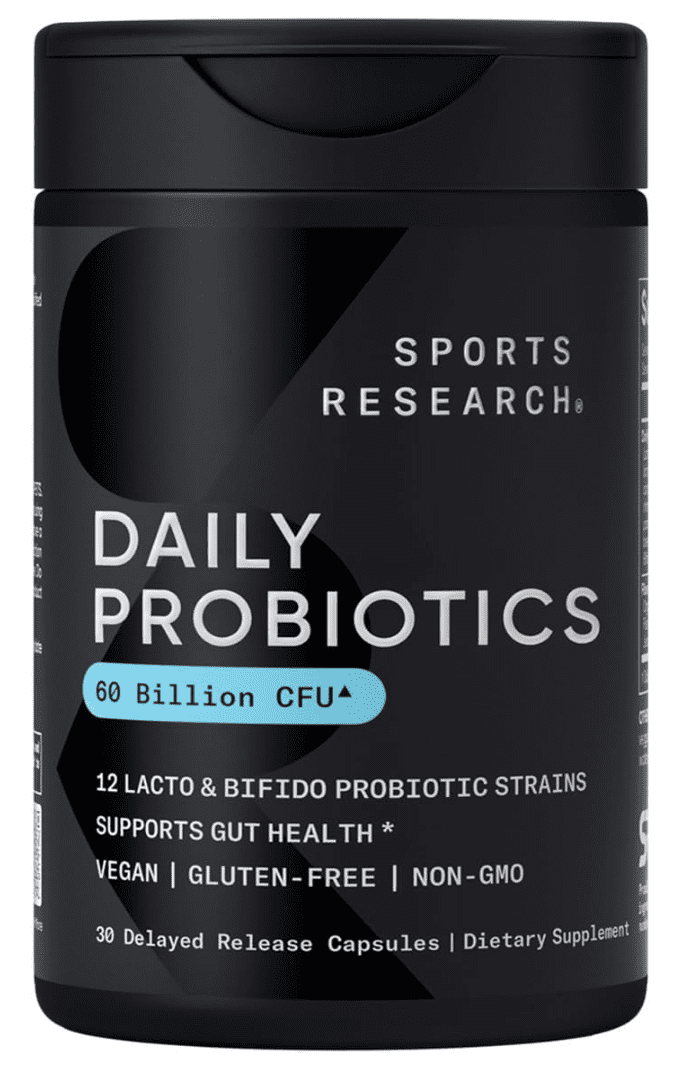
Sports Research Daily Probiotics: The Synbiotic Specialist
Core Strategy: “More is more” with intelligent design.
- CFU & Strains: 60 Billion CFU from a blend of 6 strains including Lactobacillus and Bifidobacterium species.
- The Synbiotic Edge: Includes organic acacia prebiotic fiber. This isn’t just filler—it’s fuel for the probiotics, designed to help them thrive.
- Goal: To deliver a high-impact, comprehensive gut health formula in one capsule.
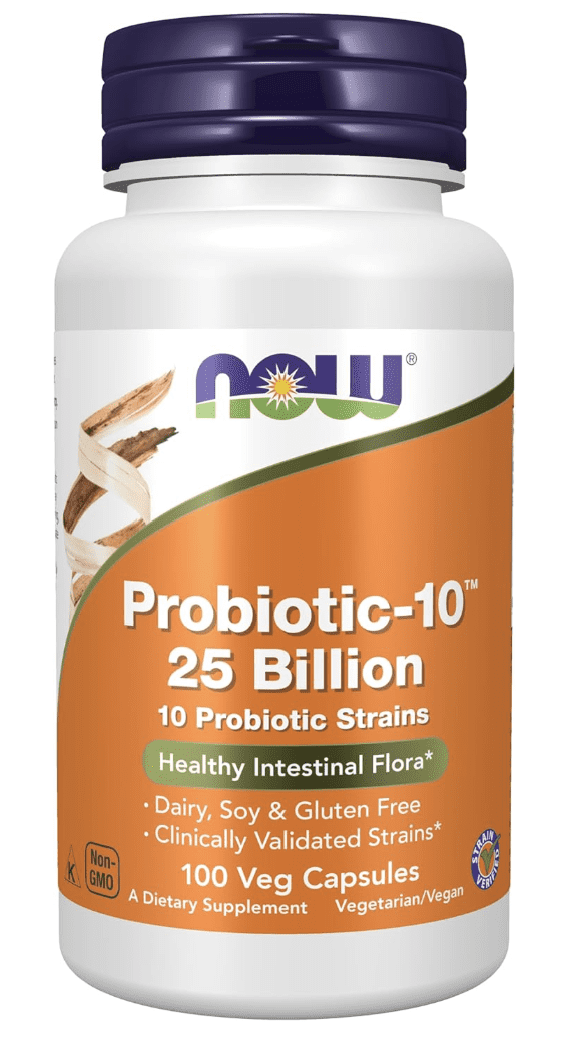
NOW Foods Probiotic-10: The Efficient Workhorse
Core Strategy: Proven, no-frills efficacy.
- CFU & Strains: 25 Billion CFU from a diverse 10-strain blend. This offers broader diversity, which can be beneficial for general microbiome support.
- Simplicity: It’s a straightforward probiotic. No added prebiotics, enzymes, or other compounds.
- Goal: To provide reliable, affordable, and broad-spectrum probiotic support without complexity.
Round 2: Survivability Tech – Getting Bacteria Where They Need to Go
A probiotic is only as good as its delivery system. This is a major point of differentiation.
- Sports Research: Uses a delayed-release, acid-resistant veggie capsule. This technology is designed to protect the delicate bacteria from stomach acid, aiming to deliver more viable CFUs to the intestines.
- NOW Foods: Typically uses a standard vegetarian (cellulose) capsule. While effective, it offers less targeted protection against stomach acid than a dedicated delayed-release system.
The Takeaway: Sports Research invests more in delivery technology, which is a key factor in its higher price point and a reason it can justify a 60B CFU count. NOW Foods relies on a proven, cost-effective delivery method.
“The ‘value’ of a probiotic isn’t just its sticker price. It’s the cost per viable, delivered CFU. A cheaper capsule that degrades in the stomach might deliver a fraction of its label claim, making the real cost much higher. Advanced delivery tech, while more expensive upfront, can be more efficient in the long run.”
— Charles Damiano, B.S. Clinical Nutrition
Round 3: The Real Cost – Price Per Billion CFU
Let’s move beyond the bottle price and break down what you’re actually paying for. (Note: Prices fluctuate; this is a snapshot analysis based on standard retail.)
| Metric | Sports Research | NOW Foods |
|---|---|---|
| Avg. Bottle Price | $32-$38 (30 caps) | $18-$22 (50 caps) |
| CFU per Capsule | 60 Billion | 25 Billion |
| Cost per Capsule | ~$1.07 – $1.27 | ~$0.36 – $0.44 |
| Cost per 1 Billion CFU | ~$0.018 – $0.021 | ~$0.014 – $0.018 |
Analysis: NOW Foods wins purely on cost-efficiency per billion CFU. However, this calculation doesn’t account for Sports Research’s added prebiotic fiber and more advanced capsule technology. You’re paying less for raw CFUs with NOW, and more for a “full-package” synbiotic with Sports Research.
Final Call: Who Should Choose What?
Your decision tree is simple.
Choose Sports Research Daily Probiotics if…
- You want a high-potency, all-in-one synbiotic (prebiotic included).
- You prioritize advanced, delayed-release capsule technology.
- You’re not strictly budget-limited and value a more feature-complete formula.
- You’re an active individual or lifter looking for a comprehensive gut health tool. → Check Price & Reviews for Sports Research
Choose NOW Foods Probiotic-10 if…
- Your top priority is getting reliable probiotic support at the absolute best price.
- You prefer a simple, straightforward formula without added prebiotics.
- You’re new to probiotics and want a reputable, low-risk entry point.
- You need a foundational supplement you can take consistently for the long haul without breaking the bank. → Check Price & Reviews for NOW Foods
Sports Research vs. NOW Foods: Head-to-Head Summary
| Feature | Sports Research | NOW Foods | Winner For |
|---|---|---|---|
| Formula Type | Synbiotic (Pre+Pro) | Probiotic Only | Completeness (Sports Research) |
| CFU Count | 60 Billion | 25 Billion | Raw Potency (Sports Research) |
| Strain Diversity | 6 Strains | 10 Strains | Diversity (NOW Foods) |
| Capsule Tech | Delayed-Release | Standard Veggie Cap | Survivability (Sports Research) |
| Cost Efficiency | Lower | Higher | Budget (NOW Foods) |
The Choice is Yours: Advanced Tool or Foundational Value?
Both brands deliver what they promise. The right choice depends entirely on whether your 2026 gut health strategy prioritizes advanced features or unbeatable cost-of-entry.
More From The Gut Health Guide
- Best Probiotics 2026: The Full Top 9 Ranking – See where these and other top brands like Seed and Thorne stack up.
- Sports Research Daily Probiotics – Full In-Depth Review
- NOW Foods Probiotic-10 – Full In-Depth Review