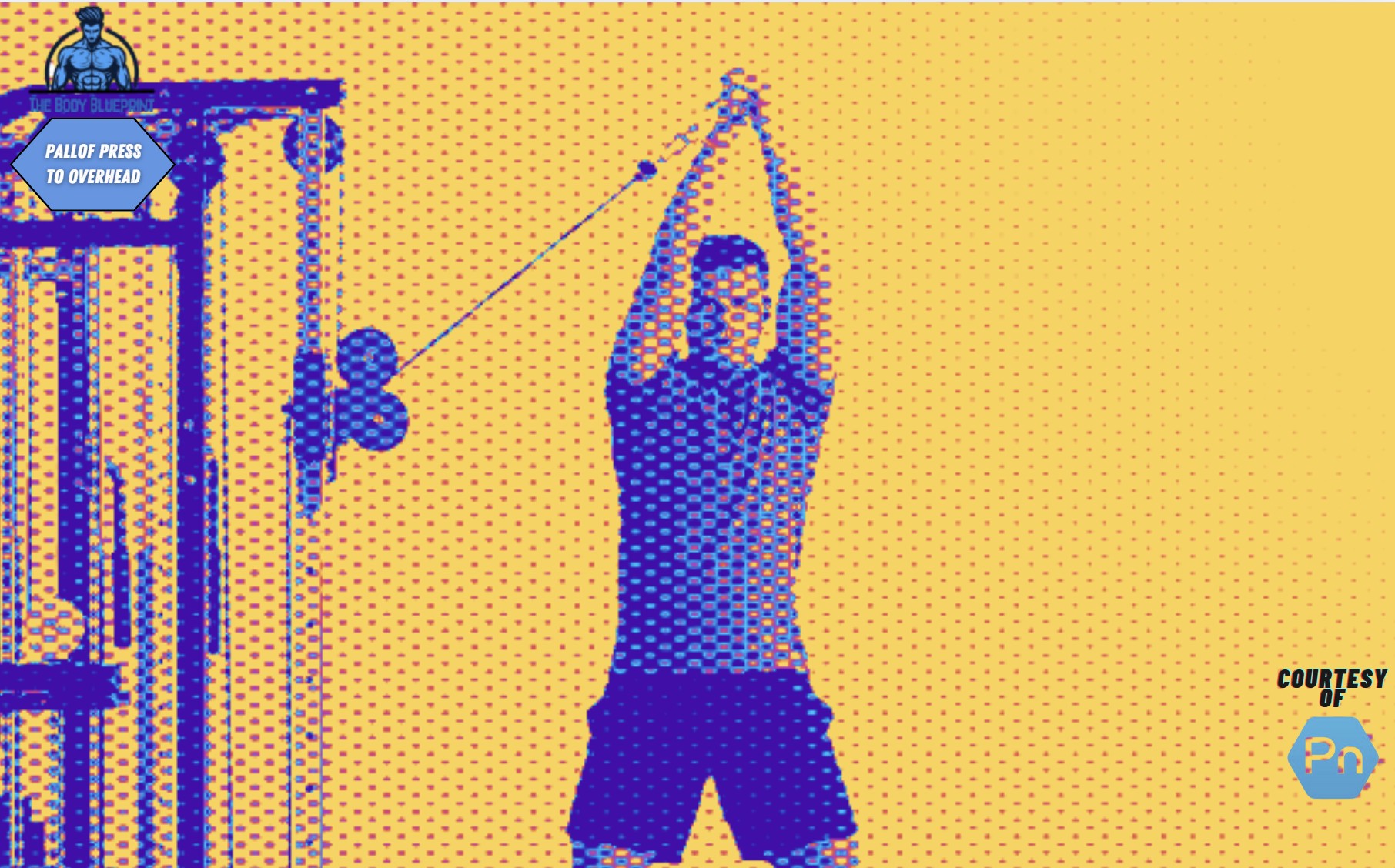
Most overhead pressing plateaus are not shoulder problems; they are core stability failures. The Pallof Press to Overhead bridges the gap by forcing the anterior core to resist extension and rotation simultaneously while the shoulders move through a full range of motion.
If your ribs flare out when you press a barbell overhead, you are leaking power. You aren’t just risking your lower back; you’re robbing your shoulders of a stable base to push from. The Pallof Press to Overhead isn’t a “warm-up”; it is structural engineering for your torso. It teaches your body to separate shoulder mobility from spinal stability. If you can’t do this, you have no business lifting heavy.
Important: If you cannot raise your arms overhead without arching your back, address your thoracic mobility first. Do not force this range of motion.
Why This Move Outclasses Standard Planks
Standard planks are static. The real world is dynamic. This exercise challenges the core in two planes simultaneously: Anti-Rotation (resisting the sideways pull) and Anti-Extension (resisting the backward arch as arms go up).
This is directly transferable to the standing barbell overhead press, where ribcage control determines your max lift.
The Benefits at a Glance
| Advantage | The Payoff |
|---|---|
| Ribcage Control | Trains you to keep the ribs tucked (“canister position”) even when arms are overhead. |
| Scapular Stability | Forces the serratus anterior to fire to stabilize the shoulder blades. |
| Rotational Resistance | Builds obliques that can resist torque, critical for protecting the spine. |
How to Perform It Like a Pro
You need a cable stack for this. We recommend a versatile setup like the RitFit Buffalo or a functional trainer. Bands work, but cables provide constant tension.
Step-by-Step Execution
- The Anchor: Set the cable at chest height. Stand perpendicular to the machine.
- The Base: Feet shoulder-width apart. Soft knees. Glutes squeezed.
- The Press: Hold the handle at your chest. Press it straight out (Standard Pallof). Hold.
- The Lift: Slowly raise your arms overhead. Crucial: As your arms go up, fight the urge to lean back or let the cable twist you.
- The Return: Lower back to chest height under control. Do not let the stack crash.
“The moment your ribs pop up, the set is over. You have broken the cylinder. Range of motion is secondary to spinal position. If you can only go halfway up without arching, stop there.”
— Eugene Thong, CSCS
Variations to Break Plateaus
1. Half-Kneeling Pallof Overhead
Drop to one knee (inside knee down). This removes the legs and forces the hips to stabilize. It exposes tight hip flexors instantly.
2. The “Y” Press
Instead of going straight up (I-shape), press out into a Y-shape. This increases the lever arm and demand on the lower traps.
3. Chaos Band
Attach a weight to the band with a smaller resistance band so it bounces. This forces reflexive stability.
Common Mistakes
- The Lean-Back: Hyperextending the lumbar spine to get the arms up. Fix: Squeeze glutes harder.
- Shrugging: Letting the shoulders creep up to the ears. Fix: Keep lats engaged.
- Speed: Rushing the lift. Fix: Use a 3-second count up and down.
Programming & Recovery
This is a high-tension exercise. Treat it with respect.
Protocol
| Level | Volume | Focus |
|---|---|---|
| Beginner | 3 x 8/side | Rib cage control. |
| Advanced | 4 x 6/side (Slow Eccentric) | Maximal tension. |
Performance Optimization
To maintain the intra-abdominal pressure needed for this move, gut health is underrated. Bloating ruins your ability to brace. Consider probiotics for men or specifically prebiotics for lifters to ensure your midsection isn’t fighting against gas.
For pre-workout blood flow to the stabilizers, L-Arginine can aid in the “pump” and connection. Check our Bulk vs Jocko GO comparison for top-tier pre-workout options.
Finally, if your lats are too tight to get overhead, use a massage gun or a dedicated massage machine on the insertion points before training to free up range of motion.
The Verdict
The Pallof Press to Overhead is the ultimate test of functional core strength. It proves you can move your limbs without compromising your spine. Master this, and your overhead press will skyrocket.