If your goal is to get lean without getting bulky, the key lies in balancing resistance training intensity, nutrition, and recovery.
The formula: moderate loads (8–15 reps), higher training volume, and a calorie-controlled diet with sufficient protein.
This combination stimulates muscle definition—not excessive size—by prioritizing metabolic stress and fat oxidation over maximal tension.
You’ll look athletic, not inflated.
A Note on “Bulking Up”: The Myth of Accidental Size
Before diving deeper, let’s address the elephant in the weight room.
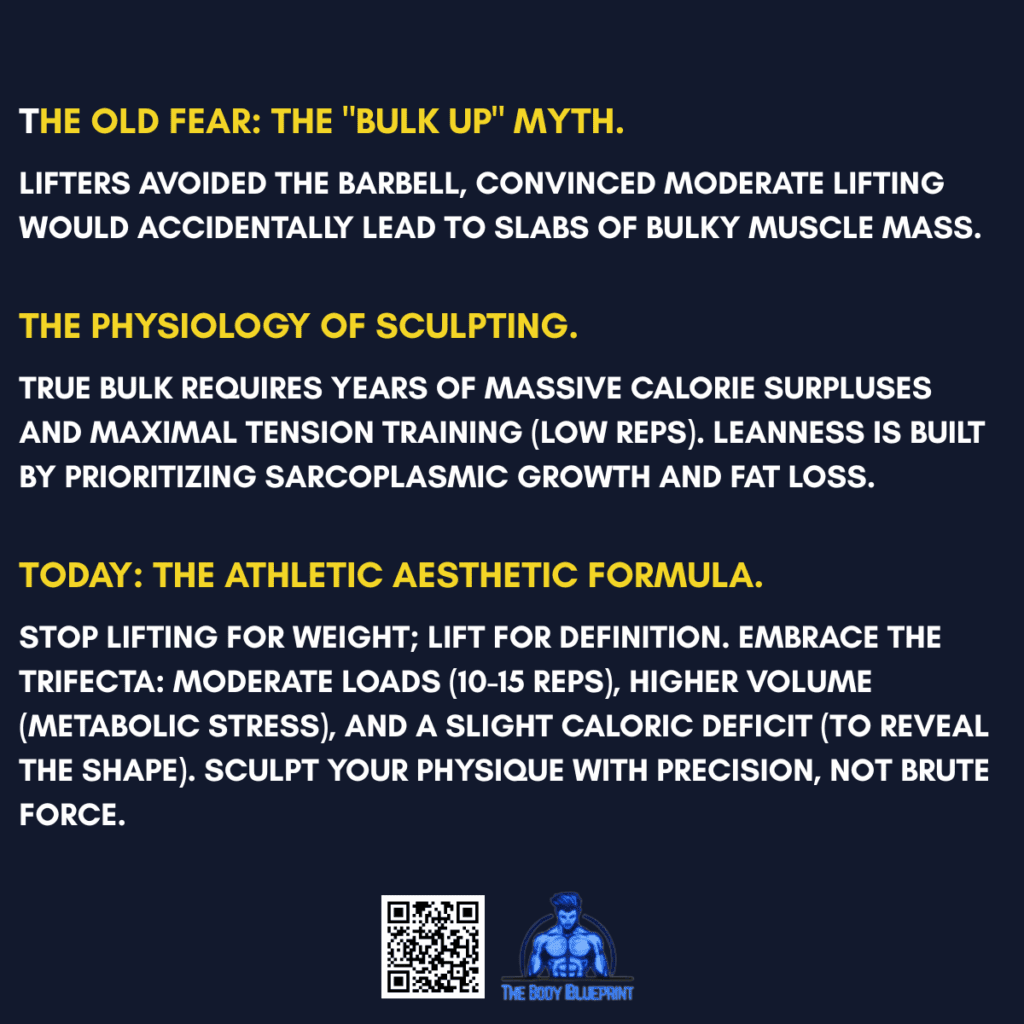
The idea that you’ll “bulk up” accidentally from lifting is one of the most persistent fitness myths—and it’s simply not true.
Building large, bulky muscle mass requires three specific factors:
- A Significant Caloric Surplus: Consistently eating more calories than you burn over months or years.
- Years of Heavy Progressive Overload: Training near your maximum capacity (85–95% 1RM) in low-rep ranges designed for maximal strength and hypertrophy.
- A Favorable Hormonal Profile: Higher levels of testosterone and other anabolic hormones—one major reason why it’s far harder for women to gain large amounts of muscle mass.
Without those conditions, your body simply doesn’t have the raw materials or internal signaling to “accidentally” add slabs of muscle.
As Eugene Thong, CSCS, explains:
“The average lifter, especially women, don’t have the hormonal environment or caloric intake to ‘bulk up’ unintentionally. What they build is shape, tone, and definition.”
By following a controlled-calorie diet and the training plan below, you’ll develop a lean, dense, and athletic look—the exact opposite of “too muscular.”
1. The Physiology of Lean Muscle
The human body builds muscle through hypertrophy, which has two main forms:
| Type | Description | Effect |
|---|---|---|
| Myofibrillar Hypertrophy | Growth of contractile fibers from heavy, low-rep lifting | Strength gains and density |
| Sarcoplasmic Hypertrophy | Expansion of fluid and glycogen within muscle cells from moderate-to-high reps | Fuller look and endurance |
For a lean aesthetic, training should favor sarcoplasmic hypertrophy and fat reduction rather than pure myofibrillar expansion.
Charles Damiano, B.S. Clinical Nutrition, adds:
“Most people chasing a lean look don’t realize it’s about conditioning the muscle, not overloading it endlessly. The right rep range builds tone, not bulk.”
2. Training Parameters That Define, Not Inflate
Modern strength programming often confuses muscle size with muscle quality.
To build definition, your program should look like this:
| Variable | Recommendation | Reason |
|---|---|---|
| Rep Range | 10–15 per set | Increases muscular endurance and calorie burn |
| Load Intensity | 60–70% of 1RM | Enough to stimulate growth without maximal tension |
| Rest Between Sets | 30–60 seconds | Keeps heart rate elevated for fat loss |
| Tempo | 2-0-2 (controlled eccentric and concentric) | Enhances muscle control and definition |
| Training Frequency | 4–5 days per week | Ensures recovery while maintaining volume |
Thong summarizes this balance well:
“The goal isn’t to train lighter—it’s to train smarter. Control the load, feel every rep, and use volume as the sculpting tool.”
3. Nutrition: The Deciding Factor
Lean physiques are built in the gym but revealed in the kitchen.
The balance between calories consumed and calories expended determines whether your muscles emerge or hide under body fat.
Nutrition Checklist:
- Caloric Intake: Slight deficit (~200–300 kcal below maintenance)
- Protein: 1.6–2.2 g per kg of body weight
- Carbohydrates: Moderate (support training performance)
- Fats: 20–30% of total calories for hormonal health
- Hydration: 3–4 liters per day for cellular efficiency
Think of food as fuel and recovery agent, not reward.
The goal is energy precision, not deprivation.
4. Conditioning for Definition
Cardio, when integrated intelligently, enhances muscle visibility.
But not all cardio yields the same return.
Best Cardio Methods for a Lean Look:
- HIIT (High-Intensity Interval Training): 2 sessions per week, 20–25 minutes
- Zone 2 Training: 45–60 minutes of steady-state cardio at 60–70% max heart rate
- Active Recovery: Walking, yoga, or swimming on rest days
HIIT burns fat while preserving muscle tissue by triggering post-exercise oxygen consumption (EPOC)—you continue burning calories for hours afterward.
Zone 2 supports endurance and metabolic flexibility without spiking cortisol excessively.
5. Recovery and Hormonal Balance
Without recovery, even the best training collapses into fatigue.
Sleep and stress management regulate cortisol, testosterone, and growth hormone—all critical to staying lean.
Recovery Priorities:
- Sleep: 7–9 hours per night
- Deload Weeks: Every 4–6 weeks to reset nervous system fatigue
- Mobility & Stretching: 10–15 minutes post-workout
- Mindfulness Practices: Meditation or deep breathing to lower stress load
Remember: overtraining is the enemy of leanness.
It raises cortisol, increases water retention, and blunts fat oxidation.
6. Sample “Lean, Not Bulky” Training Split
| Day | Focus | Key Exercises | Sets x Reps |
|---|---|---|---|
| Mon | Upper Push | Incline Dumbbell Press, Arnold Press, Cable Fly | 3–4 x 10–12 |
| Tue | Lower Body | Bulgarian Split Squat, Leg Press, Calf Raise | 3–4 x 12–15 |
| Wed | Cardio + Core | HIIT + Hanging Leg Raise | 25 min + 3 x 15 |
| Thu | Upper Pull | Pull-Up, Cable Row, Face Pull | 3–4 x 10–12 |
| Fri | Conditioning | Zone 2 Cardio (Bike or Row) | 45–60 min |
| Sat/Sun | Rest or Active Recovery | Yoga / Walking | — |
This hybrid routine combines muscle maintenance, fat oxidation, and cardiovascular support—a trifecta for lasting leanness.
7. The Mindset Behind Staying Lean
Leanness isn’t a sprint—it’s a sustainable identity.
Arnold trained for dominance.
Zane trained for proportion.
You train for longevity.
Think of it as sculpting, not stacking—you’re removing what doesn’t belong while strengthening what remains.
Summary Table: The “Lean, Not Bulky” Formula
| Category | Key Strategy | Result |
|---|---|---|
| Training | Moderate weight, high control | Defined muscle tone |
| Nutrition | Slight calorie deficit | Fat reduction |
| Cardio | HIIT + Zone 2 mix | Improved conditioning |
| Recovery | Prioritize sleep & stress balance | Hormonal stability |
| Mindset | Consistency over ego lifting | Sustainable leanness |
Footnotes
- Schoenfeld, B. J. et al. (2014). The Mechanisms of Muscle Hypertrophy and Their Application to Resistance Training.
- Morton, R. W. et al. (2016). Protein Supplementation and Resistance Training in Healthy Adults.
- Phillips, S. M. (2021). Nutritional Strategies to Support Adaptations to Exercise.