You know the feeling. The deep, satisfying ache that hums in your muscles the day after a brutal workout. For decades, we’ve worn this pain as a badge of honor, the undeniable proof that we’ve earned our gains. We’ve been evangelists of the grind, disciples of the burn, believing that the path to a powerful physique was paved with suffering.
But what if that pain was a signal you’ve been misreading?
What if the very philosophy you’ve built your body upon is, in fact, holding you back?
A quiet revolution is unfolding in the world of strength science. It’s moving away from the gospel of brutal, tear-down workouts and toward a more intelligent, nuanced conversation with your body. This isn’t about working less; it’s about accomplishing more by listening to the cellular whispers before they become screams.
It’s time to trade the sledgehammer for a scalpel.
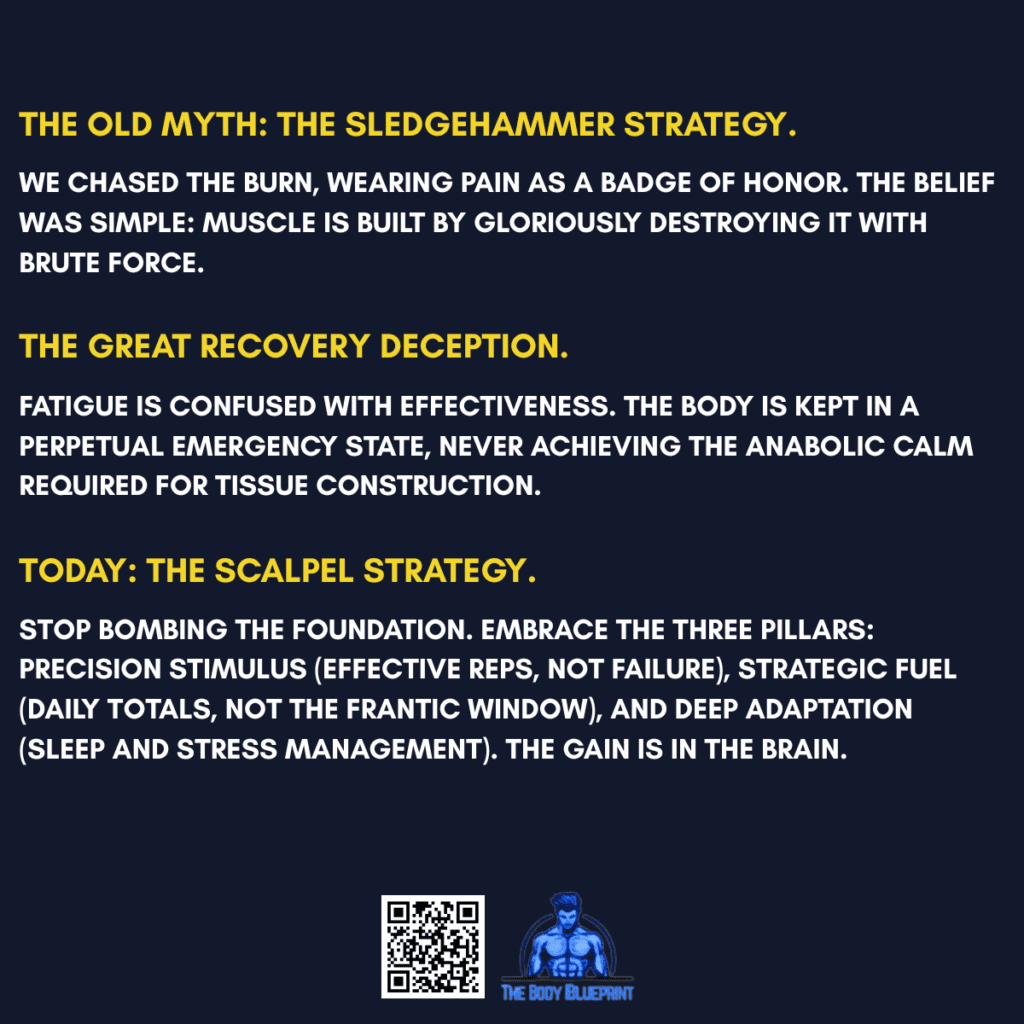
The Great Recovery Deception
The old model was simple: destroy muscle in the gym, feed it with protein, and let it rebuild bigger and stronger. We focused on the destruction with a kind of glorious violence. But the magic doesn’t happen in the destruction. It happens in the silence that follows.
Think of building muscle not as a demolition project, but as constructing a cathedral.
Your workout is just the delivery of the raw materials—the stone and lumber. The actual building, the careful placement of each block, the soaring architecture of new tissue, happens when you are resting. When you are sleeping. When you are not in the gym.
“We’ve fetishized the breakdown phase to the point of self-sabotage,” says Eugene Thong, CSCS. “The real limit for most lifters isn’t how hard they can train, but how effectively they can recover. You can’t build a palace on a foundation that’s constantly being bombed.”
This is the great recovery deception: by confusing fatigue for effectiveness, we keep our bodies in a perpetual state of emergency, never allowing them the peaceful, anabolic calm required to actually construct the physique we want.
The Three Pillars of Intelligent Growth
So, if “no pain, no gain” is a flawed compass, what should we navigate by? Growth is governed by three interconnected pillars. Ignoring one collapses the entire structure.
1. The Stimulus: Precision Over Power
The goal of your workout is not to emerge as a broken mess. It is to provide a clear, potent stimulus that signals your body to adapt. This is where the concept of effective reps comes in—not just moving weight, but creating maximal tension in the target muscle.
| The Old Way (Brute Force) | The Smarter Way (Precision Engineering) |
|---|---|
| Lifting until total failure on every set | Stopping 1-2 reps shy of technical failure |
| Chasing the burn at all costs | Chasing the mind-muscle connection |
| Adding more weight, no matter the form | Perfecting form to increase tension with the same weight |
| “Surviving” the workout | “Completing” the stimulus |
2. The Fuel: The Myth of the Magic Hour
You know protein is crucial. But the old, frantic fairytale of a 60-minute “anabolic window” slamming shut post-workout has been shelved by modern science. The new understanding is more strategic, less stressful, and far more effective.
Charles Damiano, B.S. Clinical Nutrition, clarifies the priority: “We’ve traded the stopwatch for the calculator. The single most important factor for growth is your total daily protein intake—hitting that consistent, daily target is the foundation. Everything else is fine-tuning the signal.”
The reality is that the body’s period of heightened nutrient sensitivity isn’t a narrow window but a broad, unfolding opportunity that lasts for 4-6 hours after your training session. This dismantles the old anxiety and replaces it with a strategic framework.
A powerful, simplified nutritional strategy for growth rests on these principles:
- The Pre-Workout Priming: A meal with protein and carbohydrates 60-90 minutes before training elevates blood amino acids and glycogen stores, putting your body in an anabolic state before you even lift a weight. You’re not showing up to the construction site empty-handed.
- The Daily Foundation: Your body builds muscle around the clock, not just after the gym. Spreading 0.8-1.2 grams of protein per pound of body weight across 3-4 meals throughout the entire day provides a constant supply of building blocks. This is the non-negotiable bedrock.
- The Strategic Refuel: The post-workout meal is the first and most important meal in your next daily cycle, not the final, frantic act of the last one. Aim to consume a balanced meal with protein and carbs within 2-3 hours of finishing your session. This strategically leverages the extended window of sensitivity to replenish and rebuild, turning a panicked rush into a purposeful, planned maneuver.
3. The Adaptation: Where the Magic Actually Happens
This is the pillar we most often ignore. Adaptation occurs through pathways that are switched on by your workout but are activated in a state of deep recovery. This is a biochemical conversation, not a blunt-force trauma.
The most powerful levers for adaptation are:
- Sleep: This is your body’s primary anabolic hormone release party. Poor sleep elevates cortisol, a muscle-wasting hormone, and crushes testosterone and growth hormone. It’s the difference between building with blueprints in broad daylight or fumbling in the dark.
- Stress Management: Chronic mental stress keeps your nervous system in a catabolic “fight-or-flight” mode, directly opposing the “rest-and-digest” state required for growth. Your body won’t invest in a larger physique if it thinks it’s running from a predator.
- Hydration: Your cells are mostly water. A dehydrated cell is like a deflated balloon—it can’t conduct the business of protein synthesis efficiently. It’s the simplest, most overlooked lever for cellular function.
The New Mandate: Train Smarter, Listen Closer
The new era of strength isn’t about how much you can endure. It’s about how well you can interpret the subtle language of your body. It’s about understanding that a fresh, energetic workout at 80% intensity will do far more for your long-term growth than a grinding, soul-crushing session at 100% that you need a week to recover from.
The pain of growth isn’t the loud, acute burn of a final rep. It’s the quiet, persistent discipline of going to bed an hour earlier. It’s the foresight to skip a set when your form is fraying. It’s the understanding that the gym is where you place the order, but your life outside its walls is where the meal is prepared and served.
“The goal is to create a resilient body, not just a large one,” Thong concludes. “A body that can perform, not just pose. And resilience is born from the intelligent dance of stress and recovery, not from a war of attrition.”
So, let the old mantra fade into the clang of dumbbells past. Your new philosophy is quieter, more potent, and waiting for you to embrace it.
The gain is in the brain.