You’ve felt it. That slow burn in your gut, the tremor in your neck, the primal grunt escaping your lips as you crunch for the hundredth time. You’re building a fortress of muscle, brick by painful brick. You can feel the granite hardness… buried under a layer of something stubbornly soft.
It’s a special kind of frustration, this architectural marvel hidden behind a scrim of fog.
The problem isn’t your effort. The problem is your geography. You’re digging for treasure in the wrong location. The secret map to a defined midsection isn’t found on your gym floor; it’s pinned to your refrigerator, scribbled on your grocery list, encoded in the very chemistry of what you eat.
This isn’t about willpower. It’s about wiring.
The Brutal, Simple Math of Visibility
Let’s be clear: abs are made in the gym. But they are revealed in the kitchen. This is the first, non-negotiable law of abdominal physics.
Think of your body fat as water in a lake, and your abs as a sculpted landscape at the bottom. You can’t see the landscape—no matter how intricate it is—if the water level is too high. Doing endless crunches is like adding more beautiful detail to the submerged landscape. It’s there, but it’s invisible.
The single most important factor in seeing your abdominal muscles is reducing your total body fat percentage. For most men, this means getting below 15% to see some definition, and down to the 10-12% range for that sharp, etched look.
“The conversation around a six-pack almost always starts with exercise, but it should end with nutrition,” says Charles Damiano, B.S. Clinical Nutrition. “You’re fighting a battle of energy systems. If you’re consuming more fuel than your body can burn, the instruction manual says ‘store it,’ and the default storage unit is often the midsection.”
This is the algebra of allocation. Where does the energy go?
The Kitchen Workout: Metabolic Priming
Forget the “burning” sensation. The real work in the kitchen is about metabolic priming—creating an internal environment where your body is subtly, constantly encouraged to use stored fat for fuel.
It’s a shift from a storage economy to a spending economy.
This happens through a strategic manipulation of three macronutrient levers. It’s not a crash diet; it’s a recalibration.
| Macronutrient | Primary Role | The “Kitchen Six-Pack” Strategy |
|---|---|---|
| Protein | The Architect & Bricklayer | The thermic titan. Your body uses significant energy just to process it, boosting metabolism. It builds and repairs muscle, ensuring the “landscape” you reveal is impressive. |
| Carbohydrates | The High-Octane Fuel | The timing conductor. Strategically consumed around workouts to fuel performance and replenish muscle, while managed at other times to prevent fat-storage signals. |
| Fats | The Hormonal Symphony | The chemical conductor. Essential for hormone production (including testosterone, crucial for muscle building and fat loss), it’s about choosing the right conductors—avocados, nuts, olive oil—not muting the entire orchestra. |
This isn’t about elimination; it’s about orchestration. The goal is to create a hormonal harmony where your body feels safe to release its stored reserves.
The Three Pillars of Abdominal Alchemy
- Protein: The Thermic Titan.
Your body isn’t a simple furnace; it’s a complex chemical refinery. Digesting protein requires so much energy that roughly 20-30% of its calories are burned in the processing. Eating sufficient protein isn’t just feeding muscle; it’s gently stoking your metabolic fire all day long. It’s the quiet, constant work happening in the background while you sleep and sit at your desk. - Fiber: The Unsung Regulator.
This is the “not what you think” part of the secret. We obsess over protein and fear carbs, but we ignore the gritty, unglamorous hero: fiber. Soluble fiber forms a gel-like substance in your gut, slowing digestion. This blunts insulin spikes—the very hormonal signals that scream “store fat!” It creates a steady, drip-feed of energy, preventing the crashes and cravings that lead to poor choices. It’s the peacekeeper of your blood sugar. - The Hydration-Hydra.
Dehydration is a metabolic sedative. It slows every single process in your body, including fat oxidation. But water’s role is more cunning than that. Often, the brain’s signal for thirst is misinterpreted as a signal for hunger. That mid-afternoon craving for a snack? It’s frequently a masked cry for water. Staying hydrated is like having a constant, zero-calorie appetite suppressant on tap.
“The body is a system of levers, not on/off switches,” notes Eugene Thong, CSCS. “People want to yank the ‘fat loss’ lever as hard as they can, but that just breaks the machine. What we’re doing in the kitchen is applying precise, consistent pressure to a series of small levers—protein intake, meal timing, hydration, fiber—that, together, tilt the entire system in your favor.”
Your New “Core” Workout
So, what does this look like on a plate? It’s a simple, mental checklist.
- The Foundation: A palm-sized portion of lean protein (chicken, fish, lean beef, tofu).
- The Volume & Fiber: A fist-sized (or larger) portion of non-starchy vegetables (broccoli, spinach, peppers, asparagus). This is crucial for fullness and nutrient density.
- The Energy & Intelligence: A controlled portion of smart carbs (sweet potato, quinoa, brown rice) especially around workouts, and a thumb-sized portion of healthy fats (avocado, olive oil, nuts).
This framework isn’t a prison. It’s a scaffold. It’s the architectural plan for building a body that looks as strong as it feels. For those seeking a more detailed plan with specific calorie and macro targets, see our guide to creating a sustainable fat loss diet.
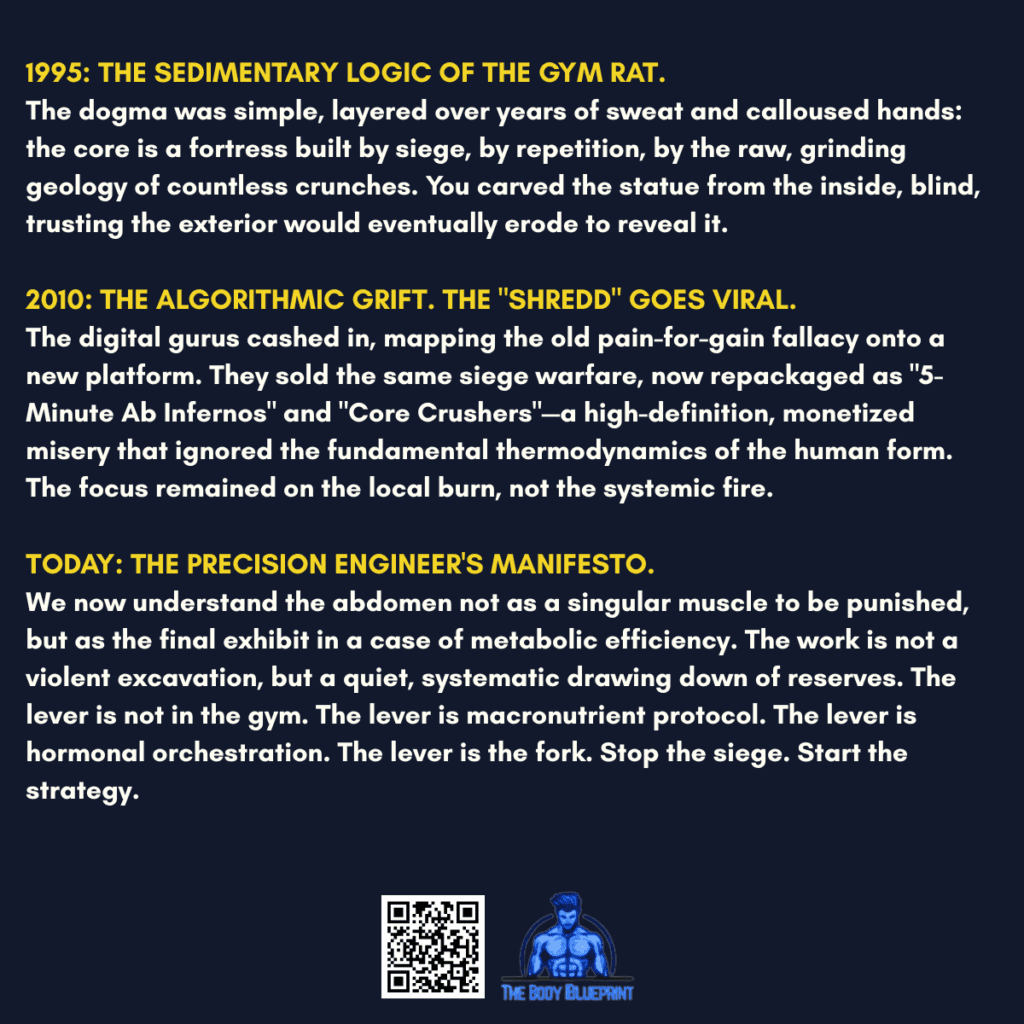
The endless crunch is a prayer to a god that doesn’t answer. It’s the hope that localized pain will yield a localized result. But the body doesn’t work on hope; it works on instruction. The signals you send with your fork—the protein that stokes the fire, the fiber that maintains peace, the water that quenches the system’s deepest needs—are the only instructions it truly understands.
The crunch is a question you’ve been asking for years. The answer was always in the kitchen, waiting for you to listen.