For tall lifters, the question of conventional vs sumo deadlift is more than a matter of preference; it’s a search for biomechanical efficiency. This guide cuts through the noise to provide a nuanced, science-backed analysis specifically for men with longer limbs, helping you decide which style aligns with your unique leverages to build strength and protect your body.
The Leverage Lock: It’s More Than Just Height
Let’s be direct: telling every tall lifter to pull sumo is a well-intentioned but flawed oversimplification. Your torso-to-limb ratio is the true king, not your height alone. You can be 6’4″ with a long torso and relatively short legs, making you a conventional deadlift natural. Conversely, you could be 6’1″ with incredibly long legs and a short torso, where sumo might feel like a gift from the lifting gods.
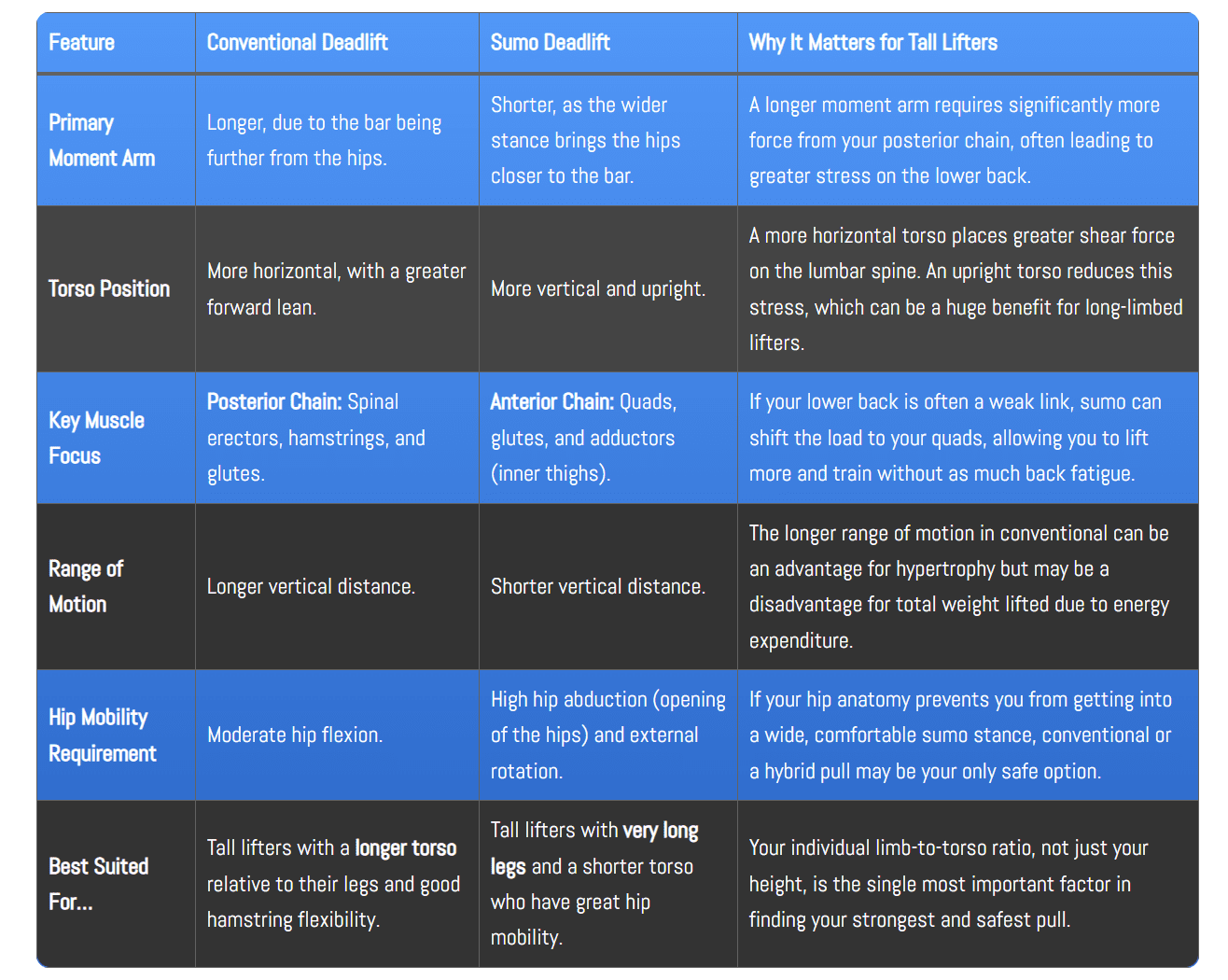
The core of the debate hinges on one physics principle: moment arm. This is the perpendicular distance from the axis of rotation (your hips) to the line of force (the barbell). A longer moment arm means your posterior chain must work harder to extend the hips.
- In a conventional pull, the barbell is out in front of the body, creating a longer horizontal moment arm at the hips and a significant moment arm at the lower back. Imagine a long lever; more force is required to move the load.
- In a sumo pull, the wider stance brings your hips closer to the bar and your torso more upright, shortening the moment arm at the hips and reducing stress on the lower back. Imagine a shorter lever; less force is required.
This is why the sumo deadlift is often described as more “technical” – it’s about creating a more efficient mechanical position from the start.
Conventional Deadlift: The Long Lever’s Challenge
The conventional deadlift is the classic test of raw posterior chain strength. For the right tall lifter, it’s unbeatable.
The Potential Advantages (If Your Levers Allow It):
- Greater Muscle Recruitment: It typically demands more from the spinal erectors, hamstrings, and lats, offering a potentially greater training stimulus for these areas.
- Raw Power Development: It teaches the body to handle load in a less mechanically advantaged position, building formidable mental and physical toughness.
- Often Stronger Off the Floor: For some, getting the bar moving from the floor is easier in conventional due to the more pronounced knee extension.
The Tall Lifter Hurdles:
The challenge for long-limbed individuals is the set-up. A long torso can help, but long legs and arms often force the hips very high, the chest nearly parallel to the floor, and place immense shear force on the lumbar spine. This isn’t inherently bad if you’re built for it and have the core strength of a marble column, but it’s a high-risk, high-reward position for many.
| Aspect | Conventional Deadlift |
|---|---|
| Best For | Tall lifters with a longer torso relative to their legs. |
| Hip Moment Arm | Longer, requiring more hip extension torque. |
| Back Stress | Higher, due to a more horizontal torso position. |
| Primary Movers | Spinal Erectors, Hamstrings, Glutes, Lats |
| Movement Pattern | A true full-body hinge. |
Sumo Deadlift: The Strategic Shortcut
Calling sumo a “shortcut” isn’t an insult; it’s a description of its mechanical efficiency. It allows a lifter to minimize the moment arm and lift more weight by optimizing their skeleton to bear the load.
The Potential Advantages (For the Right Tall Lifter):
- Reduced Shear Stress: The more upright torso drastically reduces the load on the lower back, making it a savior for tall lifters with spinal erectors that are often the weak link.
- Shorter Range of Motion: While not true for everyone (especially the very tall), bringing the hips closer to the bar often shortens the pull’s distance.
- Quad Dominance: The wide stance increases involvement from the quads and adductors (groin) to break the bar off the floor.
The Tall Lifter Hurdles:
The wide stance requires exceptional hip mobility (abduction and external rotation). Without it, you’ll struggle to get into a strong, upright position and will likely “good morning” the weight anyway. It also places unique demands on the adductors, which can be a new and potent source of soreness.
| Aspect | Sumo Deadlift |
|---|---|
| Best For | Tall lifters with very long legs and a shorter torso. |
| Hip Moment Arm | Shorter, creating a mechanical advantage. |
| Back Stress | Lower, due to a more vertical torso position. |
| Primary Movers | Quads, Glutes, Adductors, Upper Back |
| Movement Pattern | A powerful spread and stand. |
The Third Option: The Hybrid or Semi-Sumo Stance
The binary choice is a myth. Many tall lifters discover their sweet spot isn’t at either extreme, but in the middle ground—a hybrid or semi-sumo stance. This involves taking a stance that is wider than conventional but not as extreme as a full sumo pull. This modest adjustment can often provide just enough mechanical advantage to shorten the moment arm and ease lower back tension, without demanding the extreme hip mobility of a full sumo stance. It is a powerful and often overlooked tool for lifters who feel “stuck in between.”
The Decision Matrix: Finding Your Pull
Forget dogma. Your body holds the answer. Here’s how to find it.
1. The Simple Setup Test.
Load a bar with a moderate weight. Perform 2-3 reps with a conventional stance. Note how it feels. Is your back rounding immediately just to reach the bar? Are your hips shooting to the moon? Rest. Now, set up with a sumo stance. Your feet should be wide, toes pointed out. Can you get your hips close to the bar and keep your chest up without feeling a stabbing pinch in your hips? Which position feels stronger and more stable? Don’t forget to try a semi-sumo stance as part of this test.
2. Listen to Your Hip Anatomy.
This is the fresh angle many miss. The depth and orientation of your hip sockets (your femoral acetabular anatomy) are genetic. Some people are structurally built to squat and pull sumo wide. Others simply are not. If you feel a deep, bony impingement in your hips when you try to get into a sumo stance, no amount of mobility work will truly fix it. Your body is telling you no. Conventional, or a moderate hybrid stance, may be your path.
3. Consider Your Training Age.
If you are newer to lifting, there is a strong argument to start conventional. It teaches the fundamental hip hinge pattern that translates to so many other movements and builds a monster back. You can always experiment with sumo and hybrid stances later once you have a base of strength and body awareness.
The Final Verdict: It’s Not a Choice, It’s a Tool
The most empowering perspective for a tall lifter is to stop seeing this as a binary, lifelong choice. You are not a “conventional deadlifter” or a “sumo deadlifter.” You are a lifter who uses tools.
- Use Conventional to build a brutally strong posterior chain, improve your hinge mechanics, and test your absolute strength.
- Use Sumo to work around limb length, manage lower back fatigue, and potentially handle heavier loads.
- Use a Hybrid Stance to find your personal biomechanical sweet spot.
The best lifters understand their own mechanics. They might pull sumo in competition but use conventional deficits in training to attack their weaknesses. They listen to their bodies, not the comments section.
So, experiment. Film your sets. Pay attention to the signals your body sends you. The right pull isn’t the one that looks a certain way; it’s the one that feels powerful, safe, and allows you to get stronger, rep after rep, year after year.
Deadlift Biomechanics for Tall Lifters: Conventional vs. Sumo Comparison (DOWNLOAD)