The walking spiderman is a multi-planar mobilization drill engineered to unlock the “global” mobility of the hips and thoracic spine. Most athletes move in a single plane, leading to adductor tightness and thoracic rigidity that limits performance in explosive movements. By combining a deep lunge with an active reach, we perform a mechanical audit on your pelvic-thoracic synchronization, forcing the body to find stability at end-range positions.
Health & Safety: For educational purposes only. Not FDA evaluated. These exercises carry inherent risks; results vary by individual. Always consult a professional before starting any new physical regimen.
Walking Spiderman Setup: Calibrating the Deep Lunge
The foundation of the walking spiderman is a long, purposeful step that targets the hip flexors and adductors. Step forward into a deep lunge, placing both hands on the inside of your lead foot. If your lead heel lifts, you are leaking tension; revisit your ankle mobilization drills. For those with severe hip “pinching,” a pigeon stretch should be used as a prerequisite to clear the joint capsule.
Spiderman Stretch Cues: Engineering Multi-Planar Flow
As you lunge, drive the hips toward the floor while maintaining a rigid back leg. Many trainees allow the back knee to collapse, which eliminates the psoas stretch. In the Engineering Dept, we prioritize the “long spine” cue—reaching the crown of the head forward to prevent lumbar rounding. If you find this position difficult to hold, integrate 90-90 breathing to help relax the nervous system into the stretch.
| Mechanical Check | Correction Strategy |
|---|---|
| Rounded Upper Back | Think “proud chest”; pull the shoulder blades down and back. |
| Back Knee Sagging | Squeeze the back glute to lock the knee in full extension. |
| Lead Knee Cave | Gently push the lead knee outward to target the adductors. |
Thoracic Spine Mobility: Unlocking the Rotation
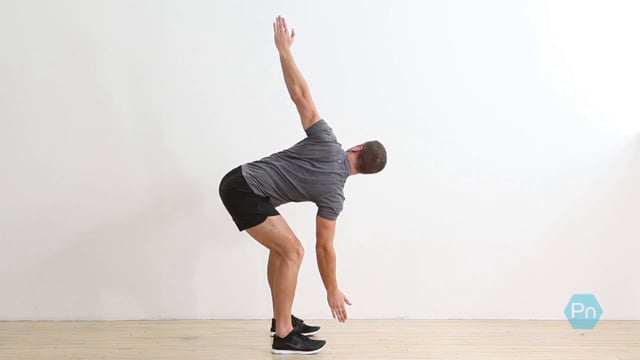
The advanced variation of the spiderman includes a rotation that targets the T-spine. By reaching the lead-side arm toward the ceiling, you decouple the ribcage from the pelvis—a critical skill for overhead lifting integrity. If you cannot rotate without the lead foot rolling, support your progress with active decompression. This drill is the ultimate precursor to high-velocity agility work.
“Mobility is the grease in the gears of performance. If you can’t hit the Spiderman position, you’re just grinding your joints in a locked cage. Engineer the reach and let the body move as a single unit.” — The Body Blueprint Team
Movement Lexicon: Spiderman Engineering Edition
Multi-Planar Mobility: The ability to move effectively across the sagittal, frontal, and transverse planes.
Thoracic Extension: The straightening of the mid-back—vital for shoulder health and width.
Adductor Recruitment: Engaging the inner thigh muscles, often neglected in standard lunge variations.
Pelvic-Thoracic Synchronization: The coordination between the hips and ribcage that prevents energy leaks during loaded squats.
Engineer Your Athletic Flow.
Stop moving like a statue. Master the walking spiderman and unlock the multi-planar mobility that drives elite athletic power.