For the Long-Limbed Lifter: Rewriting the Rulebook on Strength
If the standard advice in the gym has always felt slightly off, like you’re trying to fit into a world built for someone else, this is for you. This guide is for the tall lifter, the long-limbed individual, who understands that leverage is a double-edged sword and is ready to master it. We will provide scientifically-grounded training strategies and exercise modifications specifically tailored to your unique biomechanics. The outcome is a clear roadmap to achieving formidable strength and muscular development by working with your body’s design, not against it.
The conventional wisdom of weightlifting often assumes a common, compact frame. But for those of you with long femurs, a towering torso, and arms that seem to go on forever, blindly following that wisdom is a recipe for frustration, stalled progress, and even injury. Your levers are different. The physics of every movement changes. This isn’t a disadvantage; it’s simply a different set of rules. And once you learn them, you can play a completely different game.
The Science of Leverage: Why Your Frame is Different
At the heart of the challenge is basic physics, specifically the principle of mechanical advantage. Think of your bones as levers and your joints as fulcrums. With longer limbs, the resistance (the weight) has a longer distance to travel and creates a longer moment arm.
This means two critical things:
- Increased Range of Motion (ROM): You have to move the weight significantly farther than your shorter-limbed training partner. A full-depth squat for you is a monumental journey compared to their quick trip.
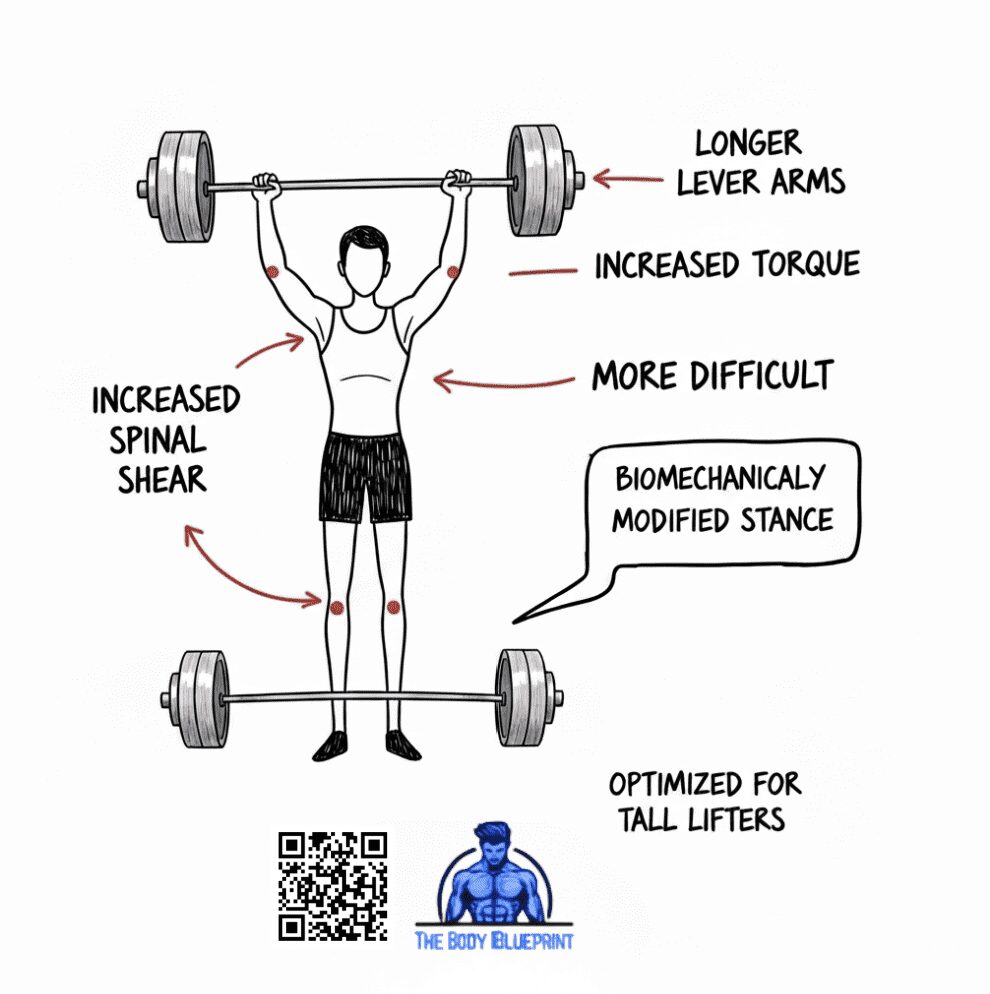
- Greater Torque: Torque is a force that causes rotation. At the bottom of a squat or deadlift, the barbell has a much longer “lever arm” to pull on, placing immense stress on your hips and spine. You are fighting a tougher battle against gravity on every rep.
This isn’t bro-science; it’s biomechanics. It explains why you might struggle to stay upright in a squat or why your deadlift feels like you’re moving the weight from another zip code. Acknowledging this is the first step toward crafting a powerful solution.
The Pillars of Effective Training for Long Frames
Your training philosophy must shift from maximizing load at all costs to optimizing efficiency and tension. It’s about finding the movements and angles that allow you to apply maximum force safely and effectively.
1. Exercise Selection: The Right Tools for the Job
Not all exercises are created equal for your body type. Your goal is to choose variations that shorten the moment arm and put your joints in a more powerful position.
- The Squat Dilemma: The low-bar back squat is often heralded as the king of lifts, but for long-femured lifters, it can be a tyrant. It often forces excessive forward torso lean, turning the squat into a stressful good-morning hybrid.
- Your Solution: Embrace the Heeled Elevation. Placing a small weight plate (about 0.5 to 1 inch thick) or wearing proper weightlifting shoes under your heels is non-negotiable. This small elevation allows for greater ankle dorsiflexion, which helps keep your torso more upright and dramatically reduces shear forces on the spine.
- Alternative Champions: Don’t be afraid to make these your primary movements:
- Safety Bar Squats: The cambered handle moves the load forward, promoting a more upright torso and saving your shoulders.
- Front Squats: This variation forces an upright posture and is brilliant for building quad and core strength.
- Goblet Squats: A fantastic teaching tool for patterning the squat movement with a vertical torso.
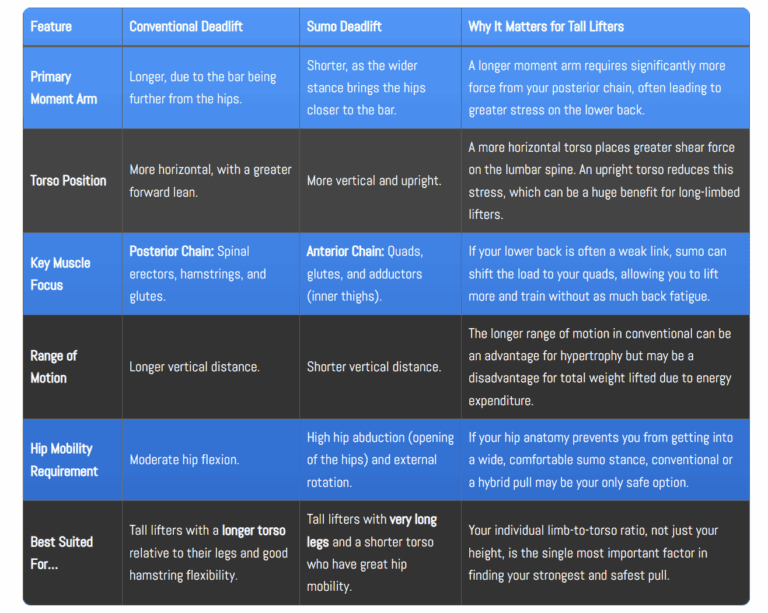
- Mastering the Deadlift: Your long arms are a secret weapon here. While you have to pull the bar farther, your setup is superior. Your longer arms mean your vertical reach to the bar is greater, allowing you to grip the bar without having to sink your hips as low as a shorter lifter. This permits a higher hip start position that aligns with a more vertical shin, creating a stronger and more efficient pulling angle for your back. You can set up with your hips in a powerful position and your spine in a more neutral alignment without rounding.
- Your Solution: The Conventional Deadlift is likely your best bet. Your anatomy allows you to be more efficient in this style compared to the sumo deadlift, which can be awkward with long legs. Focus on wedging yourself into the bar and driving with your legs, rather than yanking it off the floor.
- The Bench Press Puzzle: Long arms mean the bar has a long way to travel. The standard “touch the chest” command can put your shoulders in a vulnerable, deep-stretched position at the bottom.
- Your Solution: Control your range of motion. There is no rule that you must crush your sternum with the bar. Stop an inch or two short of your chest—where you feel strong and tight—and press from there. This maintains tension on the pecs and protects the shoulder joint. Also, maximize leg drive and back arch (within your mobility) to effectively shorten the distance the bar must travel.
- Rethinking the Barbell Row: The standard Bent-Over Barbell Row is notoriously difficult for taller lifters to perform correctly. The challenge lies in maintaining a flat back and a horizontal torso without excessive strain on the lumbar spine and hamstrings, a position that is biomechanically demanding with a longer torso.
- Your Solution: Chest-Supported Rows (like T-bar or machine variations) or Seal Rows (lying face-down on a bench) are superior choices. They completely remove the need for spinal stabilization, allowing you to focus purely on moving significant weight and hammering your back muscles with a safe, strict form.
- Stabilizing the Overhead Press: Pressing a barbell overhead with a long torso presents a unique bar path challenge. The bar must travel a long way forward to clear the head, which can put the shoulders in a vulnerable position and demand extreme core stability to prevent the rib cage from flaring and the lower back from over-arching.
- Your Solution: The Landmine Press is a fantastic alternative. The fixed arc of the movement provides a more natural bar path and is inherently safer on the shoulders. If using a barbell, focus on aggressive core and glute bracing to create a solid pillar of support. Seated Dumbbell Presses are also excellent, as they remove the lower body from the equation and allow you to work around your individual mobility.
2. Programming Nuances: Training Smarter
Your recovery demands are higher due to the greater time under tension and muscular stretch on each rep.
- Volume and Frequency: You may not recover as quickly from high-volume programs. Focus on quality over quantity. Fewer sets taken closer to failure with perfect form will yield better results than endless volume that leaves you battered.
- Rep Ranges: Don’t neglect higher rep ranges (8-15). The extended time under tension is a potent stimulus for hypertrophy and building work capacity in those long muscle bellies.
- Tempo is Your Friend: Incorporate slow eccentrics (lowering phases) and pauses. A 3-second descent on a squat forces control and builds strength throughout the entire range of motion, mitigating the “stretch reflex” you might rely on to bounce out of the bottom.
Exercise Modification Table for Tall Lifters
| Conventional Exercise | Common Challenge for Tall Lifters | Superior Variation or Modification |
|---|---|---|
| Low-Bar Back Squat | Excessive forward lean, lower back strain | Front Squat or Safety Bar Squat (with ~1 inch heel elevation) |
| Standard Deadlift | Difficulty setting hips low without rounding | Conventional Deadlift (leveraging long arms for a higher hip start) |
| Bench Press (to chest) | Shoulder impingement at bottom, long ROM | Bench Press with 1-2″ ROM reduction (don’t touch chest) |
| Barbell Row (strict) | Extreme difficulty maintaining a horizontal torso | Chest-Supported T-Bar Row or Seal Rows |
| Overhead Press | Long bar path, core stability demands, shoulder strain | Landmine Press or Seated Dumbbell Press (with focus on bracing) |
The Mindset: From Genetic Lottery to Leverage Lord
This journey requires a shift in perspective. You will not lift the same weights as your shorter, stockier friends—and that is okay. Comparing your numbers to theirs is a futile exercise. Your measure of success is progress against your previous self, using movements that respect your anatomy.
Your long limbs give you a phenomenal advantage in sports, aesthetics (when developed, those muscles have an incredible sweep), and in exercises like deadlifts, pull-ups, and rows. You are built for powerful pulling and a commanding presence.
Embrace the modifications. Celebrate the deep burn of a front squat held in the hole. Take pride in the controlled press that stops just short of the chest. You are not making excuses; you are applying advanced biomechanical principles to write your own rulebook. This is how you build a powerful, resilient, and impressive physique that is uniquely yours.