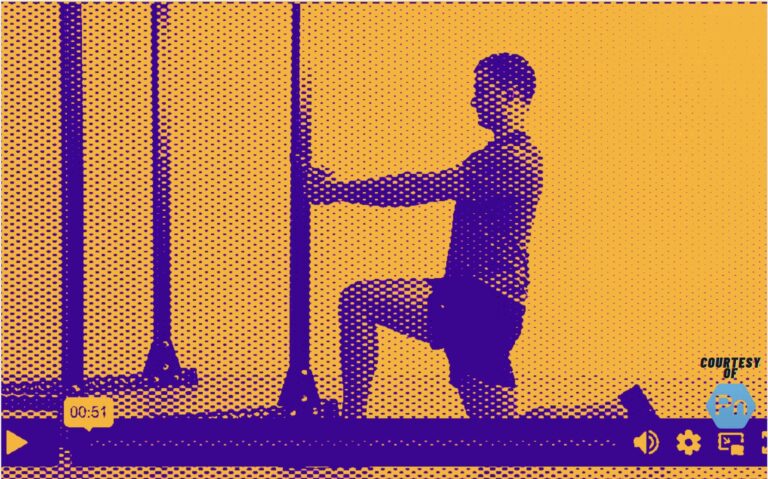
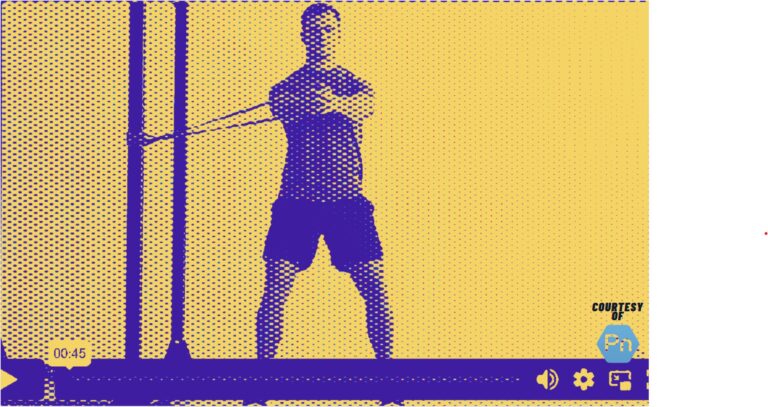
The Tall-Kneeling Band Lift is the ultimate diagnostic tool for connecting your hips to your shoulders diagonally. While standing exercises allow you to compensate with your knees and ankles, this movement removes the legs to expose the truth about your core stability.
Most lifters have a “power leak” between their upper and lower body. You might have strong legs and strong shoulders, but if your core cannot transfer force between them, you are weak. This exercise forces you to generate cross-body tension without arching your back or twisting your hips. It is not about how much weight you can move; it is about how much tension you can maintain without breaking your posture.
Important: If your knees hurt on the floor, use a pad. Pain inhibits glute activation. You cannot stabilize your hips if your brain is focused on knee pain.
Why Removing Your Legs Builds a Better Core
By kneeling, you reduce your base of support and eliminate the ability to use your ankles or knees to absorb force. This forces the glutes to do their job: extend the hips and lock the pelvis in place.
This creates “Reflexive Stability.” Your core must fire automatically to prevent you from falling over as you pull the band diagonally.
The Benefits at a Glance
| Advantage | The Payoff |
|---|---|
| Glute Integration | Forces the glutes to stay contracted to maintain an upright torso. |
| Anti-Extension | Teaches the abs to prevent the lower back from arching as the arms go overhead. |
| Diagonal Chain | Connects the opposite hip to the opposite shoulder (The Serape Effect), crucial for athletic power. |
Tall-Kneeling Band Lift Technique Guide
You are a statue from the waist down; if your hips wiggle, you are using momentum, not muscle. The movement happens exclusively at the shoulders and thoracic spine.
Step-by-Step Execution
- The Setup: Kneel on both knees (Tall Kneeling). Anchor the band low (to your side).
- The Lock: Dig your toes into the ground (dorsiflexion). Squeeze your glutes hard to push hips forward. Ribs down.
- The Grip: Grab the band with both hands. Arms straight. Band should be near your hip.
- The Lift: Pull the band diagonally across your body, up towards the opposite shoulder.
- The Finish: Extend the arms fully overhead. Eyes follow the hands.
- The Return: Control the descent. Do not let the band snap you down.
“Think of your body as a pillar. The wind (the band) tries to blow the pillar over. Your job is to remain vertical. If you lean back to lift the weight, you have broken the pillar.”
— Eugene Thong, CSCS
Common Mistakes That Kill Stability
If you feel this in your lower back, you have turned off your abs. The primary error is substituting lumbar extension (arching) for shoulder mobility.
- The Lean Back: Arching the spine to get the band overhead. Fix: Keep the ribs pinned to the pelvis.
- Glute Amnesia: Letting the hips sag back toward the heels. Fix: Keep hips fully extended (tall).
- Using Arms Only: Bending the elbows to “curl” the weight. Fix: Keep arms straight to force the core to rotate.
Programming & Optimization
This is a motor control exercise, not a mass builder. Use it to prime the system before heavy lifting or to correct posture on off-days.
Sample Protocol
| Goal | Sets/Reps | Context |
|---|---|---|
| Warm-Up | 2 x 8-10/side | Before Deadlifts or Overhead Press. |
| Core Strength | 3 x 12/side | Slow tempo (3 seconds up, 3 down). |
Performance Stack
Core stability relies on neural drive and tissue quality.
- Blood Flow: Diagonal patterns require systemic coordination. A Nitric Oxide Booster enhances blood flow to the stabilizers.
- Recovery: If your hips are too tight to kneel tall, you need tissue work. Use the Hypervolt Go 2 on your quads before training.
- Foundation: You can’t train if you are under-recovered. Prioritize sleep hygiene and solid diet strategies to keep inflammation low.
Tech Alternative
Smart gyms are superior for diagonal lifts because the cable resistance is incredibly smooth. If you want to perform this with digital precision, check out our comparison of Speediance vs Tonal vs Vitruvian or read our guide to the best smart home gyms.
The Verdict
The Tall-Kneeling Band Lift is the lie detector for your kinetic chain. It forces you to stabilize without your legs. Kneel down, squeeze the glutes, and link your body together.