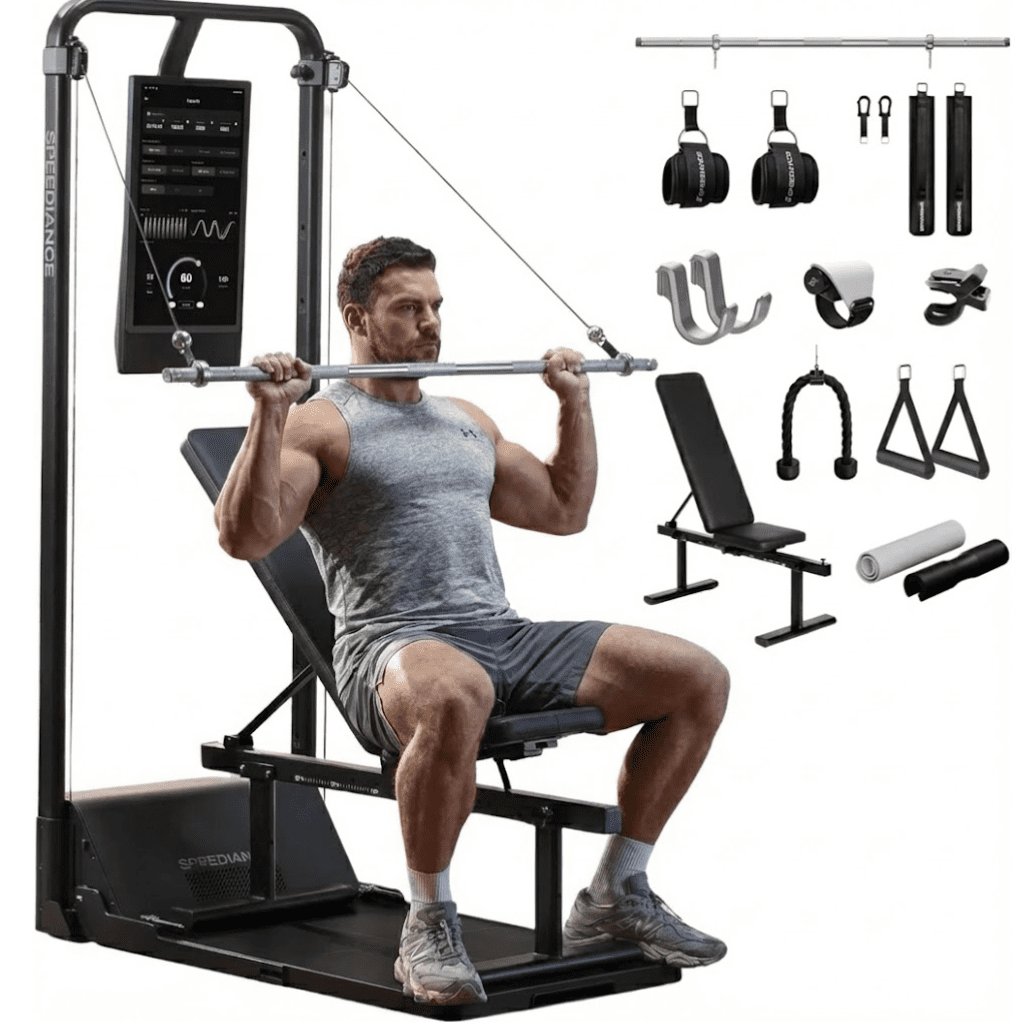
The Speediance All‑in‑One Smart Home Gym is built for lifters who want real strength training — not another “connected fitness toy” that looks good in a living room but folds under pressure.
This 2026 Buyer’s Guide breaks down resistance, biomechanics, training modes, accessories, installation, drawbacks, and whether Speediance is the right investment for your home gym.
Disclaimer: As an Amazon Associate, I earn from qualifying purchases — at no extra cost to you. It’s like I get a little something for doing the heavy lifting on research. Fair deal? Let’s get into it.
Planning your home gym layout? The Speediance Setup & Installation Guide covers spacing, ceiling height, and mounting options.
Speediance Overview & Key Specs
Speediance is a compact, digital‑weight training system designed to replace an entire gym in one footprint. The 2026 model includes updated firmware, smoother cable tracking, faster rep recognition, and the new Gym Monster 2 motor revision — which delivers more consistent tension under heavy eccentric loads.
- Resistance: Up to 220 lb digital weight
- Modes: Eccentric, Chains, Constant, Standard, Spotter
- Footprint: Compact freestanding or wall‑mounted
- Connectivity: Wi‑Fi + updated 2026 app UI
- Workouts: Strength, hypertrophy, HIIT, mobility
- Accessories: Bench, bar, handles, belt squat, more
Digital Weight System: How Speediance Actually Feels
Digital weight isn’t just “cables with a motor.” It feels different — in a good way. There’s no slack, no dead zones, and no momentum to cheat with. The machine fights you from the moment you pull until the moment you return.
How It Works (Real Lifter Explanation)
Instead of gravity, Speediance uses a motor to generate resistance. That means:
- No more fumbling with pins or plates mid‑superset.
- No clanking iron — your neighbors will thank you.
- No “easy part” of the rep — the machine keeps tension on you the whole time.
“Digital weight removes the cheat points. There’s no momentum, no coasting, no ‘easy part’ of the rep. If you’re used to cable stacks, this feels like someone turned the tension dial to ‘always on.’”
— Eugene Thong, CSCS
Resistance Modes (With Real‑World Use Cases)
- Standard: Your bread‑and‑butter cable stack feel.
- Eccentric: Adds weight on the way down — great for breaking plateaus.
- Chains: Gets heavier as you extend — mimics chain‑loaded barbells.
- Constant: No momentum, no cheating — brutal for rows and presses.
- Spotter: Saves you from getting pinned under the bar on grinders.
Training Modes & Programming (What Actually Works)
The 2026 Speediance app update added better rep tracking, smoother UI, and more strength‑focused programs. The machine isn’t trying to be Peloton — it’s trying to be your cable stack, squat rack, and trainer in one.
Built‑In Programs (Ranked by Usefulness)
- Strength Blocks: The most legit programming on the platform.
- Hypertrophy Splits: Great for chest/back/legs cycles.
- HIIT: Good for conditioning, but not the main attraction.
- Mobility: Surprisingly solid for shoulder health.
“The biggest advantage of smart gyms is consistency. When the resistance curve is predictable, you can actually measure progress rep‑to‑rep. That’s something most home setups can’t deliver.”
— Eugene Thong, CSCS
Real‑Time Metrics (What Matters)
Ignore the fluff — these are the metrics lifters actually use:
- Range of Motion: Helps fix half‑reps.
- Time Under Tension: Great for hypertrophy.
- Power Output: Useful for explosive work.
- Symmetry: Helps identify left/right imbalances.
Who Speediance Is For (And Not For)
Speediance Is Perfect For:
- Apartment lifters who need quiet, compact equipment.
- Busy professionals who want guided programming.
- Anyone who wants a full gym without racks, plates, or noise.
- People who prefer cables over barbells.
Speediance Is NOT For:
- Powerlifters chasing 500+ lb deadlifts.
- Lifters who prefer the feel of iron plates.
- Homes with unstable Wi‑Fi (rep tracking will lag).
- People who hate subscription ecosystems.
“Speediance is ideal for lifters who want structure without sacrificing autonomy. You still control the effort — the machine just removes the friction points that stop most people from training consistently.”
— Charles Damiano, B.S. Clinical Nutrition
Potential Drawbacks (Read Before You Buy)
- 220 lb max resistance: Enough for most lifters, but not for elite squat/deadlift numbers.
- Digital weight feels different: Some lifters say it’s “too smooth” compared to iron.
- Accessories add up: The bench and bar are basically mandatory.
- Wi‑Fi dependency: Lag can affect rep tracking and mode switching.
“Digital weight is incredibly effective, but it’s not a perfect substitute for heavy barbell work. If your goals involve maximal strength — 1RMs, powerlifting totals — you’ll eventually need iron.”
— Eugene Thong, CSCS
Speediance vs Tonal vs Vitruvian (2026 Comparison)
| Feature | Speediance | Tonal | Vitruvian |
|---|---|---|---|
| Max Resistance | 220 lb | 200 lb | 440 lb |
| Subscription | Optional | Required | Optional |
| Installation | Freestanding or wall | Wall‑mount only | Freestanding |
| Footprint | Compact vertical | Wall panel | Platform |
“From a nutrition and recovery standpoint, the best tool is the one you’ll use consistently. Speediance lowers the barrier to entry — no setup time, no intimidation factor, no excuses.”
— Charles Damiano, B.S. Clinical Nutrition
Related Speediance Guides
- Setup & Installation Guide
- Training Modes & Workout Guide
- Speediance vs Tonal vs Vitruvian
- Accessories & Attachments Guide
The Iron Lexicon: Smart Gym Edition
- Digital Weight
- Motor‑generated resistance that maintains tension throughout the entire movement, eliminating momentum and dead zones.
- Eccentric Overload
- Heavier resistance during the lowering phase to build strength, control, and tendon resilience.
- Chains Mode
- A resistance curve that increases as you extend, mimicking chain‑loaded barbells and accommodating strength curves.
- Auto‑Spotting
- Automatic weight reduction when reps slow or form breaks down, preventing failed reps and improving training safety.
- Time Under Tension (TUT)
- The total duration a muscle is under load during a set — a key driver of hypertrophy.
- Symmetry Tracking
- Real‑time measurement of left/right output to identify imbalances and improve movement quality.
- Constant Mode
- A setting where resistance remains identical throughout the entire range of motion, removing momentum and forcing strict form.