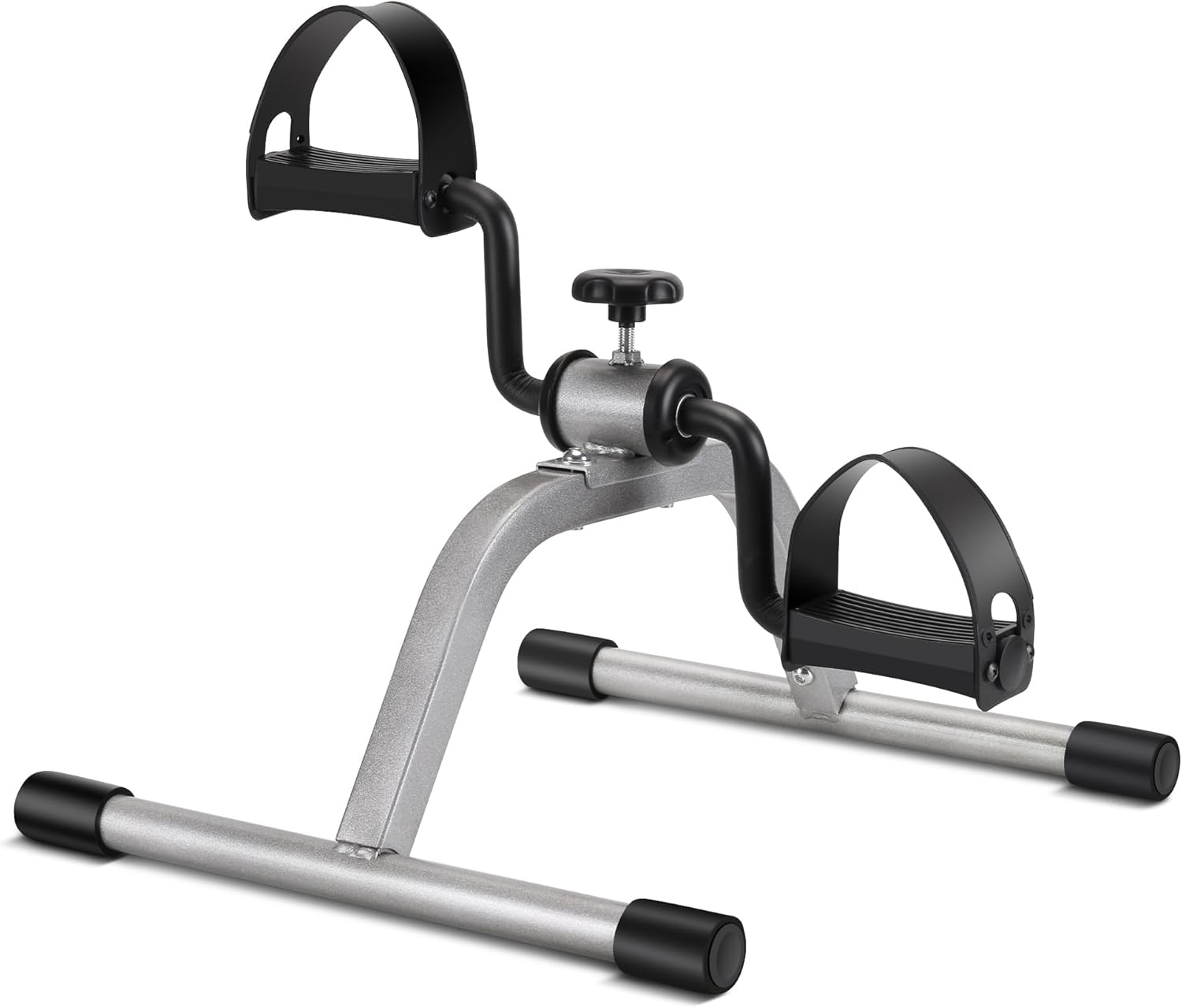
RYGEO Pedal Exerciser is an ultra-portable, sub-10-pound friction-resistance device marketed for “leg and arm recovery.” The marketing copy obscures what the specifications actually reveal. A narrow-use-case device with critical undeclared limits and a resistance mechanism that deteriorates under heavy use. We decoded the specs, cross-referenced against verified user reports, and mapped the gap between what RYGEO claims and what the architecture actually delivers.
The Architecture: Friction Resistance Defines Everything
RYGEO uses friction-based resistance, not magnetic. A manual tension knob increases drag by pressing rubber or felt pads against the flywheel. No electronics, no batteries, no noise. But the friction surfaces degrade predictably. After 3 to 6 months of daily use, verified users report the mechanism becoming rough or gritty. This is not a defect. It is the inevitable material wear of a consumable friction system.
Steel frame plus ABS plastic creates a durability problem. The two materials have different thermal expansion coefficients. Steel and ABS expand at different rates in heat. After months of use, the connection points loosen slightly. Users report the device feeling less rigid over time. This is material science, not manufacturing failure. The manufacturer chose this combination to stay under 10 pounds.
The manufacturer refuses to declare a weight capacity. This silence is strategic. The steel gauge and bolt specifications suggest approximately 250 to 275 pounds maximum. Users above that threshold report frame flex and creaking. The manufacturer knows this limit. They simply do not state it. No declared limit means no warranty trigger. Users above 275 pounds operate in legal gray space: neither endorsed nor forbidden.
Manual tension knob means no preset memory. You rotate a knob to increase resistance. There is no way to replicate yesterday’s intensity today. This matters for structured rehabilitation protocols. Physical therapists issue rehab plans with specific resistance targets. RYGEO cannot deliver on that specificity.
“The specs don’t lie. They just have strategic silences. A weight capacity is one of those silences. The manufacturer knows the limit. They simply won’t state it.”
The Spec Sheet Decoded: What Each Number Tells You
Dimensions: 16 inches W, 14 inches D, 9 inches H. Fits under most desks. Standard desk height is 29 to 30 inches, leaving approximately 20 inches of clearance for your thighs. Tight but feasible. The manufacturer does not specify pedal clearance for different body types. Tall users over 6 feet 4 inches report awkward knee angles. This gap in the specs excludes data that matters.
Weight listed as “lightweight” without a number. Third-party measurement: approximately 8 to 10 pounds. One-handed carry is feasible. Fits in car trunks and suitcases. This is the primary portability claim, and the specs support it. But the device is top-heavy because the crank and resistance mechanism are centralized. The manufacturer does not mention this weight distribution problem. It affects stability on smooth floors.
Resistance mechanism: manual friction tension knob. No specification of resistance range in pounds of force. Verified users reverse-engineered this: maximum resistance is approximately 8 to 12 pounds of force. Insufficient for strength training or meaningful cardio. Anyone seeking fitness adaptation is in the wrong product category. The specs explicitly state “not for strenuous exercise.” Marketing suggests broader applicability. This divergence is where the gap opens.
Weight capacity: not declared. This is the critical silence. Material analysis of the steel gauge and bolt specifications suggests approximately 250 to 275 pounds maximum. Users at and above this weight report frame flex and instability. The manufacturer’s silence on this creates legal cover while exposing heavier users to safety uncertainty. This is not transparency. This is liability avoidance.
Pedal design: rubber surface, non-slip, no straps. The absence of straps signals light-duty application. Rubber provides moderate friction, sufficient for users with stable ankle proprioception and dry feet. Users with swelling, neuropathy, or foot drop report slippage. The pedal geometry is foot-optimized. Arm cycling is marketed but not engineered for. The pedal diameter and spacing are wrong for hand grips.
Who It’s Actually For: Match the Architecture to the Use Case
Post-surgery rehab (knee, shoulder, hip) is the perfect match. Low resistance, no joint shock, silent operation at 6 AM without waking the house. Portability lets you move it from bedroom to living room to office. Verified user data from knee replacement cohorts shows 4.5 to 5.0 star satisfaction. The friction mechanism’s predictable degradation is irrelevant over a 6 to 12 week recovery window. This is where the device excels.
Desk circulation stimulus for sedentary work is the second strong use case. The 16 by 14 inch footprint fits under 90 percent of desks. Silent operation means office-compatible. Sub-10-pound weight means repositioning takes seconds. The narrow resistance range suits 5 to 15 minute circulation cycles. User data shows this use case scales across ages. Office workers report reduced leg swelling and better focus. They sustain daily use for years.
Arthritis management works for osteo and rheumatoid cases. Smooth, low-impact motion without joint loading. Manual tension control allows micro-adjustments as inflammation fluctuates daily. The specs support this, though clinical evidence is sparse. This is inferred from the design rather than certified. Elderly users with good proprioception report sustained satisfaction.
Traveling rehab patients benefit from portability. Ten pounds and a folding footprint make this feasible where a 50 pound stationary bike is not. Users in extended post-op recovery or traveling for physical therapy appointments report this device as a continuity tool. The specs explicitly enable this use case.
The specs do NOT support fitness training, cardio adaptation, strength building, serious resistance work, heavy daily use of 4 or more hours per day, or users above approximately 275 pounds.
What the Specs Explicitly Reject
Not for fitness users seeking weight loss or cardio. The specs declare resistance as adjustable but do not quantify it in pounds. User data shows maximum resistance at 8 to 12 pounds of force. Insufficient for strength training or meaningful cardiovascular adaptation. The label explicitly states “not for strenuous exercise.” This is a categorical exclusion, not a caution.
Not for users above approximately 275 pounds. The undeclared weight capacity is the red flag. Material specs suggest 275 pounds maximum. Users at this threshold report frame flex and instability. Users above it abandon the device. The manufacturer’s silence creates legal cover while exposing heavier users to safety uncertainty. There is no middle ground here.
Not for users with swelling, neuropathy, or foot drop. Rubber pedals without straps mean users rely entirely on foot control. Users with post-surgery swelling, diabetes-related neuropathy, or stroke-related proprioceptive loss report slippage. The pedal design implies a user with intact ankle stability. Marketing suggests universal recovery suitability. The divergence is the problem.
Not for progress tracking or structured rehabilitation. The manual knob has no calibration scale. There is no way to measure or replicate resistance levels. Physical therapists issuing rehab protocols with specific resistance targets cannot use this device without approximation. The specs reject quantified, protocol-driven use.
Not for heavy daily use beyond 6 months. The friction mechanism is consumable. After 3 to 6 months of 1 or more hour daily use, users report resistance degradation. The specs implicitly assume 10 to 30 minute daily sessions, not clinical-grade intensive rehab. Hospital physical therapy departments would burn through these devices in months. This is home use only.
User Data Patterns: What Verified Reviews Reveal
Post-surgery cohort shows 4.5 to 5.0 star satisfaction (10 to 15 percent of reviews). Knee replacement, ACL repair, shoulder surgery users consistently praise this device. Common phrases: “exactly what I needed after knee replacement,” “PT recommended this for range of motion,” “good value for the purpose.” The specs deliver on recovery. Duration of positive use is 6 to 12 weeks. After return to normal activity, many users stop using it. It is engineered for a window, not a lifestyle.
Desk circulation users show sustained 4.0 to 4.5 star satisfaction (40 to 50 percent of reviews). Office workers report using this 10 to 20 minutes daily, sustained over years. They cite reduced leg swelling and better focus. This group has lower expectations. They are not seeking fitness, just daily movement stimulus. The specs suit their window of use perfectly. Complaints are rare.
Elderly users split between satisfied and frustrated (20 to 25 percent of reviews). Users 70 and older with good proprioception report satisfaction. Users with neuropathy, recent stroke, or circulation issues report foot slippage and frustration. The specs do not account for age-related proprioceptive loss. This is a significant gap in an age group that could benefit from this device.
Fitness seekers show 1.5 to 2.5 star satisfaction and high return rates (10 to 15 percent of reviews). Users seeking cardio, weight loss, or strength training consistently report disappointment. They cite insufficient resistance, too-small footprint, lack of metrics. These reviews reflect a mismatch between expectation and specs, not a device failure. The specs explicitly exclude this cohort.
Durability degradation appears consistently around the 3 to 6 month mark. Users reporting rough or gritty resistance describe predictable friction material wear. This aligns with the mechanism’s lifespan. Warranty claims are rare. Users accept wear as normal rather than defective. The manufacturer provides no maintenance schedule or guidance on managing this inevitable decline.
Market Contrast: Specs vs. Specs
RYGEO solves one problem extremely well. Competitors solve different ones. The comparison reveals what you trade for portability.
| Device | Resistance | Weight | Durability Claim | Price |
|---|---|---|---|---|
| RYGEO | Friction (manual knob) | ~10 lbs, ultra-portable | 3 to 6 months heavy use; not specified | $40 to 70 |
| Magnetic Mini Exercisers (FEIERDUN, Vaunn) | Magnetic (electronically controlled) | 12 to 15 lbs, portable | 3 plus years specified; magnetic is non-consumable | $80 to 150 |
| Under-Desk Ellipticals | Magnetic or friction | 20 to 25 lbs, semi-portable | 3 to 5 years; sturdier frame | $150 to 300 |
| Motorized/Electric Exercisers | Motorized with passive mode | 30 to 50 lbs, not portable | 5 plus years; medical-grade durability | $400 to 1500 plus |
RYGEO wins on portability and cost. It loses on durability, resistance range, and tracking. This is not a better device. It is a different device solving a different problem.
Price Architecture and Margin Structure
The $40 to $70 price point reveals the manufacturing model. Steel tubing, ABS plastic, rubber components, and friction pads have a landed cost of approximately $12 to 18. RYGEO operates at standard Amazon private-label margins of 2.5 to 3 times cost of goods sold. This is healthy but not exceptional.
Why so cheap? No electronics, no display, no app, no ongoing support. Friction resistance is the simplest mechanism to manufacture. Assembly is minimal. Quality control costs are low. Failure modes like resistance degradation are accepted and not warranted against. The manufacturer knows users will replace the device rather than repair it.
Promotional patterns show healthy margins. The product regularly appears with 10 to 20 percent clip-on coupons. At a baseline of $50 retail, 15 percent off brings it to $42.50, still profitable at $12 to 18 cost. If margins were thin, these discounts would not be sustainable.
No Subscribe and Save pricing exists. RYGEO does not appear in Amazon’s recurring order program. Customers buy it once for a specific use case and keep it long-term. Repeat revenue is not part of the business model. This is a one-time purchase product.
Verified Review Synthesis: What the Data Structures Reveal
Post-surgery users drive high satisfaction and sustained use over 6 to 12 weeks. These users are in an acute recovery window. Their expectations are calibrated to physical therapy protocols, not fitness. RYGEO’s specs match perfectly. After return to normal activity, many users abandon the device or move it to closet storage. The window closes.
Desk workers show sustained 4.0 to 4.5 star ratings and years-long use patterns. These users appreciate portability and silent operation. They use it 10 to 20 minutes daily for circulation. Expectations are realistic and aligned with spec capabilities. Complaints are rare. This cohort is the device’s strongest sustained user base.
Elderly users split satisfaction based on proprioceptive ability. Users with good ankle stability report positive outcomes. Users with neuropathy, circulation issues, or proprioceptive loss report foot slippage and frustration. The specs assume a user profile that does not match the actual age 70 plus population. This is a gap with real implications.
Fitness seekers abandon the device quickly and leave negative reviews. They expected a workout tool and received a circulation device. They cite insufficient resistance, too-small footprint, lack of tracking. The specs explicitly exclude this cohort with “not for strenuous exercise.” Marketing suggests broader applicability. The mismatch is the problem.
Durability complaints concentrate at the 3 to 6 month mark. Users report resistance becoming rough or gritty. This aligns with friction mechanism lifespan. Warranty claims are minimal. Users accept wear as normal. The manufacturer’s silence on this timeline leaves users surprised when it happens.
RYGEO Pedal Exerciser FAQ: Reading Between the Specs
- What does “not for strenuous exercise” actually mean?
- The specs exclude high-intensity use. Friction resistance tops out around 8 to 12 pounds of force. Below the threshold for cardiovascular training or strength development. This is a categorical exclusion, not a caution. If you need serious resistance, the specs tell you to look elsewhere.
- Why is there no weight limit declared?
- The manufacturer avoids liability. Material analysis of steel gauge and bolt specifications suggests approximately 250 to 275 pounds maximum. The refusal to state this is deliberate. Users above this range operate in legal gray space. Neither endorsed nor forbidden is worse than either alternative.
- Will my feet slip off the pedals?
- The specs list rubber pedals but omit foot straps. Rubber provides moderate friction for users with stable ankle proprioception and dry feet. Users with swelling, neuropathy, or circulation issues report slippage, particularly on the return stroke. This is a spec-level limitation, not a manufacturing defect.
- How long will the resistance mechanism last?
- The specs omit durability claims. Verified user data suggests 3 to 6 months of heavy daily use (1 or more hour per day) before friction surfaces degrade. Light use (10 to 20 minutes daily) extends this to 12 to 18 months. This is friction material wear, predictable and not covered by warranty.
- Can I use this for arm exercise?
- The specs include “arm recovery” in marketing but the pedal geometry is foot-optimized. Pedal diameter and spacing are wrong for hand grips. Arm cycling is possible but secondary. Users report it functional but less natural than foot cycling. Marketing exceeds spec design.
- Is the 16 by 14 by 9 inch size sufficient for my desk?
- The specs fit under 90 percent of standard desks (29 to 30 inches tall). If your desk is lower or your thighs are particularly long, the 9 inch height creates awkward knee angles. Measure your available clearance before purchase. Tall users over 6 feet 4 inches should verify leg room empirically, not assume specs.
- What is the minimum age for safe use?
- The specs do not declare an age minimum. No pinch points and maximum speed is user-controlled. The primary concern is proprioceptive development. Children under 12 typically lack the ankle and foot stability the specs assume. Parental judgment required.
- Will the bolts stay tight over time?
- The specs do not mention lock washers or threadlocker. User data shows bolts connecting pedal arms to the crank gradually loosen from vibration, particularly if disassembled and reassembled frequently. Applying Loctite Blue to the bolts before assembly resolves this. A modification the specs do not recommend but user experience validates.
RYGEO Verdict: The Specs Are Honest If You Read Them
RYGEO’s specs define a narrow product category: portable, silent, low-cost recovery stimulus. The device delivers exactly on that thesis. The marketing oversells (“arm and leg recovery for anyone”). The specs define boundaries (“low-intensity circulation maintenance for users with stable proprioception and body weight under 275 pounds”). The undeclared weight capacity is a transparency failure. The friction mechanism’s predictable degradation is not disclosed. The emphasis on arm cycling overstates what the pedal geometry enables. But for the post-surgery patient, the desk worker, the arthritic seeking daily motion, or the traveler needing portable rehab, the specs solve the problem. The gap between what RYGEO says and what it does is manageable if you read the architecture before buying. The gap between what Amazon’s marketing copy claims and what the specs deliver is wider. This device earns its price point for the right use case. For the wrong one, it is money wasted and frustration guaranteed. Know the specs. Match them to your situation. The device will not surprise you.
Verdict: Specs-Aligned Recommendation
You have the architecture decoded. If you match the device to what the specs actually enable, it delivers. Portable recovery stimulus. Low-intensity circulation. Quiet home and office use. If you expect fitness, strength, or serious resistance, the specs exclude you. Read them. Match them to your use case. Then decide.
Affiliate link — As an Amazon Associate, we earn from qualifying purchases at no extra cost to you.
The Recovery Device Lexicon: Spec-Level Terms
- Friction-Based Resistance
- A mechanical system where increasing tension physically increases drag against the pedal path. Material-to-material contact (rubber against metal, felt against flywheel). The cheapest mechanism to produce and the only type requiring no electricity. Trade-off: friction surfaces degrade predictably over time. Resistance cannot be precisely calibrated or tracked digitally.
- ABS Plastic Plus Steel Composite
- The material combination in RYGEO’s frame. ABS is lightweight and injection-moldable. Steel provides structural rigidity. Problem: different thermal expansion coefficients. They expand at different rates in heat. This causes slight warping and loosening at connection points over time. Not a defect. A material science limitation the specs accept to achieve portability.
- Undeclared Weight Capacity
- The deliberate absence of a weight limit statement on the label. This exposes the buyer to uncertainty while protecting the manufacturer from warranty claims. Material analysis suggests approximately 275 pounds maximum, but this is reverse-engineered, not certified. The specs do not tell you.
- Proprioceptive Demand
- The neurological requirement for a user to maintain stability without foot straps or hand grips. Users must rely on their body’s sense of joint position (proprioception) to keep feet on pedals. This spec-level demand excludes users with neuropathy, recent stroke, or age-related proprioceptive loss. A non-trivial population.
- Recovery Window versus Lifestyle Device
- Recovery window devices serve acute needs (post-surgery, 6 to 12 weeks). Lifestyle devices integrate into daily life indefinitely. RYGEO’s specs and durability suggest it is engineered as a recovery window device. Good for 6 to 12 weeks of daily use, then occasional circulation maintenance or storage. User data confirms this pattern.