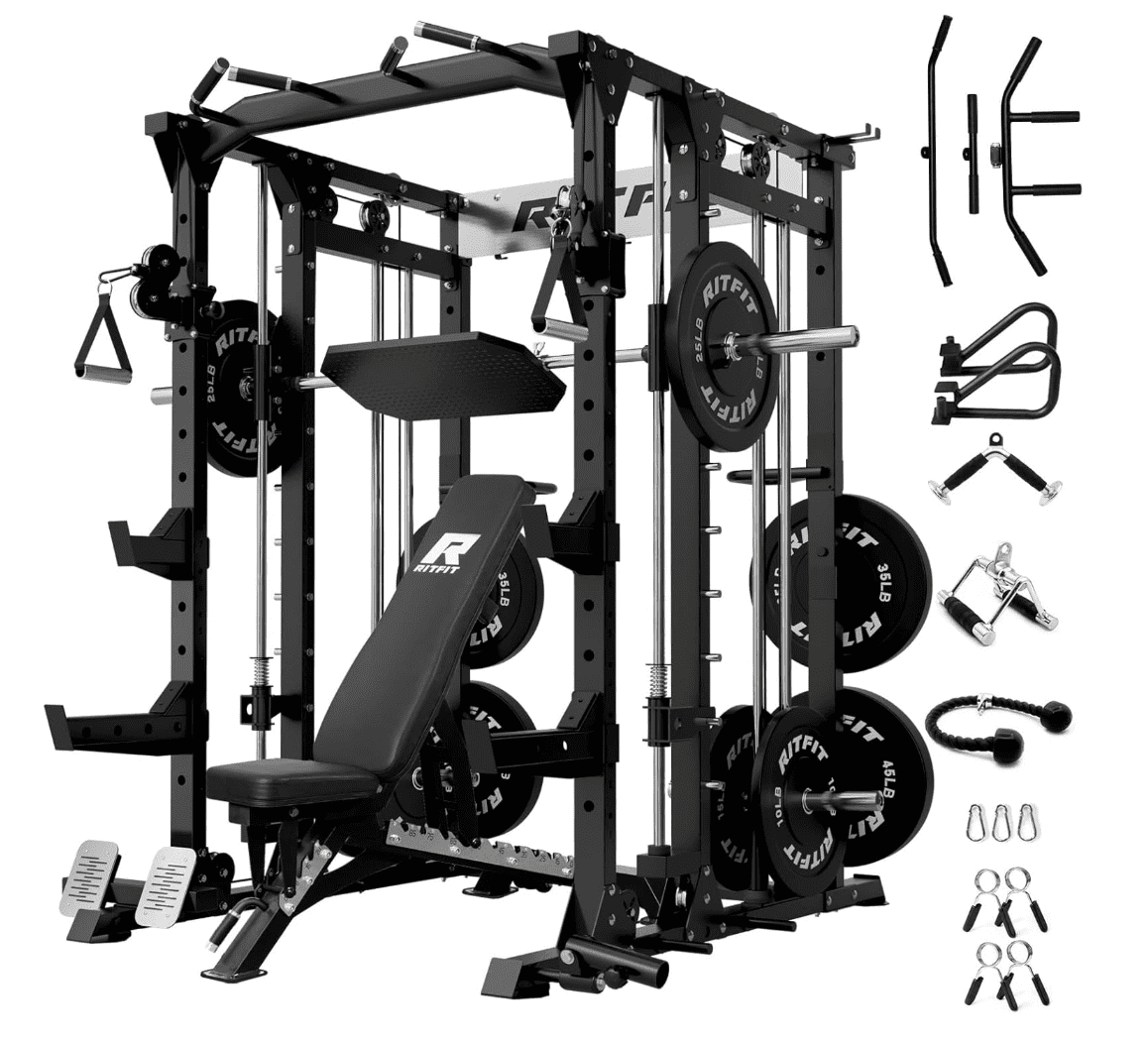
The RitFit Buffalo All-in-One Smith Machine fuses a 2-inch-by-2-inch steel frame with an integrated dual-pulley cable crossover and a linear-bearing Smith guide-rod system into a single plate-loaded station. This is the Swiss Army cage. The one you buy when you want a Smith machine, power rack, lat pulldown, cable crossover, landmine, and dip station without five separate footprints consuming your garage. But budget engineering means 2×2 steel instead of 3×3. A 2:1 pulley ratio instead of 1:1. And assembly that will test your patience like a flat-pack furniture bender. We dissected the guide-rod glide quality, cable smoothness, and real-world training ceiling to determine if the Buffalo earns its reputation as the best value-per-square-foot in the home gym market.
Comparing all-in-one systems? Read our Speediance Smart Home Gym Buyer’s Guide to see how digital resistance stacks up against plate-loaded steel. For a deeper dive into budget power racks, check our pooboo P43 Power Cage review and Sunny Health Power Zone breakdown.
The Build & Engineering: 2×2 Steel, Linear Bearings, and a 2:1 Pulley Ratio
RitFit constructs the Buffalo around a 2-inch-by-2-inch steel upright system that integrates a Smith machine guide-rod assembly and a plate-loaded dual-cable crossover into one welded base frame. The uprights are not 3×3 11-gauge monster steel. They are 2×2. This is the defining structural compromise of the Buffalo. It keeps cost down. It keeps weight manageable for assembly. It also caps the powerlifting ceiling. For 90% of home lifters, 2×2 steel is more than sufficient. For the 500-plus-pound squatter, it becomes the bottleneck. This is the gym equipment equivalent of a pickup truck with a truck-bed cap: it hauls your groceries, your furniture, and your weekend warrior ambitions without a second vehicle. The 2×2 steel will rattle when you push it hard, but it won’t fold.
- 2×2 Steel Uprights with Welded Base: The frame stakes its ground with a welded base platform that provides lateral stability the bolt-together bottom crossmembers of budget racks cannot match. 2×2 steel rates sufficient for static loads up to approximately 700-1000 pounds depending on bolt quality and assembly precision. This is not a powerlifting competition rack. It is a general strength training station with a structural ceiling that most home lifters will never approach. For those who need serious capacity, consider a dedicated 2000lb-capacity power cage.
- Linear Bearing Smith Machine Guide Rods: The Smith bar rides on linear ball-bearing carriages along chrome guide rods. This is meaningfully better than the plastic-bushing systems found on sub-roughly $500 Smith machines. The carriage glides with minimal stick-slip friction. It is not commercial-gym silent, but it avoids the grinding, catching, and jerking that makes cheap Smith machines feel dangerous under load. Wipe the guide rods with a dry cloth monthly. Apply a thin coat of 100% silicone spray. Never use WD-40. It attracts dust and degrades into grinding paste.
- Plate-Loaded Dual-Pulley Cable Crossover (2:1 Ratio): Two independent cable stacks. Two adjustable pulley carriages. A 2:1 mechanical ratio means every 2 pounds loaded on the carriage pin produces 1 pound of felt resistance at the handle. This halves the effective resistance but doubles the smoothness of the pull. The pulleys use sealed bearings. The carriages adjust vertically along the front uprights with a simple pull-pin mechanism. This is the Buffalo’s highest-value feature. It converts a single power-rack-plus-Smith footprint into a functional trainer.
- Integrated Lat Pulldown + Low Row Station: The high pulley mounts at the top crossmember. A detachable footplate anchors to the base for seated rows. This gives you a lat pulldown and seated row station without a separate tower consuming additional floor space. For more on cable training, see our muscle recovery tools guide.
- 10-Piece Accessory Kit: Tricep rope, straight bar, ankle strap, dual-handle D-grips, and cable handles ship in the box. More than most competitors include at this price tier. The attachments are nylon-webbing-and-rubber basic grade. They work. They are not commercial-durable. Replace them when they fray.
- Landmine Sleeve + Dip Handles: Both included in most Buffalo bundles. The landmine sleeve rotates 360 degrees at the base. The dip handles mount to the uprights. These two accessories alone replace roughly $200-$250 of standalone equipment. If you are building a home gym on a budget, this is where the Buffalo earns its keep.
What the Buffalo does not include: a bench. Olympic weight plates. A barbell for the power rack side. You supply your own 7-foot Olympic bar, your own plates, and your own adjustable bench. The Buffalo is the structural core. The peripherals are on you.
Think of it this way: The Buffalo is like buying a multi-tool instead of a dedicated chef’s knife, a screwdriver set, and a corkscrew. It does everything adequately. It does nothing perfectly. For most home lifters, adequately is the sweet spot. Perfect is expensive and takes up a room.
Smith Machine Performance: Linear Bearings, Guide Rods, and the Counterbalance Myth
The Buffalo’s linear-bearing Smith carriage rides on chrome-plated guide rods with a lightweight 15-to-20-pound bar that functions as a beginner-friendly alternative to a 45-pound Olympic barbell. The bar does not require counterbalancing because it simply starts light. This matters for two demographics: beginners who cannot yet stabilize a 45-pound bar through a full squat pattern, and advanced lifters who want to strip weight for high-rep burnout sets or unilateral accessory work without changing plates. This is not a true counterbalanced system with internal weight stacks that neutralize the bar to zero. This is a lightweight steel bar. For most users, this is a feature, not a bug.
The Guide Rod Glide: Better Than Budget, Not Commercial
The linear bearings produce a low-friction carriage travel that avoids the sticky start-stop sensation of plastic-bushing budget Smith machines. Wipe the guide rods with a dry cloth monthly. Apply a thin coat of 100% silicone spray. Do not use WD-40. WD-40 attracts dust and degrades into a grinding paste that will destroy your bearing smoothness within six months. This is the single most common maintenance mistake that turns a good Smith machine into a bad one.
The Bar Weight Reality
RitFit does not publish an exact bar weight. User measurements place the Smith bar at approximately 15 to 20 pounds of starting resistance. This is not a true counterbalanced system with internal weight stacks that neutralize the bar to zero. This is a lightweight steel bar. For most users, this is a feature, not a bug. A 15-pound starting bar lets beginners squat with just the bar and add weight in small increments. It lets advanced lifters perform drop sets, tempo squats, and glute bridges without the 45-pound floor of a standard barbell.
Where the Buffalo Smith Machine Excels
- Fear-Free Squatting: Built-in safety catches along the guide rods. Set the stops. Squat to failure. The hooks catch the bar. No spotter required. This is the single most valuable feature for solo home lifters. It is the difference between training to true failure and training to the point where you are scared to fail.
- Bench Press Without a Spotter: Same logic. Set the safeties at chest level. Press to failure. The bar stops before your sternum does.
- Split Squats, Lunges, and Tempo Work: Fixed bar path eliminates the stabilization component. This lets you load the target musculature with more weight, more reps, and more time under tension than free-weight variations allow for the same exercise.
- Glute Bridges and Hip Thrusts: The Smith bar path locks into a vertical groove that eliminates the awkward setup and balance component of barbell hip thrusts.
Where the Buffalo Smith Machine Falls Short
- Fixed Bar Path: The Smith machine’s defining feature is also its defining limitation. The bar moves straight up and down. Your body does not. For pure strength development, free-weight squats and bench press recruit more stabilizer musculature and transfer better to real-world strength expression. If you are training for sport, the Smith machine is a supplement, not a replacement.
- 600+ Pound Ceiling: The Smith bar and guide rods handle approximately 600 pounds of loaded weight before the carriage bearing system shows signs of increased friction. This is more than most home lifters will ever load. It is not limitless.
The Smith machine analogy: The Smith machine on the Buffalo is like training wheels on a bicycle. Purists will sneer at it. But for hypertrophy, tempo work, and training to failure without a spotter, those training wheels let you push harder and longer than you ever would on two wheels alone. You do not ride the training wheels forever. But they get you on the bike.
Cable System & the 2:1 Pulley Ratio: Smooth, Adjustable, and Plate-Hungry
The Buffalo’s dual adjustable pulley system operates on a 2:1 mechanical ratio with sealed bearing pulleys and quick-pin height adjustment carriages that slide the full length of the front uprights. This cable architecture is the Buffalo’s highest-value feature. It converts a single power-rack-plus-Smith footprint into a functional trainer. Cable flyes, tricep pushdowns, face pulls, lat pulldowns, seated rows, cable curls, lateral raises, woodchops. All in the same floor space as the rack. For the lifter who does not have room for a separate cable tower, this is a game-changer.
The 2:1 Ratio Explained
A 2:1 pulley ratio means the cable travels twice the distance of the weight stack for a given pull. This halves the felt resistance. Load 100 pounds on the carriage pin. You feel 50 pounds at the handle. The trade-off: smoother, more fluid cable travel with less inertia and less abrupt resistance onset. For isolation exercises and functional training, this is the preferred ratio. For heavy lat pulldowns and seated rows, you will need to load significant plate weight to achieve meaningful resistance. Commercial functional trainers almost universally use 2:1 ratios. This is not a budget concession. It is an industry standard for cable smoothness.
Real Cable Weight Capacity
RitFit advertises frame capacities in the 700-to-1000-pound range. Those numbers apply to the steel uprights under static barbell load. They do not apply to the cables. The cable tensile rating is approximately 200 to 300 pounds. For most cable exercises (tricep pushdowns, face pulls, cable flyes), this is more than adequate. For heavy weighted pull-ups or rack pulls using the cable carriage, you approach the cable’s safety envelope. Train within it. A snapped cable under load is dangerous. Respect the rating.
The Plate Management Problem
The Buffalo is plate-loaded. The Smith bar needs plates. The cable carriages need plates. If you own only one pair of 45s, you will spend more time moving plates between stations than actually training. The Concept of Plate IndependenceTM solves this: keep two dedicated pairs of 45s on the cable carriages. Keep a separate set for the Smith bar and barbell. If your budget does not stretch to extra plates immediately, factor plate cost into your total investment calculation. This is the hidden cost of plate-loaded systems that no one talks about.
Pro Tip: The 2:1 Ratio Plate Math Shortcut
At a 2:1 ratio, 100 pounds on the carriage pin = 50 pounds felt resistance. To hit 50 pounds of cable resistance for tricep pushdowns, you need two 25-pound plates per side, not two 45s. This reduces plate demand for cable work. Most cable exercises require 20 to 60 pounds of felt resistance. That translates to 40 to 120 pounds loaded per carriage. Two 25s and two 10s per side covers the vast majority of cable training. For heavier lat pulldowns, you will need the 45s. Plan accordingly.
Selection Matrix: Who Needs a 2×2 All-in-One?
Match the machine to your training style, not your training ego. The Buffalo is a versatility maximizer. It is not a specialization tool. For the right lifter, it replaces four machines. For the wrong lifter, it collects dust while they wish they had bought a dedicated power rack. Be honest with yourself about who you are as a lifter.
- The Multi-Modal Home Lifter: You train for hypertrophy, general strength, and functional fitness. You want to squat, bench, row, pulldown, flye, press, curl, and extend without buying separate stations. The Buffalo delivers seven exercise modalities in one footprint. This is your machine. You are the target demographic.
- The Solo Trainer Who Trains to Failure: You train alone. You take sets to muscular failure. The Smith machine’s built-in safety catches and the power rack’s adjustable spotter bars mean you can fail safely on squats and bench press without a human spotter. This is the Buffalo’s most underrated safety feature. For those of us who do not have a training partner, this is the difference between training hard and training smart.
- The Budget-Conscious “One Purchase” Buyer: You have $800 to $1,200 to spend on a home gym core. You cannot afford a Rogue rack plus a cable tower plus a Smith machine. The Buffalo compresses those three purchases into one. You accept 2×2 steel and a 2:1 pulley ratio in exchange for not spending roughly $3,000-plus. This is where the Buffalo makes financial sense.
- The Accessory Training Enthusiast: You use cables, landmine, and dip station for the majority of your accessory volume. The Buffalo’s 10-piece attachment kit, landmine sleeve, and dip handles ship in the box. You are training cable flyes, tricep pushdowns, landmine rows, and chest dips on day one without buying a single add-on.
- Who This Is NOT For: If you squat 500-plus pounds and compete in powerlifting, the 2×2 steel is structurally insufficient for your training ceiling. Buy a dedicated 3×3 power rack. If you want commercial-grade cable smoothness with a 1:1 ratio, the Buffalo’s 2:1 system will feel underloaded. Buy a dedicated functional trainer. If you hate Smith machines on principle and will never use the guided bar path, you are paying for a feature you will not use. Buy a standard power rack with a cable attachment. If you lack floor space for a 3-to-4-foot operational perimeter in front of the unit, measure before ordering. The Buffalo’s footprint plus movement clearance demands more room than the assembled dimensions suggest. Measure twice. Buy once. Or measure once and curse later. Your call.
Buffalo Pros and Cons: Versatility Density vs. Structural Ceiling
The Advantages
- Unmatched Modality Density: Smith machine + power rack + dual cables + lat pulldown + low row + landmine + dip station. Seven machines. One footprint. No competitor at this price offers this combination.
- Linear Bearing Smith Carriage: Genuine bearing-based glide. Avoids the plastic-bushing stick-slip that plagues sub-roughly $500 Smith machines.
- 10-Piece Attachment Kit Included: Tricep rope, straight bar, ankle strap, D-handles. No nickel-and-diming on accessories.
- Landmine + Dip Handles in Box: Two high-value accessories that most competitors sell as $50-$100 add-ons each.
- Welded Base Frame: Superior lateral stability compared to bolt-together bottom crossmembers. Less wobble during cable crossover work.
- Built-In Safety Catches on Smith: Solo training to failure without a spotter. The safety catches are integrated into the guide rods. They do not require separate setup.
The Trade-offs
- 2×2 Steel, Not 3×3: The defining structural compromise. Adequate for 90% of home lifters. Insufficient for 500-plus-pound powerlifters.
- 2:1 Pulley Ratio: Halves felt resistance. Requires heavy plate loading for meaningful cable resistance. Heavy lat pulldowns demand two pairs of 45s on the carriage.
- Plate Management Chore: Plate-loaded design means constant plate transfer between Smith bar, barbell, and cable carriages unless you own extra plates.
- Lengthy Assembly: This is a big unit with many components. Budget 4 to 6 hours with two competent adults. Solo assembly is not recommended. The welded base frame is heavy.
- Operational Footprint Exceeds Assembled Dimensions: The machine itself is compact. Cable flyes, landmine work, and unilateral cable exercises demand 3 to 4 feet of clearance in front and to the sides. The footprint on paper is not the footprint in practice.
- Cable Tensile Ceiling: 200-to-300-pound cable rating. Not a limitation for cable exercises. A limitation if you attempt heavy rack pulls or weighted pull-ups off the cable carriage.
Market Contrast: Buffalo vs. The All-in-One Field
Modality density and price are the Buffalo’s competitive weapons. Steel gauge and pulley ratio are its concessions. The Buffalo competes against racks that offer more structural headroom for more money, and racks that offer fewer features for less money. No machine wins every column. The Buffalo wins the versatility-per-dollar column.
| Machine | Core Edge | Primary Trade-off |
|---|---|---|
| RitFit Buffalo | 7-in-1 modality density at sub-$1,200 price | 2×2 steel. 2:1 pulley ratio. Lengthy assembly. |
| pooboo P43 Power Cage | 2000lb capacity + 20+ attachments + dual cables | No Smith machine. Less modality density. |
| Sunny Health Power Zone | Lowest price. Simple. Stable. | No cables. No Smith. No attachments beyond safeties. |
| MAJOR FITNESS Drone3 | 2500lb capacity. Integrated dual cables. 19 positions. | Higher price. No Smith machine. Minimal included attachments. |
| RitFit M2/M3 Series | Compact footprint. Modern pulley architecture. | Newer model. Less track record. Different feature mix. |
For more home gym comparisons, see our Best Home Gym Equipment (2026 Edition) and Best Compact Cardio Machines for Small Spaces.
Assembly, Flooring & Maintenance: The Hidden Costs
The Buffalo’s welded base frame and multi-component architecture demand a two-person assembly window of 4 to 6 hours with basic hand tools and a healthy tolerance for instruction-manual deciphering. RitFit’s assembly instructions are functional, not elegant. You will encounter bolt bags with identical-looking hardware. Sort everything before you start. Match bolts to the manual diagram before you thread the first nut. A power drill with the correct socket attachment will save your wrists. Do not overtighten bolts into the 2×2 steel. Snug plus a quarter turn. Over-torquing strips the bolt holes and reduces the frame’s structural integrity. This is a marathon, not a sprint. Pace yourself. Have a beer ready for when you are done.
Flooring Requirements
Minimum: 3/8-inch rubber gym mats interlocked under the full Buffalo footprint plus the lifter’s standing and movement zones. The Buffalo’s welded base concentrates weight on four contact points. On bare concrete, those points will mar the floor and transfer vibration through the frame. Rubber mats dampen noise, protect the subfloor, and provide a non-slip surface for cable and landmine work. If you deadlift inside the rack, upgrade to 3/4-inch rubber or a plywood-and-rubber lifting platform. This is not optional. It is protection for your floor and your equipment.
Smith Machine Maintenance Protocol
- Monthly: Wipe guide rods with a dry microfiber cloth. Apply a thin coat of 100% silicone spray to each rod. Run the carriage up and down three full cycles to distribute. Wipe excess.
- Quarterly: Inspect cable integrity. Look for fraying at the attachment loop and along the cable sheath. If you see broken strands, replace the cable immediately. A snapped cable under load is dangerous. Do not ignore fraying. It does not fix itself.
- Biannually: Check all frame bolts for tightness. The vibration of daily training loosens bolts over time. Snug any that have backed out. Do not overtighten.
- Never: Use WD-40 on guide rods. It attracts dust, degrades into grinding paste, and destroys bearing smoothness. Silicone only. This is non-negotiable.
Pro Tip: The Anti-Rust Protocol for Garage Gyms
If your Buffalo lives in a non-climate-controlled garage, the chrome guide rods are vulnerable to humidity-induced surface rust. Apply a thin coat of 3-in-1 oil to the guide rods after the monthly silicone spray if you live in a humid climate. Wipe off excess. The oil film creates a moisture barrier that silicone alone does not provide. This is not necessary for climate-controlled indoor setups. Garage gyms demand extra care. Ignore this at your equipment’s peril.
Final Verdict: The Versatility Maximizer at a Structural Ceiling
The RitFit Buffalo All-in-One Smith Machine is the highest modality-density-per-dollar machine in the sub-roughly $1,500 home gym category. Seven training stations in one footprint. Linear-bearing Smith carriage that glides better than its price suggests. A 10-piece attachment kit that eliminates the accessory nickel-and-dime game. Landmine and dip handles in the box. This is the machine for the lifter who wants a complete gym without a complete room. It is the home gym equivalent of a multitool: it does everything adequately, and that is more than enough for most people.
The trade-offs are structural, not hidden. 2×2 steel is not 3×3. A 2:1 pulley ratio is not 1:1. The cable tensile rating caps at 200 to 300 pounds. The Smith bar is lightweight, not counterbalanced. Assembly is an afternoon project, not a quick setup. Plate management is a chore unless you own extra plates.
These are not flaws. They are the cost of compression. RitFit compressed a Smith machine, power rack, cable crossover, lat pulldown, low row, landmine, and dip station into one welded steel frame at a price that undercuts buying any three of those machines separately. Something had to give. It was the steel gauge. It was the pulley ratio. For the target lifter, those concessions are invisible in daily training. For the powerlifter squatting 500-plus, they are dealbreakers. Know who you are before you buy.
If you train for hypertrophy, general strength, and functional fitness, and you want the maximum number of exercise modalities per dollar and per square foot, the Buffalo is a confident recommendation. If you squat 500-plus pounds and need 3×3 steel, buy a dedicated power rack. If you want 1:1 cable resistance, buy a standalone functional trainer. If you want a machine that does everything adequately for less than the cost of separate stations, the Buffalo is the best value in the all-in-one market. It is not the strongest. It is not the smoothest. It is the smartest purchase for the multi-modal home lifter with a budget and a space constraint.
Verdict: The Best Modality Density Under $1,500
Smith machine. Power rack. Dual cables. Lat pulldown. Landmine. Dip station. One footprint. If versatility-per-dollar is your metric, the Buffalo is your anchor.
Related Home Gym Guides
- Best Compact Cardio Machines for Small Spaces
- Speediance All-in-One Smart Home Gym Review
- Best Home Gym Equipment (2026 Edition)
- pooboo P43 Power Cage Review: 2000lb Capacity + Cable Crossover
- Home Workout Equipment Reviews
- Build Muscle Without a Gym
- Best Home Saunas for Men
- Best Budget Home Saunas Under $1000
The Iron Lexicon: All-in-One Smith Machine Edition
- 2:1 Pulley Ratio
- A mechanical advantage system where the cable travels twice the distance of the weight stack for a given pull. Halves the felt resistance but doubles the smoothness of cable travel. Preferred for isolation and functional training exercises where fluid resistance matters more than raw load. Commercial functional trainers almost universally use 2:1 ratios.
- Linear Bearings
- Ball-bearing carriages that ride on chrome guide rods. Produce lower friction and smoother travel than plastic bushings. Found on mid-tier and premium Smith machines. Require periodic cleaning and silicone lubrication to maintain performance. The Buffalo’s linear bearings are a meaningful upgrade over the bushing systems on sub-$500 competitors.
- 2×2 Steel Uprights
- Steel uprights measuring 2 inches by 2 inches in cross-section. The industry standard for budget and mid-range power racks. Sufficient for static loads up to approximately 700-1000 pounds depending on gauge thickness and bolt quality. Not recommended for powerlifters moving 500-plus pounds regularly. 3×3 steel is the commercial and competition standard.
- Smith Machine Safety Catches
- Adjustable hook stops integrated into the Smith machine guide rods. Catch the bar at a preset height if the lifter fails a rep. Enable safe solo training to muscular failure without a human spotter. Set them at or slightly below the bottom of your range of motion for the exercise.
- Plate-Loaded Cable System
- A cable resistance system where the user loads standard Olympic weight plates onto a carriage pin rather than using a pre-built weight stack. Reduces manufacturing cost. Eliminates the need for a dedicated weight stack. The trade-off is plate management: you must load and unload plates onto the carriage between exercises, and you must own enough plates to feed both the cable carriages and the barbell/Smith bar simultaneously.
- Operational Footprint
- The total floor space required including the machine’s assembled dimensions plus the clearance zone for movement execution. Cable flyes, landmine rotations, and unilateral cable work demand 3 to 4 feet of clearance in front of and beside the machine. The assembled footprint on the spec sheet is not the operational footprint in practice.
- Concept of Plate IndependenceTM
- The training principle of keeping dedicated plates on each station to eliminate the friction of constant plate transfer. For the Buffalo, this means two pairs of 45s on the cable carriages, separate plates for the Smith bar, and separate plates for the barbell. Plate independence maximizes training density and minimizes between-exercise downtime.
Bottom Line: The RitFit Buffalo is the highest-value all-in-one Smith machine in the budget home gym market. Seven training modalities in one welded steel frame. Linear-bearing Smith carriage. 10-piece attachment kit. Landmine and dip station included. It is not the strongest rack. It is not the smoothest cable system. It is the machine that does the most things adequately for the least money per square foot. For the multi-modal home lifter who wants a complete gym without a complete room, the Buffalo is the smartest first purchase in the all-in-one category.