
The PRIME Fitness Cold Massage Roller Ball combines a stainless steel cryo-sphere with a 360° free-rolling cradle to deliver cold retention and myofascial pressure in a single handheld tool. No ice cups. No frozen water bottles. Just cold retention and deep tissue pressure for post-training soreness, tight forearms, and stiff calves. Here is an analysis of the cold retention specs, the rolling mechanics, and how this tool fits into a modern recovery stack.
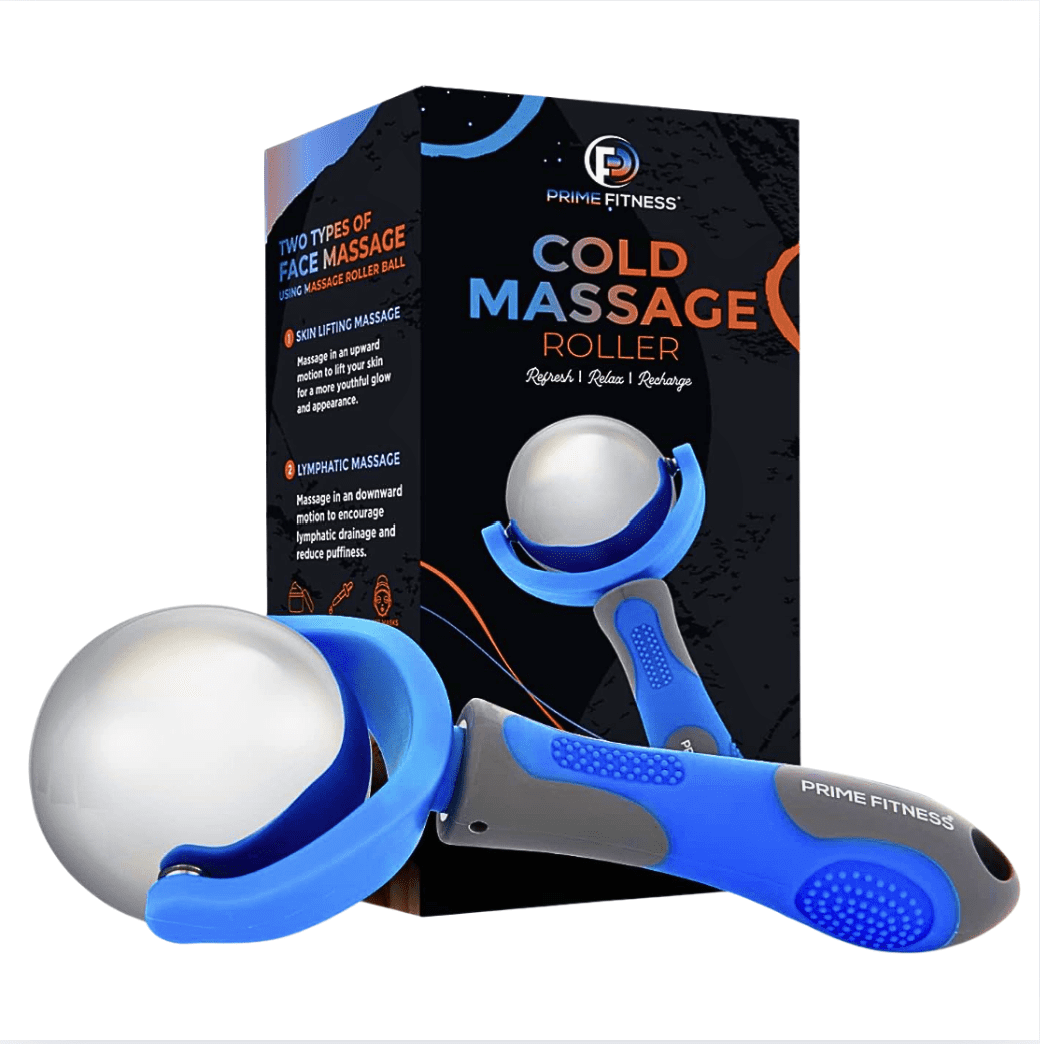
Here’s the Amazon listing: PRIME Fitness Cold Massage Roller Ball
What Is the PRIME Fitness Cold Massage Roller Ball?
The PRIME Fitness Cold Massage Roller Ball is a handheld cold recovery device built around a stainless steel sphere housed in a free-rolling plastic cradle with an ergonomic handle. The design is straightforward: freeze the steel ball for 2–4 hours, then roll it over sore spots to deliver cold contact and sustained pressure in a single motion. No melting ice. No numb hands holding a frozen block.
The steel ball retains cold for roughly 20–25 minutes per session based on manufacturer specs. The 360° cradle allows the ball to rotate freely as the user applies pressure, targeting tight spots in the forearms, calves, neck, and plantar fascia. The handle keeps the grip dry and warm, eliminating the main friction point of ice-based recovery tools.
“Cold plus pressure is like sending a fire extinguisher and a massage therapist into the same room at the same time. It calms the tissue down and flushes it out faster than either alone.”
— Eugene Thong, CSCS
Selection Matrix: Who Actually Needs This?
Match the tool to your specific tight spots. This is a precision device, not a full-body recovery solution.
- The Lifter (Pull Days Are Killer): Forearm flexor tightness after deadlifts, rows, or pull-ups. The roller ball targets the deep fascia that a standard foam roller cannot reach.
- The Runner: Calf stiffness and shin splint irritation. The cold + pressure combo provides localized relief that static stretching alone cannot match.
- The Desk Worker: Neck and trap tightness from screen hunch. Small enough to keep in a desk drawer for a quick midday release.
- The Plantar Fasciitis Sufferer: Rolling the arch of the foot with cold contact and pressure is one of the most practical use cases for this tool.
- Not for you: If you need full-leg or back recovery, stick with a foam roller or percussion gun. This tool covers small areas only.
PRIME Fitness Roller Ball Pros and Cons: Precision vs. Scope
The Advantage (Pros)
- Cold + Pressure in One Tool: Eliminates the need for a separate ice pack and massage ball. One device does both.
- Long Cold Retention: 20–25 minutes of usable chill per freeze cycle based on manufacturer specs.
- Ergonomic Grip: The handle keeps hands warm and dry. No frozen fingers mid-session.
- Smooth 360° Roll: The ball rotates freely inside the cradle. Multi-angle pressure without jamming.
- Portable: Fits in a gym bag, carry-on, or desk drawer. No cords, no batteries, no mess.
The Trade-off (Cons)
- Small Treatment Surface: Only works for small-to-medium muscle groups. Useless for quads, hamstrings, or lats.
- Requires Freezer Access: Needs 2–4 hours of freezing before each use. Not ideal for spontaneous post-gym recovery.
- Single Temperature: No adjustable thermostat. You get whatever temperature the freezer delivers.
- Fixed Pressure Point: The steel ball is hard. Users who prefer softer, modulated pressure may find it uncomfortable.
- Single-Use Freeze Cycle: Once the cold wears off, you need to refreeze. No hot-cold switching mid-session.
Market Contrast: Cryo Roller Ball vs. The Recovery Field
The PRIME Fitness roller ball occupies a specific niche: precision cold contact with pressure. It beats ice packs on versatility but loses to foam rollers on surface area.
| Tool | Core Edge | Primary Trade-off |
|---|---|---|
| PRIME Fitness Cold Roller Ball | Cold + precision pressure in one tool | Small treatment surface, needs freezer prep |
| Standard Ice Pack | Larger coverage area, no prep for gel packs | No pressure capability, messy condensation |
| Lacrosse Ball / Massage Ball | Excellent pressure, cheap, no freezer needed | No cold contact, friction can irritate skin |
| Foam Roller | Large muscle group coverage, adjustable pressure | Bulky, no cold contact, poor for small areas |
| Percussion Gun | Deep vibration, variable speed, no freezer prep | Expensive, no cold contact, loud |
FAQ: Freezing, Rolling, and Practical Use
- How long does it take to freeze?
- 2–4 hours in a standard freezer per the manufacturer guidelines. Overnight freezing is recommended for maximum cold retention.
- How long does the cold last?
- Roughly 20–25 minutes depending on ambient temperature and applied pressure. Sufficient for forearms plus one additional small area.
- Can it be used without freezing?
- Yes. At room temperature, it functions as a standard massage ball. You lose the cold contact but retain the rolling pressure.
- Is this safe for neck use?
- The design allows it, but users should avoid direct contact with the spine. Target the trapezius and levator scapulae alongside the neck.
- Can this replace a foam roller?
- No. It complements a foam roller. Use the roller for large muscle groups and this for precision work on forearms, calves, feet, and neck.
- Does the steel ball rust?
- No. It is stainless steel. Wipe it dry after each use to prevent water spots on the handle and cradle.
PRIME Fitness Cold Roller Ball Verdict: The Precision Recovery Tool
The PRIME Fitness Cold Massage Roller Ball delivers on its core design promise: cold contact plus pressure in a portable, mess-free format. The stainless steel ball retains cold as specified, the 360° roll is smooth, and the ergonomic handle solves the frozen-finger problem of ice-based recovery. The limitations are clear — small treatment surface, freezer prep required, no temperature control. But for targeted work on forearms, calves, feet, and neck, it is a well-designed tool that fills a specific gap in the recovery stack. Confident recommendation for the athlete who wants precision cold contact without the ice bath or ice cup hassle.
Verdict: Precision Cold Contact for Targeted Recovery
You have the facts. Cold + pressure in one tool. 20-minute chill time. Smooth rolling action. If you want targeted recovery without the mess, this earns its spot.
The Cold Recovery Lexicon: Key Terms and Design Specs
- Cold Contact
- The transfer of thermal energy from a cold surface to body tissue. Stainless steel provides faster thermal transfer than gel packs due to higher thermal conductivity.
- Myofascial Release
- Manual pressure applied to fascia — the connective tissue layer surrounding muscles. Used to reduce perceived tightness and improve range of motion.
- Cold Retention
- The duration a material stays at or below a usable temperature after removal from a freezer. Stainless steel retains cold longer than most gel-based alternatives.
- 360° Free-Rolling Cradle
- A rotating housing that allows the steel ball to move freely in any direction, enabling multi-angle pressure without repositioning the handle.
- Targeted Recovery
- Focused treatment on specific small muscle groups such as forearms, calves, or the plantar fascia, as opposed to whole-body modalities.
- Thermal Conductivity
- A material property that determines how efficiently it transfers heat. Steel has high thermal conductivity, meaning it pulls heat away from tissue faster than plastic or rubber.
For more on recovery tools and protocols, check our Cold vs. Compression Recovery Guide and Best Recovery Tools for Lifters and Runners.