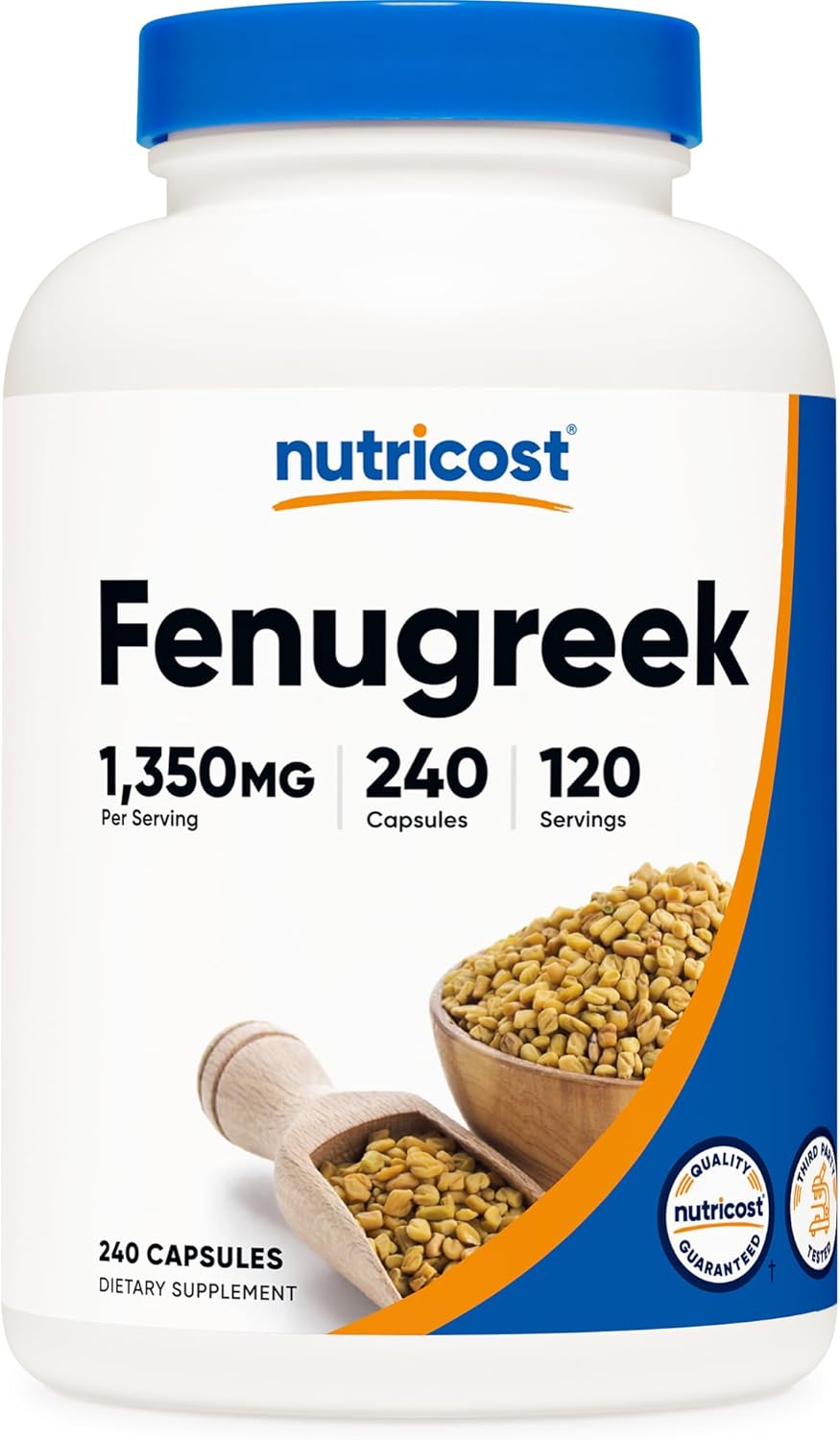
Nutricost Fenugreek Seed 1350mg delivers furostanolic saponins, protodioscin, and trigonelline alkaloids across a generous 240-capsule supply at a price point that makes most branded testosterone boosters look like a tax on gullibility. Fenugreek is not hype. It is a botanical with a documented androgenic mechanism, a clinical trial record dating back decades, and a 2024 double-blind RCT published in PLOS ONE confirming measurable effects on serum and salivary testosterone. This is our 2026 technical breakdown of what is inside, how the mechanism works, and who should be running this daily.
Medical Disclaimer: Not FDA evaluated. Not intended to treat, cure, or prevent disease. Consult a physician before use.
The Price: 240 Capsules of Androgenic Botanical Support at Commodity Cost
Nutricost Fenugreek Seed 1350mg (240 capsules) typically retails between $16 and $22, delivering 120 two-capsule servings at roughly $0.13 to $0.18 per serving. That is four months of daily use for under $22. Comparable fenugreek extracts from premium supplement brands run $30 to $45 for 60 servings at equivalent dosing. You are not buying a worse product. You are buying the same active compound class without the branding overhead.
Nutricost manufactures in a GMP-compliant, FDA-registered facility, and the formula is Non-GMO and gluten-free. Clean label, high volume, defensible cost. That is the value proposition in full.
Ingredient Deep Dive: The Fenugreek Seed Mechanism
Fenugreek seed (Trigonella foenum-graecum) contains furostanolic saponins, protodioscin glycosides, galactomannans, and the alkaloid trigonelline as its primary bioactive compound classes. Each plays a distinct role. Together, they represent one of the most studied androgenic botanical profiles in the supplement category.
- Furostanolic Saponins and Protodioscin: These are the primary androgenic drivers in fenugreek. Furostanol saponins are steroidal in structure and are theorized to serve as precursor inputs to endogenous steroidogenesis pathways. Protodioscin specifically has been studied for its ability to modulate luteinizing hormone (LH) signaling and support upstream testosterone biosynthesis. They are the reason fenugreek appears in virtually every clinical testosterone support trial.
- Aromatase and 5-Alpha Reductase Inhibition: Fenugreek’s glycoside fraction has demonstrated in vitro inhibition of aromatase and 5-alpha reductase, the two enzymes responsible for converting testosterone into estrogen and dihydrotestosterone (DHT) respectively. Blocking these conversion pathways means more total testosterone remains in its bioavailable, unconverted form. A 2024 study published in IJMS confirmed that fenugreek seed extract suppressed DHT levels and reduced 5-alpha reductase activity in an animal BPH model.
- SHBG Modulation via Insulin Sensitivity: Sex hormone-binding globulin (SHBG) binds free testosterone in circulation, rendering it biologically inactive. Fenugreek’s galactomannan fiber fraction supports insulin sensitivity through enhanced GLUT4 translocation and hexokinase activity. The liver suppresses SHBG production in response to insulin. Better insulin sensitivity means lower SHBG. Lower SHBG means a higher free testosterone index. This is an indirect but clinically meaningful mechanism.
- Trigonelline Alkaloid: Trigonelline is structurally analogous to niacin (vitamin B3) and has been studied independently for antibacterial, fat-lowering, and neuroprotective properties. It contributes to fenugreek’s broader metabolic profile beyond the androgenic mechanisms above.
Think of fenugreek as a goalie, not a striker. It does not manufacture more testosterone from nothing. It protects the testosterone you already produce from being converted away by aromatase and 5-alpha reductase before it can do its job. Less gets lost. More stays on the field.
Each serving is 2 capsules (675mg per capsule) delivering a full 1350mg of fenugreek seed. This is a whole-seed format, not a standardized extract. The dose is high relative to the category, compensating for the lower concentration of active saponins per gram compared to standardized extracts like Testofen. The 2024 RCT used doses ranging from 600mg to 1800mg. This product sits squarely within the studied range.
The Research: What Controlled Trials Actually Show
A 2024 double-blind, randomized, placebo-controlled trial published in PLOS ONE assessed fenugreek extract at doses of 600mg, 1200mg, and 1800mg daily across 95 men aged 40 to 80 over a 12-week intervention. Testosterone was quantified via HPLC-MS/MS. Free testosterone index (FTI) was calculated. SHBG was measured via ELISA.
Key findings from the trial:
- Plasma total testosterone and free testosterone index (FTI) increased from baseline across all fenugreek dose groups. The 1800mg group showed a statistically significant 12.2% increase in FTI (p = 0.025).
- Salivary testosterone increased significantly versus both baseline (31.1%, p = 0.0002) and versus placebo (37.2%, p = 0.042). Salivary testosterone is a reliable proxy for bioavailable, unbound testosterone.
- Plasma testosterone versus placebo did not reach statistical significance across all measures, reflecting the honest complexity of botanical testosterone research. The effect is real. It is not dramatic. It is a supportive intervention, not a pharmaceutical replacement.
A meta-analysis of clinical trials by Mansoori et al. (2020) confirmed that fenugreek extract supplementation produced statistically significant increases in total testosterone across multiple human trials. The consolidated clinical review published in medtigo Journal (2026) reinforced these findings, noting that fenugreek’s saponin fraction modulates steroidogenesis and enzyme activity via aromatase and 5-alpha reductase pathways.
| Study | Dose | Duration | Key Finding |
|---|---|---|---|
| Lee-Ødegård et al. (2024), PLOS ONE | 600 to 1800mg/day | 12 weeks | Salivary testosterone increased 37.2% vs. placebo. FTI increased 12.2% at 1800mg. |
| Mansoori et al. (2020), Meta-Analysis | Varies | Multiple trials | Statistically significant increases in total testosterone across pooled human trials. |
| SFSE-G Androgenic Study (2024) | Glycoside extract | 28 days | Significant in vitro inhibition of aromatase and 5-alpha reductase confirmed. |
Is It Worth It? The Calculation
Nutricost Fenugreek Seed 1350mg is the correct choice for men over 35 seeking a budget-accessible, whole-seed fenugreek protocol at a dose within the clinically studied range. It will not replace a suppressed endocrine system. It will not override poor sleep, nutritional deficiency, or chronic cortisol elevation. What it does is reduce the androgenic loss that occurs through enzyme-mediated testosterone conversion. That is a meaningful contribution to a well-constructed hormonal support stack.
- Buy it if: You are 35 or older and looking for a cost-efficient botanical foundation for testosterone support under $20.
- Buy it if: You are already optimizing zinc, vitamin D, magnesium, and sleep and want a botanical layer that targets aromatase and 5-alpha reductase activity specifically.
- Buy it if: You want a 4-month supply in a single purchase with no subscription required and no proprietary blend concealing the dose.
- Skip it if: You need a standardized extract like Testofen (standardized to 50% fenusides) for a specific clinical protocol. This is a whole-seed format. Active compound concentration per gram is lower than in standardized extracts.
- Skip it if: You are pregnant or nursing. Fenugreek is a documented galactagogue with uterine stimulant properties at high doses. Not appropriate during pregnancy.
Nutricost Fenugreek vs. The Field
| Product | Format | Dose Per Serving | 2026 Verdict |
|---|---|---|---|
| Nutricost Fenugreek 1350mg | Whole Seed | 1350mg (2 caps) | Best cost-per-serving in the category. 240-cap supply. Clean label. No proprietary blend. |
| Nugenix Total T2 (Testofen) | Standardized Extract (50% Fenusides) | 600mg | Higher active compound concentration per gram. Premium price. Better for targeted clinical protocols. |
| NOW Foods Fenugreek | Whole Seed | 500 to 1000mg | Lower dose per serving. Comparable clean label standard. Nutricost delivers more per capsule. |
| Generic Proprietary Blend Testosterone Boosters | Undisclosed blend | Unknown | Avoid. No verifiable fenugreek dose. No mechanism accountability. You are buying a label. |
The Bottom Line
Nutricost Fenugreek Seed 1350mg is the rational entry point for botanical androgenic support: a documented mechanism, a dose within the clinically studied range, 240 capsules, and a price that removes every financial excuse for not running the protocol. The furostanolic saponin and protodioscin content targets aromatase and 5-alpha reductase activity. The galactomannan fraction supports insulin sensitivity and SHBG suppression. The 2024 PLOS ONE RCT confirms the biological signal is real.
It is not a pharmaceutical intervention. It is a well-dosed, clean-label botanical that protects the testosterone you are already producing from being converted away before it can work. In the context of a full hormonal support stack, that contribution compounds.
Verdict: Stop Letting Aromatase Win. 240 Capsules. One Decision.
Furostanolic saponins. Aromatase and 5-alpha reductase modulation. 1350mg per serving. Four months of supply. Secure your stack via the link below.
*Prices subject to change. Verified 2026 clinical review. Sources: Lee-Odegard et al. (2024) PLOS ONE, Mansoori et al. (2020), IJMS (2025).