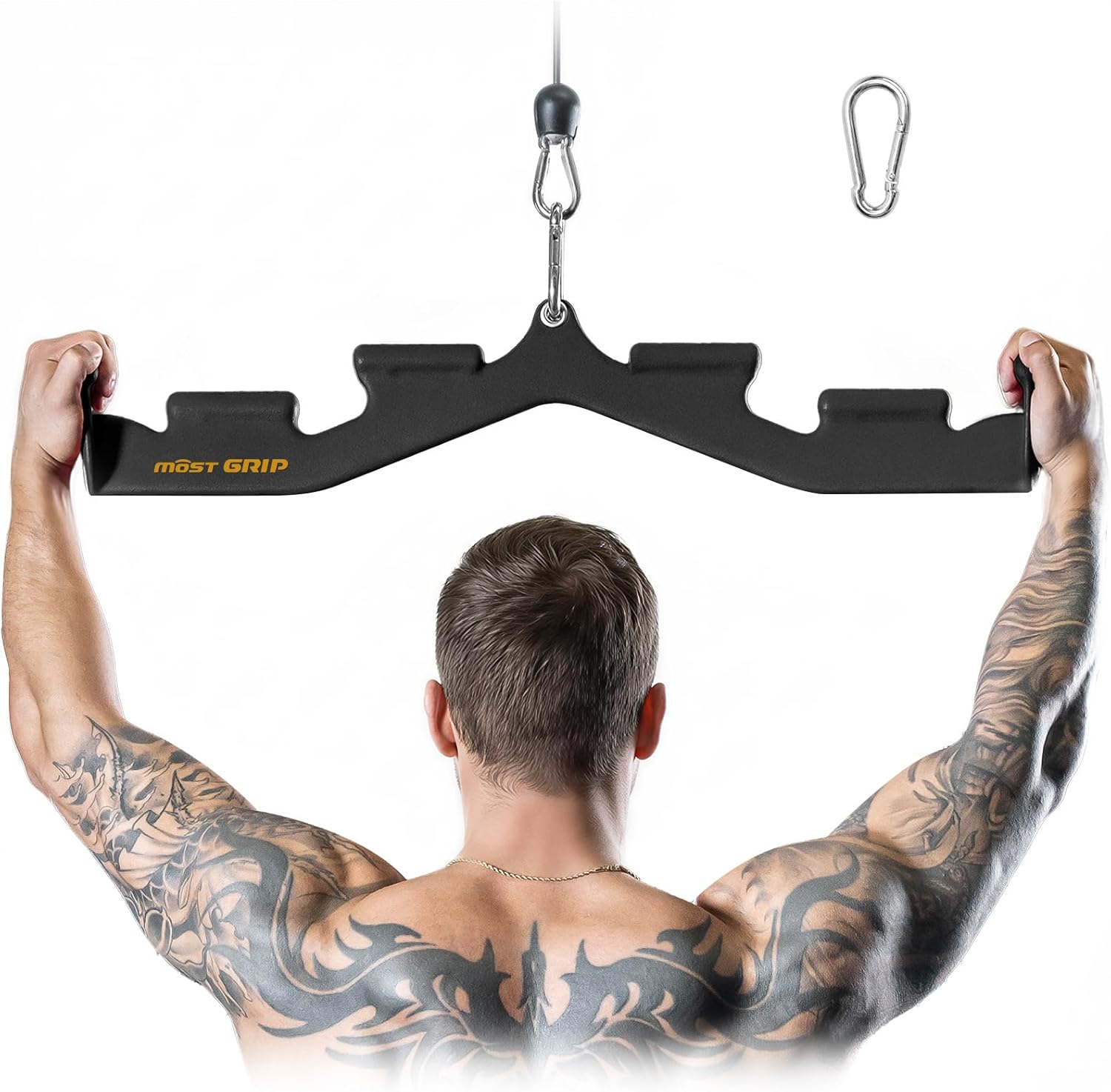
The MOST GRIP Lat Pull Down Bar is a 20-pound high-grade steel cable attachment with six rubber-coated ergonomic handles across wide, narrow, and neutral grip positions on a triangular stability frame. One bar, three grip angles, six contact points. We audited the specs, grip geometry, material composition, and attachment system against standard single-grip lat bars to map where this multi-handle bar earns its spot and where it does not.
Overview: One Bar, Three Grips, Six Handles
The MOST GRIP Lat Pull Down Bar is a multi-grip cable attachment built on a triangular steel frame that houses six rubber-coated handles across wide, narrow, and neutral grip positions. The product listing specifies high-grade steel construction, a 20-pound total weight, and a carabiner clip attachment for standard cable machines. The design intent is straightforward: one bar replaces a wide-grip lat bar, a narrow-grip handle, and a neutral-grip V-bar without swapping attachments between sets. For the full catalog of cable-based back training options, see our cable back exercises guide and the full back exercises library.
The Swiss Army Knife vs. The Toolbox Analogy
A gym with four separate lat bars is a toolbox. Each tool does one job with dedicated geometry. The MOST GRIP bar is a Swiss Army knife. Three grip angles from one frame. You trade a millimeter of grip specialization for zero seconds spent unhooking and re-clipping between sets. For the home gym lifter with one cable station, the Swiss Army knife wins. For the commercial gym with a full rack of dedicated bars, the toolbox still has an edge. Pick the tool that matches your setup.
Specs and Build Quality: High-Grade Steel, 20 Pounds, Triangular Frame
The MOST GRIP Lat Pull Down Bar is listed as high-grade steel construction, weighing 20 pounds with rubber-coated ergonomic handles and a triangular stability design built to reduce side-to-side movement under load. The product page specifies welded frame construction, bolted reinforced handle mounts, a black powder coat finish, and an included carabiner clip. Here is what the manufacturing specs say on paper.
- Material: High-grade steel, per the product listing. No plastic load-bearing components. Welded frame. Bolted handle mounts.
- Weight: 20 pounds. This is heavier than most single-grip lat bars, which typically list at 5 to 12 pounds. The additional mass comes from the triangular frame and six handle mounts. The weight adds pre-load to the cable stack and contributes to stability during the pull, per the design specification.
- Handles: Six ergonomic handles with a rubber-coated textured anti-slip surface. Three grip zones. Two handles per zone. The rubber coating is specified as anti-slip. Thickness and durometer are not published on the listing.
- Triangular Stability Design: The triangular frame geometry distributes load across three contact points. The manufacturer specifies this design as a method to reduce the side-to-side wobble common in single-point carabiner attachments. The geometry is fixed and non-adjustable.
- Attachment Point: Carabiner clip, included. Compatible with standard cable machine pulley loops. Fits home gym cable towers, functional trainers, and commercial cable stacks with a loop or ring attachment point. Not compatible with rack-mounted pulley systems lacking a carabiner loop.
- Finish: Black powder coat, per the listing. Specified as corrosion-resistant for garage gym environments.
Grip Positions: Wide, Narrow, and Neutral in a Single Bar
The MOST GRIP bar specifications list wide-grip, narrow-grip, and neutral-grip positions across six handles on a single triangular frame. Each grip position targets a different region of the back based on hand spacing and wrist angle. No bar swap required between positions. Move your hands. Keep pulling.
- Wide Grip (Outer Handles): Pronated grip at approximately 1.5x shoulder width, per the product listing. This hand position is designed to emphasize the latissimus dorsi during pulldowns. The outer handles are angled slightly, which the manufacturer specifies as a wrist-strain reduction feature versus a fully straight bar. For a full list of back width exercises, see our best exercises for V-taper back guide.
- Narrow Grip (Inner Upper Handles): Pronated grip at approximately shoulder width. This hand position is designed to shift the pull angle toward the middle trapezius and rhomboids. The same grip also works for seated cable rows with a closer hand position. See our upper back exercises guide for more movements that target this area.
- Neutral Grip (Inner Lower Handles): Palms facing each other. This is the V-bar equivalent position. A neutral wrist angle is specified to reduce shoulder and elbow strain compared to a pronated grip. The pull angle is designed to engage the lower lats and teres major. For the broader back training context, see our full list of back exercises.
The handle spacing is fixed. The MOST GRIP bar does not adjust. The six handles are welded into place on the triangular frame. The fixed spacing is designed for the average adult male shoulder width. Lifters outside the 5’6″ to 6’2″ range or with very narrow or very broad shoulder structures may find one or more positions fall outside their optimal hand placement. That is the trade-off of a single-piece frame versus three separate adjustable bars. For adjustable cable exercise alternatives, see our cable exercises library.
The Fixed-Address vs. Change-of-Address Analogy
Three separate lat bars are like having three houses. You commute between them. The MOST GRIP bar is one house with three rooms. You walk through a doorway instead of driving across town. The rooms are fixed in size. If you are 6’5″ with a wingspan like a condor, the doorframes might feel tight. If you are in the middle of the bell curve, the rooms fit. Pick the living arrangement that matches your dimensions.
MOST GRIP Lat Pull Down Bar Pros and Cons
The trade-off is a 20-pound triangular steel frame with three built-in grip positions against fixed handle spacing and a carabiner-only attachment system.
Pros
- Three grip positions in one bar: Wide, narrow, and neutral. No swapping attachments between sets.
- 20-lb high-grade steel: Welded frame. Bolted reinforced handle mounts. No plastic load-bearing components.
- Triangular stability design: Three-point load distribution specified to reduce side-to-side wobble.
- Six rubber-coated ergonomic handles: Textured anti-slip surface, per the product listing.
- Carabiner clip included: Compatible with standard cable machine pulley loops.
- Black powder coat finish: Specified as corrosion-resistant.
- Replaces three separate bars: Saves rack space and eliminates swap time between grip positions.
Cons
- Fixed handle spacing: Non-adjustable. Lifters outside the average height range may find positions suboptimal.
- 20 pounds pre-loads the cable stack: Smaller cable stacks may struggle to counterweight the bar at lighter resistance settings.
- Carabiner-only attachment: No rotating eyelet or swivel mechanism specified. Not compatible with rack-mounted pulleys lacking a carabiner loop.
- Not rack-mountable: Designed as a cable attachment only.
- Rubber grips wear over time: The coating is durable but not permanent. Replacement requires replacing the entire bar.
Who the MOST GRIP Lat Bar Is For (and Not For)
Match the bar to your gym setup, training style, and handle-swap tolerance. One bar is not right for every cable station.
Good Fit
- Home gym owners with one cable station who want three grip positions without buying three bars
- Lifters who circuit-train or superset and value no bar swaps between grip angles
- Anyone targeting full back development from a single attachment
- Garage gym users who need a corrosion-resistant powder coat finish
- Lifters in the 5’6″ to 6’2″ height range where the fixed handle spacing is designed to fit
- Back-day purists who run compound pulls through multiple grip angles. See our compound exercises for mass guide
Not the Best Fit
- Very tall or very broad lifters who need adjustable grip spacing
- Commercial gym users who already have a full rack of dedicated bars
- Lifters who want a rotating or swiveling attachment point
- Anyone with a small cable stack where 20 pounds of pre-load limits usable resistance range
- Rack-only users without a carabiner loop on their pulley system
How the MOST GRIP Bar Compares to Standard Lat Attachments
The MOST GRIP bar competes on grip versatility and zero-swap convenience. Standard single-grip bars compete on grip specialization and lighter weight.
| Feature | MOST GRIP Multi-Grip Bar | Standard Wide Lat Bar | Standard V-Bar |
|---|---|---|---|
| Grip Positions | 3 (wide, narrow, neutral) | 1 (wide pronated) | 1 (neutral) |
| Handles | 6 ergonomic, rubber-coated | 2 (knurled or rubber) | 2 (rubber grips) |
| Weight | 20 lbs | 5-12 lbs | 2-5 lbs |
| Swap Required Between Grips | None | Yes (unclip and reclip) | Yes (unclip and reclip) |
| Handle Spacing | Fixed | Fixed (long bar) | Fixed (narrow) |
| Attachment Type | Carabiner clip (included) | Center eyelet or carabiner | Carabiner loop |
| Best Use Case | Home gym, multi-grip efficiency | Dedicated wide pulldowns | Dedicated neutral grip rows |
The MOST GRIP bar leads on versatility and efficiency. Standard bars lead on grip specialization and weight. If your gym already has a rack of dedicated lat attachments, the MOST GRIP bar is redundant. If your home gym has one cable station and a single straight bar, it replaces three purchases. For more cable exercise programming, see our cable back exercises guide. For home gym equipment on a budget, see our affordable home exercise equipment roundup.
Exercises the MOST GRIP Bar Is Designed to Support
The three grip positions on a single triangular frame are specified for lat pulldowns, seated cable rows, straight-arm pushdowns, and face pulls without swapping the attachment.
- Wide-Grip Lat Pulldowns: Outer handles. Pronated grip. Pull to upper chest. Designed for lat width emphasis. See our back exercises library for more lat-building movements.
- Narrow-Grip Seated Cable Rows: Inner upper handles. Pronated shoulder-width grip. Pull to lower sternum. Designed for mid-back thickness.
- Neutral-Grip Pulldowns: Inner lower handles. Palms facing. Pull to upper chest. Designed for lower lat emphasis with a wrist-neutral angle.
- Straight-Arm Pushdowns: Wide or narrow handles. Arms kept straight. Push from shoulder height to hip. Isolates the lats without biceps involvement. For a full breakdown of cable isolation work, see our cable exercises library.
- Face Pulls: Neutral grip handles. Pull to forehead height. Designed for rear delt and external rotator engagement. For more upper back specialization, see our upper back exercises guide.
The Pit Stop vs. The Garage Analogy
Swapping lat bars between sets is a pit stop. You stop pulling. Unclip. Reclip. Resume. The MOST GRIP bar design eliminates the pit stop. You change grip by moving your hands six inches, not by unhooking the carabiner. In a superset or circuit, those saved seconds compound into saved minutes. For the home gym lifter on a tight schedule, the pit-stop elimination is the value proposition. The bar is a time-saving tool, not a luxury.
MOST GRIP Lat Pull Down Bar FAQ
- Does the MOST GRIP bar fit all cable machines?
- The included carabiner clip is specified to attach to any standard cable machine pulley with a loop or ring. It fits home gym cable towers, functional trainers, and commercial cable stacks with loop attachment points. It does not fit rack-mounted pulley systems that require a pin or hitch without a carabiner loop. Check your cable machine’s attachment type before purchasing.
- Is the 20-pound weight a problem for lighter cable stacks?
- Possibly. A 20-pound bar adds 20 pounds of pre-load to the cable stack before any weight plates are engaged. On a stack that starts at 10 pounds of selectable resistance, the lowest effective load is 30 pounds (bar plus first plate). For most training, this is not a factor. For rehab work or very light warm-up sets, the bar weight limits access to the bottom of the weight stack.
- Can the handle spacing be adjusted?
- No. The six handles are welded into fixed positions on the triangular steel frame. The spacing is designed for the average adult male shoulder width. Lifters outside the 5’6″ to 6’2″ range or with very narrow or very broad shoulder structures may find one or more grip positions fall outside their optimal hand placement.
- How does the MOST GRIP bar compare to buying three separate bars?
- The MOST GRIP bar combines a wide-grip lat bar, a narrow-grip handle, and a neutral-grip V-bar into a single 20-pound frame. Three separate bars cost roughly the same or slightly less combined, take up more wall storage space, and require swapping between exercises. The MOST GRIP bar trades grip specialization for zero-swap convenience. For the full list of back exercises compatible with cable attachments, see our list of back exercises.
- Are the rubber grips durable?
- The rubber-coated handles are listed with a textured anti-slip surface. Rubber grip coatings wear over time. Heavy chalk use, sharp calluses, and direct sunlight in a garage gym accelerate wear on any rubber-coated handle. The grips are not individually replaceable. With normal use, the coating is expected to last years before noticeable degradation.
- Can this bar be used for triceps pushdowns?
- Yes. The neutral grip handles or narrow pronated handles are compatible with triceps pushdowns. The bar is overbuilt for this application (a simple V-bar or rope is lighter and more maneuverable for pushdowns), but the grip positions function for the movement. See our arm exercises library for dedicated triceps movements.
Final Verdict
The MOST GRIP Lat Pull Down Bar is a 20-pound high-grade steel cable attachment with six rubber-coated ergonomic handles across three fixed grip positions on a triangular stability frame. The product listing specifies welded steel construction, a black powder coat finish, and a carabiner clip attachment. The design intent is three grip angles in one bar with zero attachment swaps between sets.
The fixed handle spacing is the primary limitation on paper. If your shoulder width lands outside the range the bar was built for, one or more positions will not align optimally. If your gym already has a full rack of dedicated lat bars, this bar is redundant. If your cable stack starts very light, the 20-pound bar weight shifts the usable resistance range upward.
For the home gym lifter with one cable station who runs back days with multiple grip angles, the MOST GRIP bar replaces three purchases and eliminates swap time entirely. That is the product specification. The rest is fit and preference.
A lat bar is a lever. The MOST GRIP bar is three levers welded into one fixed triangular frame. It weighs 20 pounds. It has six handles. It does not adjust. It does not swivel. It attaches via carabiner. It is built for the lifter who values grip variety and setup speed over grip-per-millimeter specialization.
Verdict: Three Grips, One Frame, Zero Swaps
20-lb high-grade steel. Six ergonomic handles. Wide, narrow, and neutral grip positions on a single triangular frame. Built for the home gym lifter who wants back-day grip variety without a rack of separate bars.
Related Back Training and Cable Exercise Guides
- Cable Back Exercises: The Complete Guide
- Back Exercises Library: Every Movement Ranked
- List of Back Exercises: Full Catalog With Muscle Targets
- Best Exercises for V-Taper Back
- Upper Back Exercises to Dominate
- Compound Exercises for Mass
- Cable Exercises: Full Library
- Home Back Exercises: No Machine Required
- Dumbbell Back Exercises Guide
- Affordable Home Exercise Equipment
- Compound Exercises Library
- Best Biceps Exercises for Mass
- Arm Exercises Library