You’ve done everything right.
The scale, once a stubborn monument to inaction, has been ticking down for months. You’ve said no to the late-night carbs, yes to the dawn patrol workouts. You’ve earned the compliments, the looser-fitting jeans, the feeling of waking up in a body that feels like your own.
Then, it happens. Nothing.
The last ten pounds cling to you with a kind of biological spite. The same discipline that yielded dramatic results now buys you only frustration. The scale becomes a liar. Your motivation, once a roaring fire, is now a guttering candle in the wind.
This isn’t a failure of will. It’s a negotiation with a smarter, older version of you.
The Metabolic Siege: Your Body in Energy Conservation Mode
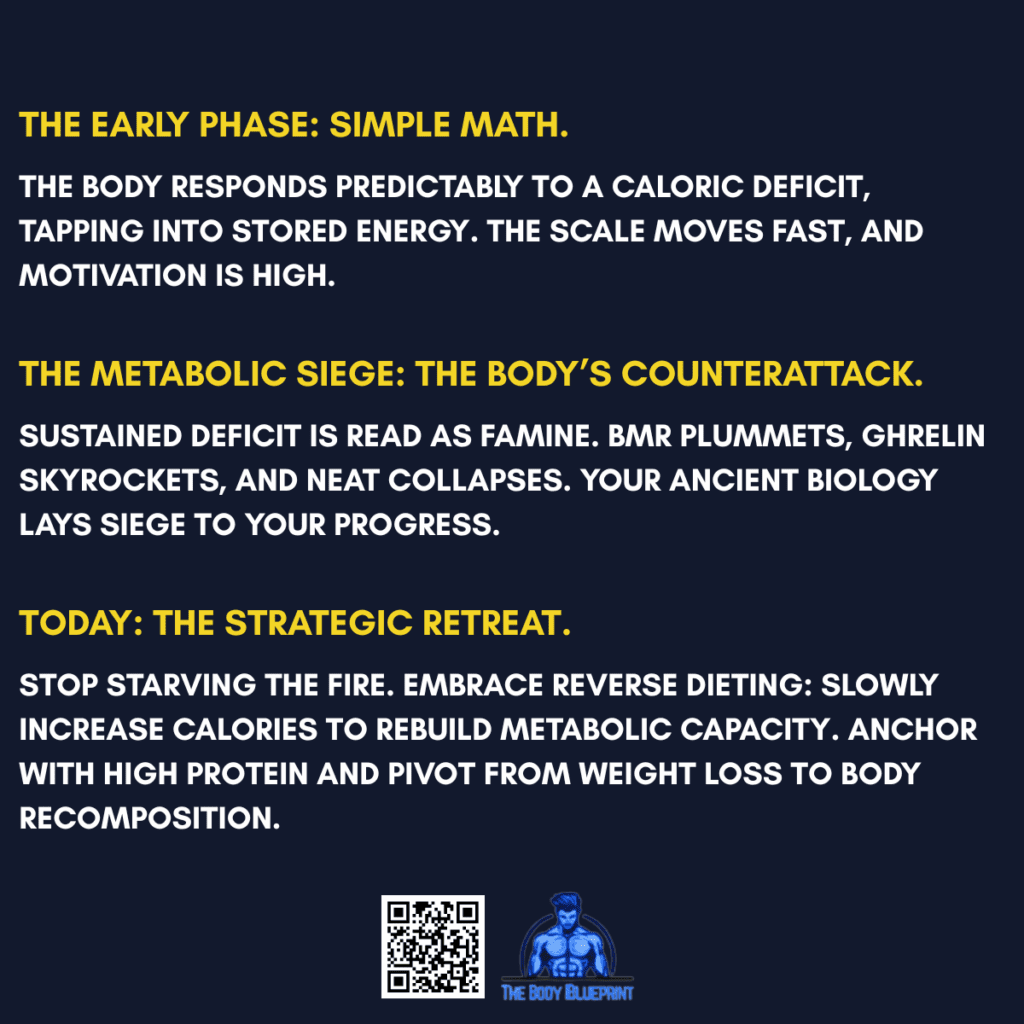
Think of your body not as a simple machine, but as a brilliantly paranoid survival system. When you first created a calorie deficit, your body responded predictably: it tapped into stored energy (fat) to make up the difference.
But a large, sustained deficit isn’t seen as a choice by your ancient biology—it’s read as a famine. And your body hates famine. So, it lays siege to your progress.
“The body is an adaptation machine,” explains Eugene Thong, CSCS. “It doesn’t know you’re trying to get lean for beach season. It thinks you’re starving in the wilderness. So, it deploys a series of brilliant, energy-conserving countermeasures to keep you alive.”
These countermeasures form a triple-threat against those final pounds:
| The Body’s “Countermeasure” | What It Feels Like | The Biological Reason |
|---|---|---|
| Metabolic Adaptation | You’re eating the same but losing less. Or you feel cold, tired, and sluggish. | Your Basal Metabolic Rate (BMR) drops. Your body is literally burning fewer calories at rest to preserve its remaining fuel stores. |
| The Hormonal Revolt | Hunger becomes a sharp-toothed beast. Cravings for hyper-palatable foods feel overwhelming. | Leptin (the “I’m full” hormone) plummets. Ghrelin (the “I’m starving” hormone) skyrockets. Your brain is being screamed at to eat. |
| The NEAT Collapse | You’re just… moving less. You fidget less, take the elevator, park closer. It’s subconscious. | Non-Exercise Activity Thermogenesis (NEAT)—the calories you burn from daily movement—is your body’s silent energy leak. It patches the leak. |
This is the silent, metabolic war happening beneath your skin. It’s not a character flaw. It’s a deeply ingrained survival protocol.
The Fork is Mightier Than the Barbell (At This Stage)
Here’s the psychological gut-punch that most fitness influencers won’t tell you: you can’t out-train this biological fortress.
Chasing the last 10 pounds by adding more cardio is like trying to put out a house fire with a water pistol. You’re just adding more stress to a system already screaming for relief, further convincing your body the famine is real.
“The final phase of fat loss is a game of nutritional chess, not a weightlifting boxing match,” states Charles Damiano, B.S. Clinical Nutrition. “Precision, patience, and strategic retreats are more valuable than brute force.”
The leverage is in your nutrition. But not in the way you think.
The Three-Part Pivot for Breaking the Plateau
Forgetting the “loss” and starting a smarter game.
1. Reverse Dieting: The Art of the Strategic Retreat
The solution to a slowed metabolism isn’t to starve it further. It’s to convince your body the famine is over. This is done by slowly, methodically increasing your calorie intake—primarily from carbohydrates and protein—week by week. This isn’t a binge; it’s a calculated recalibration.
Here’s the practical implementation: Start by adding a small, manageable increment of 100-150 calories (focus on complex carbs like oats or sweet potato) to your daily intake. Hold that for one week. Monitor your weight and energy. If the scale stays stable or even drops slightly, and your energy improves, add another 100-150 calories the next week. This slow, weekly titration is how you teach your metabolism to burn hot again, rebuilding the metabolic muscle you’ve eroded without piling on fat. You are methodically finding your new, higher maintenance level.
2. The Protein Anchor
While you reverse your calories, keep protein absurdly high. Protein is the cornerstone. It:
- Preserves precious muscle mass (the very engine of your metabolism).
- Is highly satiating, helping to manage hunger.
- Costs your body more energy to digest (its Thermic Effect of Food is high).
3. Embrace the “Pivot” to Recomposition
This is the mindset shift. Stop fighting your body. Start working with it. Shift your goal from weight loss to body recomposition—losing fat while building, or at least preserving, muscle.
This is where the magic happens. The number on the scale might not move much, or might even creep up slightly, but your physique will transform. You’ll look tighter, more defined, leaner at the same weight.
How? By introducing a simple, powerful stimulus that tells your body to build muscle, not just lose weight:
- Lift Heavy, Recover Harder: Stop chasing burnout. Focus on progressive overload in your key lifts (squat, deadlift, press, rows). Add one more rep, or 2.5 more pounds, each week. Then, prioritize sleep like your fitness depends on it—because it does.
- Walk, Don’t Run: Swap some of your grueling cardio sessions for 30-45 minutes of daily walking. It burns calories without the systemic stress, aiding recovery and keeping your NEAT subtly elevated.
The Final Negotiation
The last 10 pounds aren’t a wall. They are a doorway.
A doorway into a deeper conversation with your own physiology. It’s where you learn that the body isn’t an adversary to be conquered, but a partner to be understood. The brutal truth is that the final stretch is hard because it’s designed to be. It’s your body’s final, desperate, and ultimately brilliant, attempt to keep you safe.
The beautiful truth? By shifting your strategy from one of force to one of finesse—by feeding the machine, anchoring with protein, and lifting with purpose—you don’t just break through the plateau.
You unlock a sustainable, powerful version of yourself that was waiting on the other side all along. The last 10 pounds were never the finish line. They were the final lesson.