
The Raw Grip Deadlift: Forging a Vice-Like Hold Without Assistance
This guide is for lifters who want to increase their raw grip strength specifically for the deadlift, eliminating the need for lifting straps. We will cover the foundational techniques, targeted exercises, and strategic programming you need to develop a powerful, unassisted grip. The goal is to build lasting, raw strength that allows you to lift heavier, safer, and with the confidence to own every rep.
You’re under the bar. The plates are loaded heavier than last time. You brace your core, set your lats, and begin the pull. The weight breaks the floor, but halfway up, it happens—the bar starts to slide. Your back is strong, your legs are driving, but your grip is the weak link, the failing tether that forces you to abandon the rep. This moment of defeat is a common rite of passage, but it doesn’t have to be your story.
Training your grip without straps isn’t just about ditching equipment; it’s about building a foundational pillar of total-body strength. It’s the difference between lifting the weight and owning the weight. Let’s forge a grip that matches your ambition.
The Anatomy of a Crushing Grip: It’s More Than Your Fingers
Most guys think grip strength is just about finger curls and forearm size. The reality is far more interesting. Your grip is a complex system of three primary types of strength, all governed by the nervous system’s ability to recruit muscle fibers with violent efficiency.
- Crush Grip: The strength between your fingers and palm—this is your standard handshake grip and what you use to squeeze the bar.
- Support Grip: This is the king of deadlift grips. It’s the ability to hold onto something for a prolonged period, relying directly on the muscular endurance and tendon strength of your forearm flexors.
- Pinch Grip: The strength between your fingers and thumb, crucial for overall thumb stability and lock.
For the deadlift, the support grip is your main event. When you grip the bar, you’re not just telling your fingers to close; you’re sending a neurological signal to your entire arm and upper back to create full-body tension. A weak grip doesn’t just mean a dropped bar; it can lead to a subconscious nervous system shutdown, preventing you from engaging your posterior chain with maximum force because your body knows the weak link will fail.
Foundational Techniques: Your First Line of Defense
Before you add a single accessory exercise, you must master the two primary gripping styles. Your choice here is a nuanced decision, not a random one.
The Double Overhand Grip (DOH): The Gold Standard of Grip Training
This is your true measure of raw grip strength. Using a pronated (palms-facing-you) grip on both hands forces your forearm extensors and flexors to work in unison. Always perform your first warm-up sets and as many working reps as possible with a DOH grip. It’s your built-in grip training tool. Only when your grip is about to fail should you switch to a mixed grip for your heaviest sets.
The Mixed Grip: The Powerlifter’s Anchor
One hand pronated, one hand supinated (palm facing away). This prevents the bar from rolling by counteracting the forces. It’s incredibly effective for moving maximal weight but comes with nuances.
- The Nuance: Consistently using the same hand in the supinated position can lead to muscular imbalances and a higher risk of a bicep tendon strain on that arm. The solution is simple yet often ignored: alternate your mixed grip. Train sets with your left hand supinated, and other sets with your right hand supinated. This promotes symmetry and joint health.
Grip Style Comparison Table
| Grip Style | Pros | Cons | Best For |
|---|---|---|---|
| Double Overhand (DOH) | Builds balanced grip strength, promotes symmetry, safest on biceps | Fails first under heavy load | Warm-ups, submaximal volume work, grip development |
| Mixed Grip | Extremely secure, allows for heaviest singles | Risk of bicep strain, can create imbalances | Maximal attempts, heavy singles |
| Hook Grip | Very secure, no muscle imbalance risk | Painful to learn, can tear calluses, requires thumb mobility | Competitive lifters, those willing to endure the discomfort |
The Grip Strength Arsenal: Exercises That Build Legendary Forearms
Incorporate these movements 1-2 times per week, either at the end of your deadlift session or on a separate day. Quality over quantity.
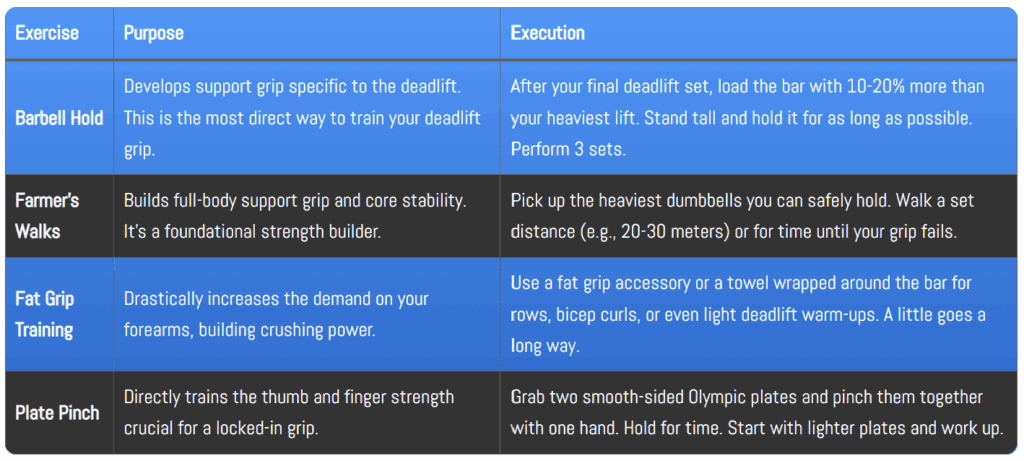
1. The Barbell Hold: Pure Deadlift Specific Strength
This is non-negotiable. After your final deadlift set, load the bar with 10-20% more weight than you just lifted. Deadlift it up, stand tall, and hold it for as long as you can. Fight for every second. Aim for 3 sets of max-duration holds. This trains your nervous system and tendons to handle supramaximal weight specifically in the deadlift position.
2. Fat Grip Training: The Secret Weapon
Fat Gripz or a thick towel wrapped around the bar instantly increases the diameter you must grip. This places immense demand on your finger and thumb flexors and dramatically increases neural recruitment.
- How to Use: Use fat grips for your rows, dumbbell holds, or even warm-up sets of deadlifts. The stimulus is so potent that a little goes a long way.
3. Plate Pinches: Forge a Mighty Thumb
The thumb is the clamp that locks your grip in place. Grab two smooth-side-out Olympic plates and pinch them together with one hand. Hold for time. Start with 10kg plates and work your way up.
4. Dead Hangs: The Simplest, Most Overlooked Tool
Find a pull-up bar. Grab it with a double overhand grip and simply hang. Focus on pulling your shoulder blades down and back—don’t just sink into your sockets. Work up to cumulative 60-90 seconds of hanging per session.
5. Farmer’s Walks: The Ultimate Grip Finisher
Pick up the heaviest dumbbells or farmer’s walk implements you can hold and walk. This builds monstrous support grip, core stability, and trap strength. Walk until your grip fails.
Programming Your Grip for Success
You wouldn’t max out your deadlift every day; don’t do it with your grip. It responds best to high-frequency, sub-maximal effort.
- Frequency: Train your grip 2-3 times per week.
- Intensity: Your holds and pinches should be taken to failure, but your accessory work (like fat grip rows) should be challenging but not maximal.
- Volume: Low. A few sets of holds and one or two accessory exercises are plenty.
- The Rule: Grip training should not interfere with your main lifts. If your deadlift session is tomorrow, don’t annihilate your forearms today.
The Mindset of Unassisted Strength
This journey is about more than just holding onto a bar. It’s about developing a type of self-reliant strength that echoes beyond the gym. It’s the satisfaction of knowing the weight moved because you were strong enough, without assistance, without shortcuts. Every second you hold that barbell, you’re not just building muscle; you’re building resolve. You are forging the one thing that connects you to every heavy pull: your relentless, vice-like grip. Now get to work.