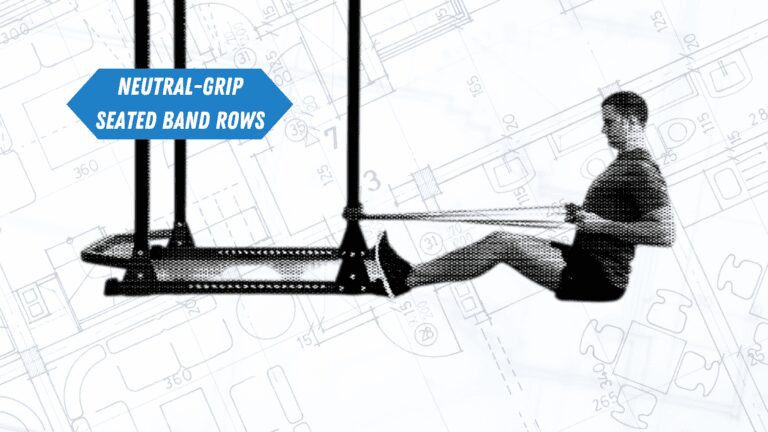
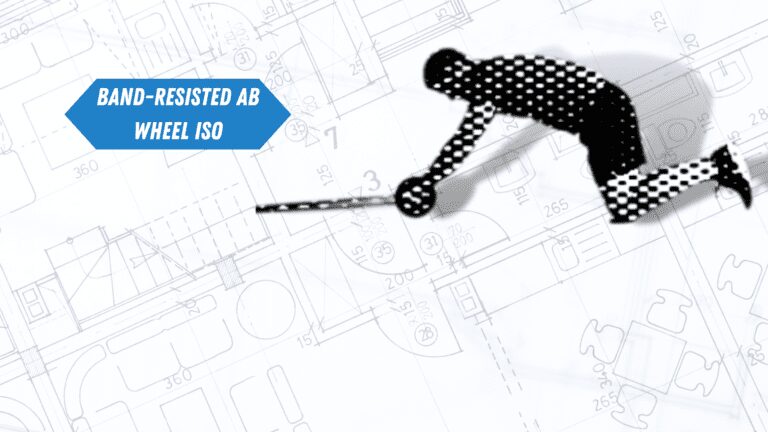
Upper trapezius, levator scapulae, and core stabilizers get targeted by the half-kneeling band overhead shrug. The band provides variable resistance throughout the range. The half-kneeling stance eliminates lower back compensation. This isn’t a typical shrug. This is a functional stability tool that builds trap strength and improves overhead control.
Half-Kneeling Band Overhead Shrugs – Execution Protocol
“The half-kneeling band overhead shrug is like a crane lifting a load with perfect stability. The band pulls you down. Your traps pull you up. Everything else stays locked in place.”
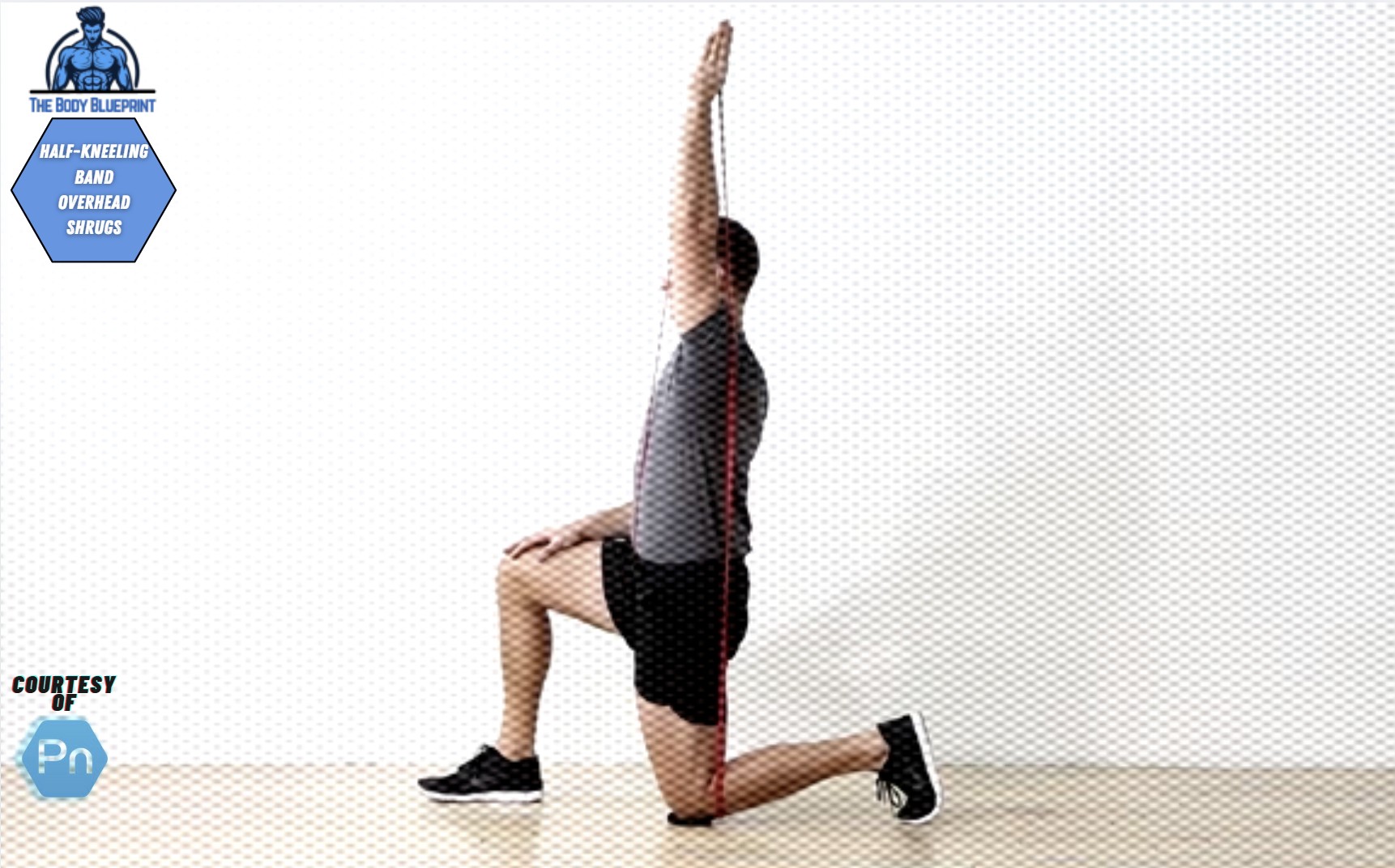
Grab a resistance band and anchor it securely at floor level. Use a heavy kettlebell. Use a door anchor. Loop it under your back foot. Your anchor must be solid. No slipping. No sliding. Your band tension should be moderate. Not slack. Not maxed out.
Kneel on one knee with the other foot planted in front. Both knees at 90 degrees. Your front foot is flat. Your back knee rests on a mat. Your hips stay square. Your core stays braced. Your torso stays tall. No leaning. No twisting.
Hold the band with both hands, arms extended overhead. Your arms are straight. Your elbows are locked. The band should already have tension. Your hands are shoulder-width apart. Your palms face forward. This is your start position.
Shrug your shoulders up toward your ears. Keep your arms straight. Do not bend your elbows. Imagine touching your shoulders to your earlobes. Your upper traps and levator scapulae contract. Your scapulae elevate. Your neck stays relaxed.
Lower your shoulders back down with control. Resist the band’s pull. Do not let it yank you down. Your traps work eccentrically. This is where the real strength is built. Slow and steady wins this one.
Complete 12-15 reps per set. Use a band that challenges you. Not too heavy. Not too light. Focus on form and control over load. Your traps fatigue quickly. Quality beats quantity.
Switch sides and repeat. Kneel on the opposite leg. Your core gets asymmetrical work. This builds balanced stability. Do not skip your weaker side. Build both sides equally.
“Think of this exercise like pulling a heavy suitcase off an overhead shelf. Your traps do the work. Your core stays braced. Your arms are just the cables. The band fights you the whole way.”
Key Benefits: Why This Variation Matters
Upper trapezius and levator scapulae get targeted without neck strain. The overhead position elongates the traps. The band resistance challenges them at end range. Your cervical spine stays neutral. No neck tension. This is safer than heavy barbell shrugs. For more trap work, see our shoulder exercises.
The half-kneeling stance forces core and hip stabilizers to work. Your glute medius and obliques must maintain pelvic stability. Your transversus abdominis braces against the asymmetrical load. This is sneaky core work. You’re not doing crunches. You’re building functional stability.
Band resistance provides constant tension throughout the range. The band pulls harder at the top. Your traps work hardest at full elevation. This matches the length-tension relationship of the muscle. Your traps are strongest at end range. The band amplifies that.
Overhead control and rotator cuff health improve. Your supraspinatus and infraspinatus stabilize the glenohumeral joint. The overhead position challenges your shoulder stability. This carries over to overhead pressing and throwing. Your shoulders stay healthy. See our joint stability guide.
| Cue | Action |
|---|---|
| Start Position | Half-kneeling, arms overhead |
| Band Tension | Moderate—not slack, not maxed out |
| Core Engagement | Braced, ribs pulled down |
| Shoulder Movement | Only shrugging—no arm or neck motion |
| Reps | 12-15, controlled pace |
Who It’s For
Athletes with overhead sports or throwing demands. Baseball pitchers benefit. Quarterbacks benefit. Volleyball players benefit. Swimmers benefit. The overhead position mimics arm slot demands. The band resistance builds eccentric control. Your traps work to decelerate the arm. This is injury prevention work. See our performance hub.
Lifters with weak traps or poor posture. Desk job warriors benefit. Your traps get lengthened and weak from forward head posture. This exercise strengthens them in an elongated position. Your scapulae retract. Your shoulders pull back. Better posture follows. See our posture guide.
Anyone looking to build functional trap strength. Barbell shrugs are limited. The bar restricts your shoulders. The band allows full overhead elevation. This builds traps through a larger range. More range equals more gains. Your traps get bigger and stronger.
Recovering athletes cleared for overhead work. The band is low impact. Your joints experience less stress. Your muscles get controlled loading. This rebuilds stability after injury. Start light. Progress slowly.
Who It’s Not For
Anyone with active shoulder impingement or rotator cuff tears. The overhead position stresses the glenohumeral joint. If you have pain, stop. Consult a professional first. We are not testing. We are analyzing mechanics.
Lifters with acute neck or cervical spine issues. The shrugs stress the cervical attachments of the upper traps. If you have neck pain, avoid this. Consult a professional. Your neck health is paramount.
Athletes seeking maximum trap strength development. This is a stability and endurance exercise. It is not a heavy strength builder. Use it as an accessory. Pair it with heavy barbell shrugs. For strength, see barbell overhead shrug.
Programming the Half-Kneeling Band Overhead Shrug
Weeks 1-2: Foundation Phase. 3 sets of 12 reps per side. Use a medium-resistance band. Focus on control. No rushing. Rest 60 seconds between sets. Master the half-kneeling position first.
Weeks 3-4: Level Up Phase. 4 sets of 12-15 reps per side. Increase band resistance slightly. Your traps adapt. They need more challenge. Add a 2-second pause at the top. This increases isometric demand. Rest 45-60 seconds between sets.
Week 5+: Beast Mode Phase. Add a 2-second pause at the top. Combine with overhead presses for a superset finisher. The superset amplifies the metabolic demand. Your traps get hammered. Your shoulders get fried. Great for conditioning.
Frequency considerations: Use this exercise 1-2 times weekly. Your traps recover quickly. But your rotator cuff needs recovery. Do not overdo it. For more on recovery, see our muscle recovery hub.
Common Mistakes to Avoid
Letting the band yank you down destroys the stimulus. The eccentric phase is crucial. Your traps work hardest when lowering the load. Resist the band’s pull. Control the descent. Do not let gravity win.
Arching your lower back during the shrug. Your lumbar spine must stay neutral. Rib flaring creates extension. This shifts load from traps to lower back. Pull your ribs down. Brace your core. Your torso stays tall.
Bending your elbows to cheat the movement. Your arms are cables. They transmit tension. They do not generate force. Bending your elbows recruits the biceps and brachialis. This reduces trap activation. Keep your elbows locked.
Speeding through the reps. Momentum is the enemy of control. Your traps need time under tension. Slow down. 2 seconds up. 3 seconds down. Feel the burn. Build the strength.
Using too heavy a band. Your traps are strong. But your rotator cuff is not. Heavy bands stress the shoulder. Your form breaks down. Your neck compensates. Use a moderate band. Master it. Then progress.
Expert Comparison: “Treat this exercise like a kettlebell swing for your traps. The band pulls you. You resist. The half-kneeling stance adds the core challenge. It’s simple. It’s effective. It’s unforgiving.”
Variations to Progress or Regress
Double-Band Shrugs Variation. Use two bands for extra resistance. This increases the total tension. Your traps work harder. Your core works harder. Advanced only. Master the single band first.
Single-Arm Shrugs Variation. Work one side at a time. This increases the core activation demand. Your obliques must resist rotation. Your glute medius must maintain stability. Great for addressing asymmetries. See our gym accessories for band options.
Elevated Shrugs Variation. Kneel on a pad or low box. This increases the overhead angle. Your traps work through a larger range of motion. More range equals more gains. Requires extra stability. Progress slowly.
Band Plus Dumbbell Combo. Hold a dumbbell in each hand. Add the band resistance. This combines gravitational and variable resistance. Your traps get double the challenge. Advanced only. Heavy loading demands perfect form.
Half-Kneeling Band Overhead Shrugs – FAQ
A: Sure. But the half-kneeling stance adds core and hip stability work. Standing allows more compensation. You get less core activation. You’re robbing yourself of bonus gains. Kneel. Build stability.
A: Check your form. Your levator scapulae attaches to your cervical spine. Tensing your neck shifts the load. Focus on lifting with your traps. Imagine pulling your shoulders up. Not your neck. Use a lighter band if needed.
A: Increase band tension. Add a pause at the top (2-3 seconds). Slow down the tempo (3 seconds up, 3 seconds down). Use two bands. Add dumbbells. Progress systematically. Do not rush.
A: If you are cleared for overhead movements, this can help. The band is low impact. Your joints experience less stress. Start light. Focus on control. If you experience pain, stop. Consult a professional. See our joint stability guide.
A: The band provides variable resistance. Dumbbells provide constant gravitational resistance. The band is harder at the top. The dumbbell is hardest at the bottom. Both have value. Use both in your program. See our shoulder exercises for more.
Final Verdict
The half-kneeling band overhead shrug is a precision trap builder. The upper trapezius activation. The levator scapulae engagement. The core stabilizer recruitment. This variation builds functional trap strength. It improves overhead control. It prevents injury. It’s not flashy. It’s effective.
The band provides variable resistance throughout the range. Your traps work hardest at the top. This matches their length-tension relationship. Your traps are strongest in elevation. The band amplifies that. This builds end-range strength. This improves overhead stability.
The half-kneeling stance eliminates compensation. Your lower back can’t help. Your core must stabilize. Your hips must stay square. This is pure trap work with a stability bonus. You cannot cheat this movement.
Your trap strength determines your overhead performance. Neglect the traps. Pay the price. Build them. Your overhead press, pull-ups, and carries will improve. Your shoulders will stay healthy. Your posture will improve.
Build Unstoppable Traps and Stability
The half-kneeling band overhead shrug is your ticket to trap strength and shoulder stability. Use it consistently. Progress slowly. Watch your overhead control and posture improve. For more shoulder exercises and programming, explore our comprehensive guides.
Key Terms for This Trap Exercise
- Upper Trapezius
- The upper portion of the trapezius muscle. Responsible for scapular elevation and neck extension. A key posture and shoulder stability muscle.
- Levator Scapulae
- A muscle that elevates the scapula and rotates it downward. Works with the upper traps during shrugging movements.
- Variable Resistance
- Resistance that changes throughout the range of motion. Bands provide variable resistance. Harder at the end range. Easier at the start.
- Half-Kneeling Stance
- A kneeling position with one knee on the ground and one foot planted. Challenges core stability and hip mobility. Eliminates lower back compensation.
- Scapular Elevation
- Movement of the shoulder blades upward. The primary action of the upper traps and levator scapulae. The shrug movement.
- Eccentric Control
- Controlled lengthening of a muscle under tension. The lowering phase of the shrug. Builds muscle damage and drives hypertrophy.