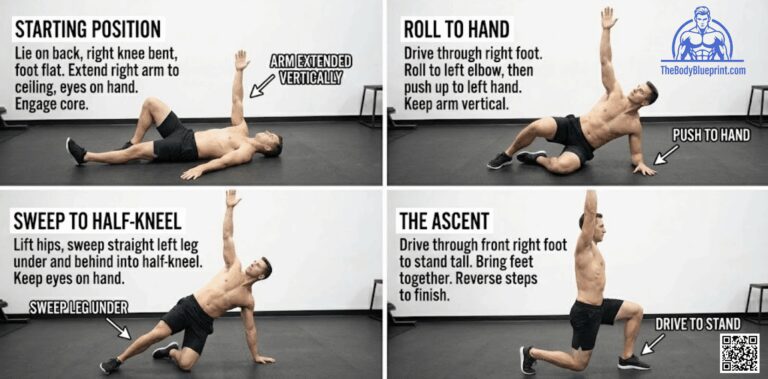
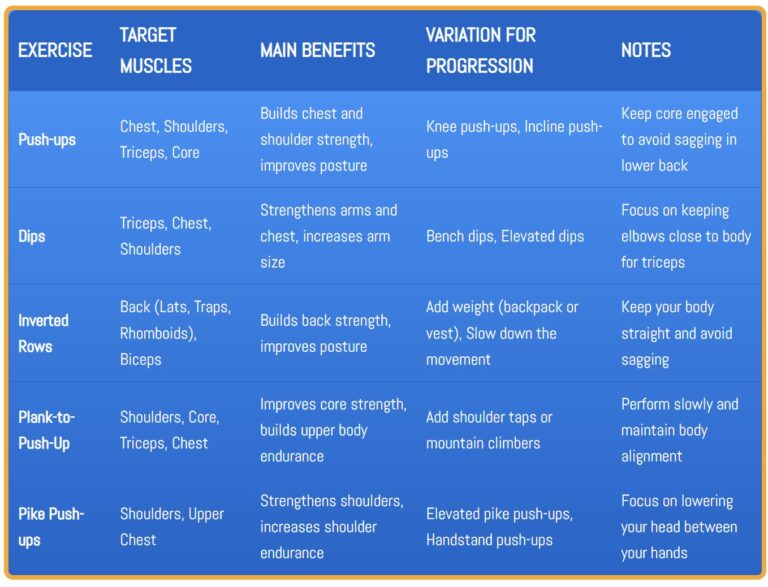
Dynamic bodyweight training is a movement-based strength method that uses full-range motion to build power, coordination, and muscular development. Unlike static holds, dynamic exercises challenge the body through motion, making them essential for athleticism and physique-building.
- Movement-driven strength — muscles contract concentrically and eccentrically.
- Higher metabolic demand — ideal for conditioning and hypertrophy.
- Skill development — improves coordination, rhythm, and control.
For a comparison of static vs dynamic training, see Differences Between Static and Dynamic Bodyweight Exercises.
What Is Dynamic Bodyweight Training?
Dynamic bodyweight training uses movement through a full range of motion to build strength, power, and muscular development. The body moves; the muscles contract and lengthen.
This creates a training effect that improves coordination, increases muscle recruitment, and builds the kind of functional strength that carries over into sports, lifting, and daily movement.
Benefits of Dynamic Bodyweight Training
Dynamic training improves strength, conditioning, and movement efficiency by challenging the body through motion. It builds muscle and athleticism simultaneously.
- Greater muscle recruitment — more fibers activated per rep.
- Improved cardiovascular conditioning — higher metabolic demand.
- Better movement quality — coordination and rhythm improve.
- Scalable difficulty — progressions for every level.
“Dynamic training teaches your body to move as a system, not a collection of parts.”
— Eugene Thong, CSCS
Core Movement Patterns in Dynamic Training
Dynamic training relies on fundamental movement patterns that build strength and athleticism across multiple joints. These patterns form the backbone of bodyweight programming.
1. Push Patterns
Push patterns use upper-body pressing motion to build chest, shoulder, and triceps strength. Push-ups, dips, and handstand push-ups are staples.
2. Pull Patterns
Pull patterns use upper-body pulling motion to develop the back and biceps. Pull-ups, chin-ups, and bodyweight rows dominate this category.
3. Squat Patterns
Squat patterns use lower-body flexion and extension to build quads, glutes, and hips. Air squats, split squats, and pistol squats are key examples.
4. Hinge Patterns
Hinge patterns use hip-dominant movement to strengthen the posterior chain. Hip hinges, glute bridges, and back extensions fit here.
5. Locomotion Patterns
Locomotion patterns use full-body movement to build coordination and conditioning. Bear crawls, crab walks, and lateral shuffles are common.
2026 Progressions for Dynamic Bodyweight Training
Dynamic progressions use increased range, leverage, or complexity to scale difficulty. This makes bodyweight training endlessly adaptable.
- Range of motion — deeper push-ups, lower squats.
- Leverage changes — decline push-ups, archer pull-ups.
- Tempo manipulation — slower eccentrics, explosive concentrics.
- Unilateral variations — single-leg or single-arm movements.
- Complexity — combining patterns into flows.
Dynamic training evolves with the athlete — there’s always another layer of difficulty waiting.
The Iron Lexicon: Dynamic Training Edition
- Dynamic Training
- Movement-based strength work using full-range motion.
- Concentric Contraction
- The shortening phase of a movement.
- Eccentric Contraction
- The lengthening phase of a movement.
- Movement Pattern
- A fundamental motion used to organize training.
- Progression
- A method of increasing difficulty through leverage, range, or complexity.