Let’s get straight to the point. You’re comparing Isopure Zero Carb vs Quest Protein Powder, and you’re wondering: “Is one of these the undisputed king for a lean diet, or are we splitting hairs between two solid options?” Good. You’re focused. Let’s break it down now.
This isn’t just about hitting your protein intake. It’s about finding a clean, effective supplement that fits your dietary needs, whether that’s avoiding lactose or ensuring you get enough calcium for bone health. Both of these powders can help you recover and reset after a tough workout, but they take different paths to get there.
Who Should Chug Isopure (And Who Should Grab Quest)
| ISOPURE ZERO CARB IS FOR YOU IF… | QUEST PROTEIN IS FOR YOU IF… |
|---|---|
| You need a 100% lactose-free formula due to intolerance or other sensitivities. | You want a protein powder that doubles as a meal replacement with more fiber. |
| Your goal is pure protein with virtually nothing else—zero carbs, zero fat. | You want the added benefit of 20-30% of your daily calcium for bone health. |
| You value a minimal ingredient list and a simple, effective supplement. | You enjoy a thicker, more filling shake and don’t mind a few extra grams of carbs. |
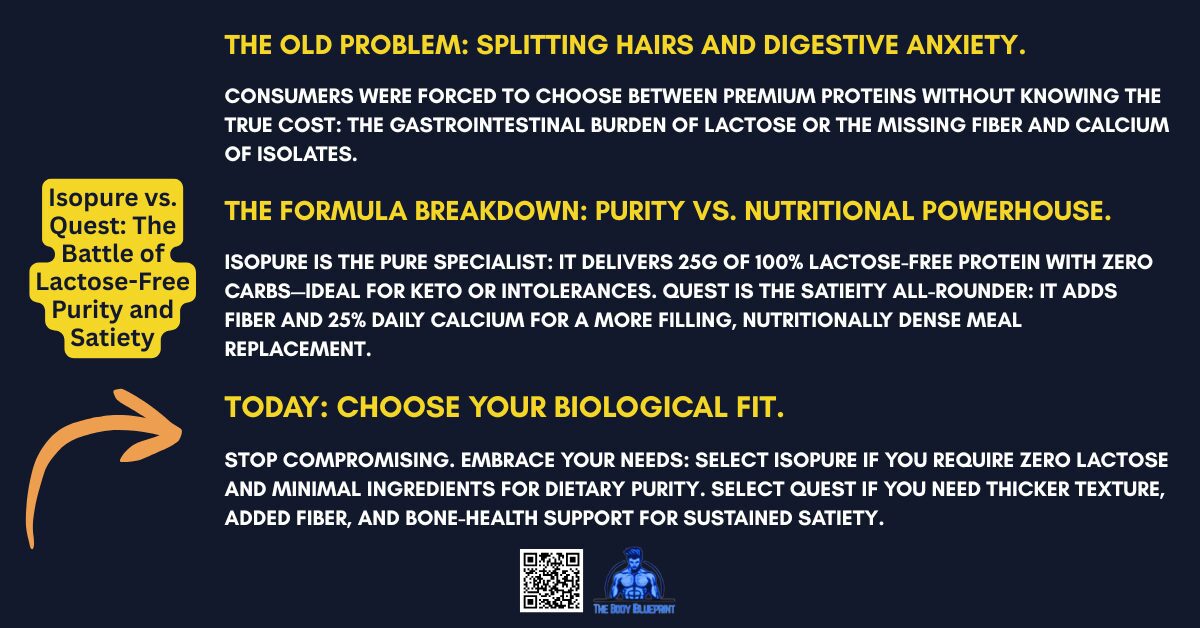
The Macro Breakdown: Pure Protein vs. Nutritional Powerhouse
At its core, Isopure delivers 25 grams of pure protein with zero carbs and zero sugar. It’s a laser-focused tool for hitting your protein intake without any extras. Quest, with around 20-25 grams of protein per serving, adds value with 5 or more grams of fiber and a significant calcium boost.
“Your protein powder should work with your body, not against it. For those with lactose intolerance, a formula that doesn’t cause digestive stress is non-negotiable. That’s where a truly lactose-free option becomes essential,” says Charles Damiano, B.S. Clinical Nutrition.
In regard to bone health, it’s worth noting that Quest provides a distinct advantage by including around 25% of your recommended daily value for calcium. This is a valuable addition for overall health, especially for active individuals.
Head-to-Head: The Unfiltered Pros & Cons
👍 ISOPURE ZERO CARB – YOUR BEST BET FOR:
- Zero lactose – making it a good option for those with intolerance
- Minimal ingredient list – you know exactly what you’re getting
- Perfect for strict keto or carb-cutting phases
- Contains BCAAs (Branched Chain Amino Acids) to help with recovery
👎 ISOPURE – MAY NOT BE FOR YOU IF:
- You want a thicker, more satisfying shake (it mixes very thin)
- You need the added nutritional benefits of fiber and calcium
👍 QUEST PROTEIN – THE SMARTER CHOICE FOR:
- Enhanced nutrition with added fiber and 25% daily calcium
- Better satiety – the extra fiber helps keep you full
- Superior flavor and texture in most varieties
👎 QUEST – RECONSIDER IF:
- You are on a very strict ketogenic diet (contains a few carbs)
- You have a severe lactose sensitivity (it uses milk protein isolate)
Specs That Matter For Your Goals
| Feature | Isopure Zero Carb | Quest Protein |
|---|---|---|
| Protein (grams) | 25g | 20-25g |
| Carbohydrates | 0g | 5-10g (mostly fiber) |
| Lactose | Free | Low, but present |
| Key Benefit | Purity & Simplicity | Nutrition & Satiety |
My Protein Recommendation
My Recommendation: ISOPURE ZERO CARB
👉 Full Disclosure: Links to Amazon in this article are affiliate links. As an Amazon Associate, I earn from qualifying purchases. You don’t pay a penny more, you snag the best deals here, and you support this work (I earn a commission). Fair trade for the research grind?
6 Protein Powder Questions (That Actually Matter)
A: This is a common area of confusion. “The old myth that high protein intake harms bones has been largely debunked by modern research,” explains Charles Damiano, B.S. Clinical Nutrition. “In fact, protein is crucial for bone matrix formation. The calcium in Quest isn’t there to offset protein; it’s a beneficial add-on that makes it a smart choice for individuals looking to support their overall bone health.”
A: Absolutely. The Isopure formula is 100% lactose-free, making it one of the best options for those with lactose intolerance or other dairy sensitivities. It’s a simple, effective supplement that avoids the digestive issues many experience with other whey proteins.
A: Isopure contains BCAAs (Branched Chain Amino Acids) in each serving. These are the essential amino acids your body uses to help recover and rebuild muscle tissue after a workout. “Think of BCAAs as the key that starts the engine of muscle repair,” says Eugene Thong, CSCS. “They’re not the fuel, but they signal your body to reset and grow stronger.”
A: It can be, but you must factor in the carbs. With 5-10 grams of carbs per serving (mostly from fiber), it can fit into a more liberal keto diet. However, for those aiming for under 20 total grams of carbs per day, Isopure’s zero-carb formula is the simpler, more effective supplement for staying in ketosis.
A: Quest is the clear winner here. The combination of 20-25 grams of protein, 5 or more grams of fiber, and added vitamins/minerals makes it far more satiating and nutritionally balanced. Isopure is designed to be a pure protein hit, not a meal.
A: A clean, minimal ingredient list makes for a smart choice for individuals with dietary restrictions. It reduces the chance of reactions to fillers, artificial sweeteners, or other additives. In this regard, Isopure’s straightforward formula is its biggest strength for those who need a simple, effective supplement.
Final Thought: The “better” powder depends entirely on your biology and goals. Isopure is the specialist for pure, lactose-free protein. Quest is the all-rounder for enhanced nutrition. Choose the one that fits your body, not just your macros.