
Foam rolling is not a passive stretching routine; it is mandatory mechanical maintenance for your connective tissue. Heavy lifting and high-output training create structural friction, leading to fascial gridlock. If you do not actively iron out your tissue, your mobility will degrade, and your power output will drop. This 2026 hub breaks down the exact performance mechanics of the best foam rollers on the market. From high-density structural logs to high-frequency oscillating motors, we are evaluating the exact hardware you need to optimize your recovery logistics and keep your engine running flawlessly.
Disclaimer & Disclosure: I break down the science; you do the heavy lifting. As an Amazon Associate, I earn from qualifying purchases at no added cost to you. Fair deal?
Tissue Logistics: Why You Need a Foam Roller
Your biological hardware requires active physical compression to clear metabolic waste and maintain optimal fluid dynamics.
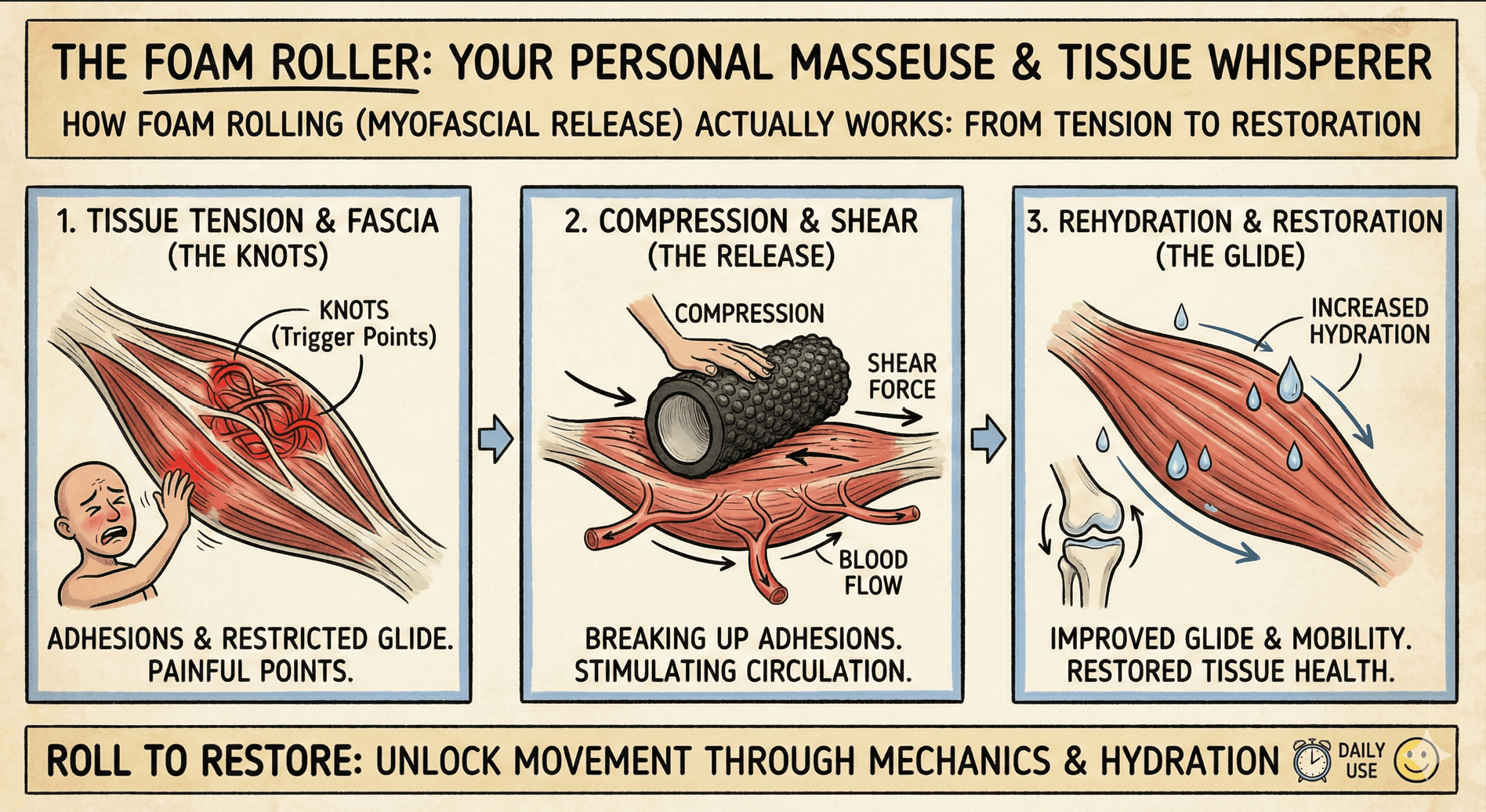
You cannot just sit on the couch and expect your tissue to remodel itself after a brutal leg day. Connective tissue (fascia) encases your muscles. When subjected to heavy loads, it tightens and binds. A proper foam roller applies direct mechanical pressure to these restricted zones, promoting localized blood flow and ensuring that your muscle remodeling protocols function efficiently. It is the cheapest, most effective form of daily structural maintenance.
The Best Foam Rollers: High-Density Baseline
High-density rollers are the blunt-force instruments of fascial maintenance.
If you have dense, thick muscle mass, a soft roller will simply compress under your weight. You need uncompromising hardware that forces the tissue to yield.
“A high-density foam roller is like a heavy-duty alignment rack for your chassis. It doesn’t pamper you; it forcefully recalibrates your fascial tension so your hinges stop grinding. If you are moving heavy iron, you need raw, unyielding pressure to unbind the gridlock.”
— Eugene Thong, CSCS
1. Amazon Basics High Density Foam Roller
This is the heavy infantry of recovery. It is a molded polypropylene log that maintains its shape under extreme loads. It offers zero give and zero frills—just pure, unapologetic structural pressure. Perfect for ironing out the IT band and quads after heavy barbell front squats.
Deep Dive: Read our full diagnostic review of the Amazon Basics High Density Roller.
Textured & Medium-Density Hardware
Textured rollers mimic the precision of a therapist’s hands to unbind stubborn fascial gridlock.
Sometimes you need more than just flat compression. A grid-style roller allows you to sink deeper into the muscle belly to separate bound tissues and optimize localized circulation.
2. 321 Strong Foam Roller (Medium Density)
The tactical mid-tier option. The 321 Strong utilizes a 3D massage grid designed to replicate the fingers, thumbs, and palms of a massage therapist. It provides adequate structural pressure without bruising the tissue, making it the ideal primer for your daily warm-up logistics.
Deep Dive: Read our full diagnostic review of the 321 Strong Roller.
3. 5-in-1 Foam Roller Set
This is a complete recovery infrastructure in one package. You get the primary high-density roller for large muscle groups, plus a massage ball and resistance band to target the micro-frictions in your glutes and shoulders. It is the ultimate budget-friendly biological maintenance kit.
Deep Dive: Read our full diagnostic review of the 5-in-1 Roller Set.
The Best Vibrating Foam Rollers
Adding mechanical oscillation to deep tissue compression drastically accelerates fluid dynamics and recovery.
Vibration overrides the nervous system’s pain response, allowing you to sink deeper into restricted tissue while the motor drives blood flow directly into the muscle.
“Adding a high-frequency motor to a foam roller is like injecting nitrous into a combustion engine. The oscillation actively overrides your nervous system’s brake pedal, allowing you to bypass the bracing reflex and access deep-tissue gridlock in half the time.”
— Charles Damiano, B.S. Clinical Nutrition
4. Hyperice Vyper 3
The premier oscillating engine on the market. The Vyper 3 delivers massive torque and high-intensity vibration directly into your structural framework. If you are an elite athlete pushing maximum volume, this is the premium hardware required to speed up your remodeling timeline.
Deep Dive: Read our full diagnostic review of the Hyperice Vyper 3.
5. FITINDEX Vibrating Foam Roller
High-frequency output without the premium price tag. The FITINDEX offers a 5-speed motor housed in an aggressive grid texture. It is a highly effective, portable bypass valve to clear out systemic tension in your legs and lower back after heavy volume.
Deep Dive: Read our full diagnostic review of the FITINDEX Vibrating Roller.
Targeted & Soft Density Recovery
You must match the density of your hardware to the specific needs of your connective tissue.
Sometimes laying your entire body weight on a roller is anatomically impossible or too aggressive for delicate tissue.
6. Tiger Tail Massage Stick (22″)
The ultimate tactical bypass tool. The Tiger Tail allows you to manually dictate the exact leverage and pressure applied to your tissue. It is mandatory gear for pinpointing the calves and shins where a traditional floor roller simply cannot reach.
Deep Dive: Read our full diagnostic review of the Tiger Tail Stick.
7. OPTP PRO-Roller Soft Density
Low-density support for delicate infrastructure. The OPTP PRO-Roller offers a forgiving, soft-density foam that will not trigger a defensive bracing response from your nervous system. Ideal for Pilates, stretching, and easing into your upper back mobility routines.
Deep Dive: Read our full diagnostic review of the OPTP Soft Roller.
Final Verdict: Upgrading Your Routine
A foam roller is the cheapest, highest-yield investment you can make in your physical longevity. Evaluate your biological output, select the appropriate density and texture from the hardware listed above, and start ironing out your chassis. Consistency is the only metric that matters.
Maintain Your Hardware
Do not wait until your mobility is entirely locked up to start caring about your fascia. Upgrade your recovery protocol and keep your physical engine operating at maximum capacity.