The Band-Resisted Ab Wheel Iso is the ultimate core-tension hack, designed to eliminate “lower back cheating” and force the abs into a state of maximum recruitment.
If you’re just mindlessly rolling back and forth on an ab wheel, you’re missing the data. By adding band resistance to an isometric hold, we are forcing the anti-extension muscles of the core to work at 100% capacity. It’s time to stop doing “reps” and start building structural integrity.
Disclaimer: Consult a physician or qualified trainer before starting any new exercise. This guide focuses on performance and aesthetic optimization and is for educational purposes only.
Band-Resisted Ab Wheel Iso: High-Tension Stability
The Band-Resisted Ab Wheel Iso is an advanced core stability drill where a resistance band pulls the ab wheel away from the body during a static hold. Unlike the standard Ab Wheel Rollout, which focuses on the concentric and eccentric phases, the Iso (isometric) hold forces the core to resist extension under constant, variable tension. It’s the “data-proven” method for teaching your brain how to keep your spine neutral under extreme stress.
- Primary Focus: Rectus Abdominis, Obliques, Serratus Anterior.
- Equipment Needed: Ab Wheel, Resistance Band, Anchor Point.
- Skill Level: Intermediate to Advanced.
- Key Purpose: Eliminate lower back compensation and maximize time under tension (TUT).
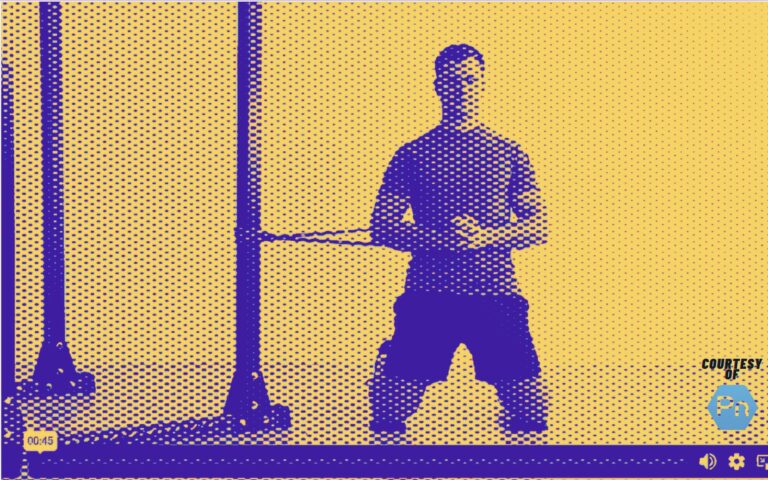
Band-Resisted Ab Wheel Iso instructional video. Note the hollow-body position and locked-in lats.
Why Band-Resistance Changes the Core Game
Standard isometrics are good; band-resisted isometrics are elite. The band adds a “tug-of-war” element that forces the deep stabilizers to fire to prevent the wheel from flying forward. If you want a core that supports heavy Barbell Deadlifts, this is your primary tool.
- Anti-Extension Mastery: It teaches you to stop your lower back from arching, a critical skill for heavy lifting and injury prevention.
- Lat-Core Integration: The band forces the lats to work in tandem with the abs, building a “shield” around your spine.
- Neuro-Muscular Efficiency: Your brain has to work harder to stabilize a moving resistance than a static one.
- Metabolic Burn: The isometric hold creates an occlusion effect in the muscle, driving growth through metabolic stress.
Step-by-Step Form: The 5-Point Checklist
- The Anchor: Loop a resistance band around a low anchor point and then around the center of the ab wheel.
- The Setup: Kneel facing away from the anchor point. Your core should be pre-braced. Prime the pattern with 90/90 Wall Balloon-Breathing.
- The Roll: Roll out into a hollow-body position. Do not go so far that your back arches.
- The Hold: Stay in the fully extended position. Fight the band as it tries to pull the wheel further away. Keep your glutes squeezed.
- The Recovery: Pull the wheel back to the starting position under total control. Do not “snap” back.
“The band creates an ‘anti-gravity’ effect for the core. It demands that the lifter find stability in a compromised position. If you can’t hold this for 10 seconds without your hips sagging, you haven’t earned the right to do full Ab Wheel Rollouts. The ISO is where true core armor is built.”
— Eugene Thong, CSCS
3 Common Form Mistakes & How to Fix Them
Precision is the difference between a six-pack and a herniated disc.
1. The “Banana Back”
The Mistake: Letting the lower back sag toward the floor as the band pulls. The Fix: Squeeze your glutes like you’re trying to crush a walnut. If you still can’t stay flat, reduce the distance of the rollout or use a lighter band.
2. Holding Your Breath
The Mistake: Relying on the Valsalva maneuver to survive the set. The Fix: Use “sip” breaths. You need to maintain intra-abdominal pressure without cutting off oxygen. See 90/90 Wall Balloon-Breathing for the blueprint.
3. Shoulder Sag
The Mistake: Letting your ears touch your shoulders. The Fix: Push the floor away. Engage your lats. Think about “packing” your shoulders into your back pockets.
“From a physiological perspective, the isometric hold creates significant intra-abdominal pressure. This is a massive metabolic drain. If you aren’t fueling with a clean source like Momentous Grass-Fed Whey, you’re leaving recovery data on the table. The core is a muscle group—feed it.”
— Charles Damiano, B.S. Clinical Nutrition
Programming for Performance
Isometrics thrive on quality, not quantity.
- Foundational Stability: 3 sets of 10-second holds. Focus on “maximum brace.”
- Endurance Finisher: 2 sets of “Hold to Form Failure.” Once your hips drop 1 inch, the set is over.
- The “Shield” Protocol: Superset with Single-Arm Farmer’s Carries for total midsection dominance.
Variations to Scale Difficulty
- To Regress: Perform the Ab Wheel Iso without the band. Master the bodyweight hold first.
- To Progress: Use a thicker band or perform the hold from a standing position (Elite level).
- Unilateral Challenge: Anchor the band slightly to one side to increase oblique recruitment.
The Verdict
The Band-Resisted Ab Wheel Iso is the ultimate filter. It separates those who just “do abs” from those who build a functional, bulletproof engine. If you want results in 2026, you need to own the isometric. Brace. Fight the band. Grow.
Band-Resisted Ab Wheel Iso FAQ
Does this help with back pain?
By strengthening the anti-extension muscles, it can help stabilize the lumbar spine. However, if you have active pain, consult a professional and stick to the Dead Bug first.
How far out should I roll?
Only as far as you can maintain a “flat” or “hollow” lower back. The “pixels” of your form are more important than the distance.
What band should I start with?
Start with a light “micro” band. The goal is to feel the resistance, not to have the wheel ripped out of your hands.