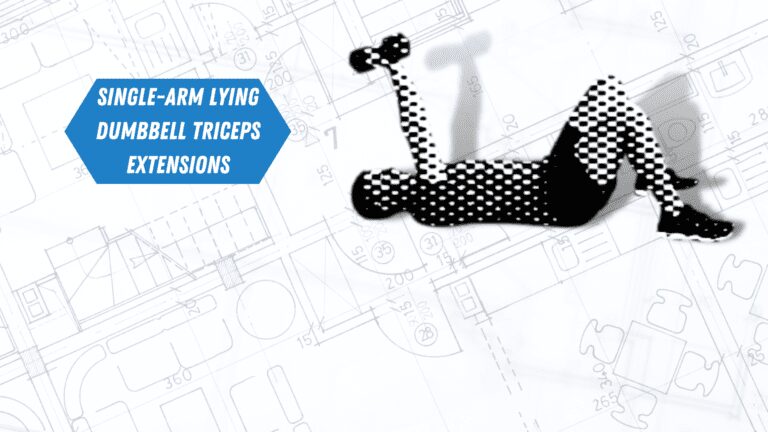
The Single-Arm Lying Dumbbell Rolling Triceps Extension is the smartest way to build massive triceps without destroying your elbows. While standard skullcrushers place immense shearing force on the joint, the “rolling” technique shifts that stress onto the muscle belly where it belongs.

Important: The “roll” is controlled, not reckless. If you throw the weight up without tension, you risk hitting your face. Maintain a grip of steel throughout the movement.
Why Rolling Extensions Save Your Joints
The standard skullcrusher keeps the elbow locked in space, which isolates the tricep but grinds the tendon. The Rolling Extension allows the elbow to move backward, turning the movement into a hybrid pullover/extension. This distributes the load across the shoulder joint and the elbow joint, allowing for heavier weight with less pain.
The Benefits at a Glance
| Advantage | The Payoff |
|---|---|
| Joint Longevity | Deloads the elbow tendon at the point of maximum stress (the bottom). |
| Overload Potential | You can lift significantly heavier weight because you are using momentum to initiate the concentric (lifting) phase. |
| Long Head Activation | The backward roll stretches the long head of the tricep more than a static extension. |
How to Perform Rolling Triceps Extensions
This is a rhythm lift; do not try to be robotic. You want a smooth transition from the roll to the press.
Step-by-Step Execution
- The Setup: Lie on a flat bench. Hold a dumbbell in one hand, arm vertical. Use the other hand to brace your abs or hold the bench.
- The Descent: Lower the dumbbell toward the opposite shoulder. As you approach the bottom, let your elbow drift back toward your ear.
- The Roll: At the very bottom, the dumbbell should be behind your head and your elbow pointing back. Feel the stretch in your lat and tricep.
- The Rebound: Drive the elbow forward slightly and explosively extend the arm. Use the momentum to help start the lift.
- The Lockout: Squeeze the tricep hard at the top. Reset for the next rep.
“Think of this as throwing a punch backwards. You are coiling the spring (rolling back) and then releasing it (extending). It should feel powerful, not stiff.”
— Eugene Thong, CSCS
Common Mistakes That Kill Progress
If you turn this into a shoulder press, you are wasting your time. The shoulder movement is subtle—just enough to deload the elbow.
- Too Much Roll: Turning it into a pullover. Fix: The elbow should only move back a few inches, not a foot.
- Flaring Elbows: Letting the elbow drift way out to the side. Fix: Keep the elbow tucked in, pointing toward your feet/wall.
- No Lockout: Stopping short at the top. Fix: Fully extend the arm to contract the tricep.
Programming & Optimization
This is a strength-builder for the triceps; unlike cable pressdowns, you can go heavy here.
Sample Protocol
| Goal | Sets/Reps | Context |
|---|---|---|
| Mass/Strength | 4 x 8-10 reps | Heavy load. Rest 2 mins. |
| Hypertrophy | 3 x 12-15 reps | Focus on the stretch. |
Performance Stack
Heavy tricep work requires joint support and cellular energy.
- Joint Health: Even with better mechanics, heavy loads stress the joint. Use the Hypervolt Go 2 to warm up the area before lifting.
- Recovery: Repair is everything. Optimize deep sleep with high-quality sleep hygiene protocols.
- Cellular Age: As we age, tendon repair slows. NAD+ Cell Regenerator supports mitochondrial health for faster tissue repair.
- Digestion: Absorption matters. Ensure your gut is absorbing nutrients with a top-tier probiotic. Compare Seed vs Align to find the best fit.
Tech Alternative
If you train at home, digital weights can simulate this curve.
Compare Speediance vs Tonal vs Vitruvian to see which smart gym offers the best articulating arms for tricep work.
The Verdict
The Rolling Tricep Extension allows you to train heavy without pain. It fixes the flaw of the skullcrusher. Roll back, stretch deep, and extend with power.