Muscle activation is the neurological bridge between your brain and your muscle fibers. That connection determines whether you’re actually recruiting the tissue you think you’re working. This 2026 guide breaks down the science of neuromuscular efficiency. It explains why certain muscles “switch off.” It provides the activation drills that restore proper movement patterns for better strength gains and injury resistance.
Disclaimer: This guide is for educational purposes only and is not medical advice. Always consult with a qualified professional about your personal health needs. As an Amazon Associate, I earn from qualifying purchases at no added cost to you.
What Is Muscle Activation?
Muscle activation is the process of intentionally engaging specific muscles to improve neural drive from your central nervous system. Think of it as waking up a muscle that’s been napping during your compound lifts.
When you perform a goblet squat, your brain should recruit your glutes, quads, hamstrings, and core in sequence. But if your glutes are inhibited, your lower back and hamstrings take over. That’s how you end up with a sore back and underdeveloped glutes despite squatting heavy.
“Neuromuscular efficiency is the difference between looking like you lift and actually transferring that strength to compound movements. Activation drills prime the nervous system to recruit the right motor units at the right time.”
— Eugene Thong, CSCS
Why Muscles Shut Down
Muscles don’t randomly decide to stop working. Inhibition usually stems from three sources. Understanding the cause helps you pick the right fix.
1. Prolonged Sitting
Hours of sitting places your glutes in a lengthened, inactive position. Your brain essentially forgets how to fully activate them. That’s why single-leg glute bridges feel awkward at first. The neural pathway is rusty.
2. Previous Injury or Compensation
If you’ve ever sprained an ankle or tweaked your lower back, your nervous system created protective movement patterns. Those patterns often involve shutting down certain muscles to rely on others. This is why banded external rotations help restore rotator cuff function.
3. Weak Stabilizers
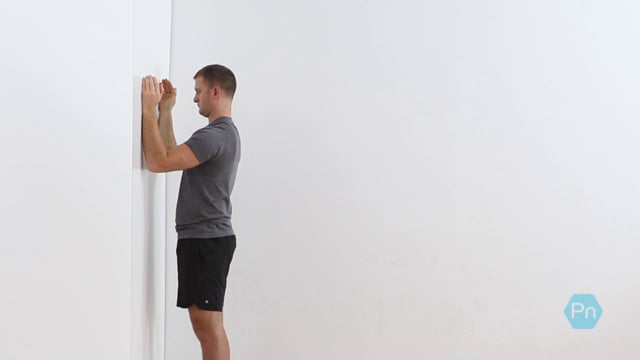
Sometimes the muscle isn’t inhibited. It’s just weak relative to its surrounding synergists. Your body always takes the path of least resistance. If scapular wall slides feel impossible, your upper traps are likely dominating your movement patterns.
Top Muscle Activation Exercises
These drills target the most commonly inhibited muscle groups. Use them before your main lifts to ensure proper recruitment.
Glute Activation
- Band-Resisted Glute Bridge: Place a band just above your knees. Drive through your heels and squeeze your glutes at the top. Hold for two seconds. This teaches hip extension without lower back involvement. See our band-resisted glute bridge guide.
- Single-Leg Glute Bridge: Keep your pelvis level. If you cramp in the hamstring, you’re not activating the glute properly. Check our single-leg glute bridge breakdown.
- Lateral Band Walks: Keep tension on the band. Don’t let your knees cave inward. Learn proper form with X-band walks.
Scapular & Rotator Cuff Activation
- Band Pull-Aparts: Pinch your shoulder blades together at the peak. This wakes up rhomboids and rear delts. See our band pull-apart guide.
- Prone Y-T-I Raises: Lie face down on an incline bench. Raise your arms to form Y, T, and I shapes. This recruits lower traps and external rotators. Check prone Y raise and prone T raise guides.
- Banded No-Money Exercise: Place bands around your hands. Externally rotate against resistance. This fires up the infraspinatus and teres minor. Learn banded no-money technique.
Core Activation
- Dead Bug: Press your lower back into the floor. Move slowly. If your back arches, your transverse abdominis isn’t activating. See our dead bug tutorial.
- Pallof Press (Iso Hold): Stand perpendicular to a band or cable. Press out and resist rotation. This teaches your obliques and deep core to stabilize under load. Check Pallof press iso hold and Pallof press with bands.
- Bird Dog: Extend opposite arm and leg. Keep your spine neutral. If you wobble, your core isn’t locking in. Learn from our single-leg stability progressions.
Anterior Tibialis Activation
- Toe Walks: Walk on your heels with toes elevated. This wakes up the tibialis anterior. That muscle is crucial for ankle stability and explosive movements.
- Band-Resisted Dorsiflexion: Anchor a band low. Loop it around your foot. Pull your toes toward your shin. Great for runners and anyone doing burpees.
“The goal of activation work isn’t fatigue. It’s neural priming. You’re not trying to burn out the muscle. You’re trying to get it to fire on command during your main lifts. Two sets of 10-15 reps with controlled tempo is usually plenty.”
— Eugene Thong, CSCS
Best Tools for Muscle Activation
Bodyweight drills work, but certain tools accelerate the process. They provide sensory feedback and targeted tension that wakes up dormant muscles faster.
1. Resistance Bands
Bands provide variable resistance. They force your muscles to work through a full range of motion while maintaining constant tension. Essential for banded face pulls, pull-aparts, and external rotation work.
- Our Pick: The FitSimplify Resistance Band Set offers multiple tensions.
- Budget Option: WODFitters Band Set is durable and affordable.
2. Lacrosse Balls & Mobility Tools
Sometimes muscles are inhibited due to trigger points. A lacrosse ball helps release tension in glutes, pecs, and rotator cuff before activation. Check our foam roller guide for more recovery tools.
- Our Pick: RumbleRoller Lacrosse Ball is firm enough for deep tissue work.
3. Mini Bands
Short loop bands placed above the knees or ankles are perfect for lateral band walks and glute bridges. They provide immediate feedback if your knees cave during squats. See our banded external rotation library.
- Our Pick: Perform Better Mini Bands offer consistent tension without rolling.
4. Vibrating Foam Rollers
Research suggests vibration can temporarily improve range of motion. This makes activation drills more effective. Read our FitIndex vibrating foam roller review.
- Our Pick: FitIndex Vibrating Foam Roller offers multiple speeds.
5. Massage Guns
Using a massage gun on inhibited muscles can stimulate sensory receptors and improve neural drive. Compare options in our massage gun comparison.
- Our Pick: Hypervolt Go 2 is portable and powerful enough for pre-workout activation.
How to Program Activation Work
Activation doesn’t require a separate workout day. It’s a pre-workout primer. It should take 5-10 minutes max.
The Template
- Step 1: Identify your weak links. If your glutes don’t fire during back squats, prioritize glute activation.
- Step 2: Choose 2-3 activation drills targeting those muscles.
- Step 3: Perform 1-2 sets of 10-15 reps with controlled tempo. No failure. No burn. Just neural priming.
- Step 4: Immediately transition into your main lift while the activation “holds.”
Sample Activation Circuits
Lower Body Day (Pre-Squat):
- Band-Resisted Glute Bridge – 1×15
- Lateral Band Walks – 1×10 each direction
- Bird Dog – 1×8 each side
Upper Body Day (Pre-Press):
- Banded Pull-Aparts – 1×15
- Prone Y-T-I Raises – 1×8 each shape
- Scapular Wall Slides – 1×10
Core & Conditioning Day:
- Dead Bug – 1×10 each side
- Tall Kneeling Pallof Press – 1×8 each side
- Single-Leg Glute Bridge – 1×10 each leg
“Think of activation like priming a pump. You’re not filling the tank. You’re just getting the water flowing so the main event works efficiently. Five minutes of targeted drills can transform how your main lifts feel.”
— Charles Damiano, B.S. Clinical Nutrition
Common Activation Mistakes
Most lifters screw up activation work in predictable ways. Here’s how to fix them.
- Mistake #1: Treating Activation Like a Workout. If you’re sore from activation drills, you did too much. These are primers, not builders.
- Mistake #2: Rushing Through Reps. Activation requires intent. Slow down and focus on the mind-muscle connection. Learn more about fast vs slow twitch fibers.
- Mistake #3: Ignoring the Weak Link. If your glutes are dormant but you never do glute activation, don’t expect them to wake up during squats.
- Mistake #4: Skipping Hydration and Nutrition. Muscle function depends on electrolytes and fuel. Check our Pedialyte AdvancedCare review and Nuun Sport review for hydration options.
Prehab & Joint Support Applications
Activation drills also support joint stability and injury prevention. They strengthen the muscles that protect your joints during training.
Ankle Stability & Injury Prevention
Weak tibialis anterior and peroneals can lead to ankle instability. Add these before lower body work:
- Toe Walks: 2 sets of 20 steps. This activates the tibialis anterior.
- Band-Resisted Dorsiflexion: 1×15 each leg. This builds ankle control.
- Single-Leg Balance: Stand on one leg for 30 seconds. Progress to eyes closed. This improves proprioception.
Knee Stability & Joint Support
Quad-dominant patterns often leave VMO and glutes underactive. That stresses the knee. Try these:
- Terminal Knee Extension with Band: Loop a band around a post and your knee. Extend your knee against resistance. This fires the VMO. Check our single-leg glute bridge for glute support.
- Lateral Band Walks: Strengthens glute medius, which controls knee valgus. Proper form prevents knee collapse during squats.
- Step-Ups with Controlled Tempo: Use a low box. Control the descent. This teaches proper tracking.
Shoulder Stability & Injury Prevention
Rotator cuff activation is essential for anyone who presses overhead. Include these before upper body days:
- Banded External Rotations: 1×15 each arm. Wakes up infraspinatus and teres minor. See our banded external rotation library.
- Prone Y-T-I Raises: 1×8 each shape. Targets lower traps and scapular stabilizers.
- Banded Face Pulls: 1×15. Improves external rotation and scapular retraction. Check our banded face pull guide.
For comprehensive joint support, pair activation work with proper nutrition. Collagen supplements support connective tissue health. Omega-3s support healthy inflammatory response. Magnesium supports muscle function and recovery.
The Final Word on Muscle Activation
Muscle activation isn’t a trend. It’s a fundamental component of intelligent training. If you’ve plateaued, feel joint pain during lifts that should be pain-free, or struggle to feel certain muscles working, activation work is likely your missing piece.
Start with the basics: glute bridges, band pull-aparts, and dead bugs. Add a set before your main lifts for two weeks. Track how your movement quality changes. For most lifters, the difference is night and day.
Pair your activation work with proper recovery tools like foam rollers. Support your connective tissue with quality collagen. Maintain joint health with omega-3s.
Related Training Guides
- Best Workout Routines for Men (2026)
- Bodyweight Exercise Library: 100+ Movements
- Core Strength Exercises: The Complete List
- Glute Exercises: The Ultimate Guide
- Best Ab Exercises for a Stronger Core
- Lower Belly Pooch: Deep Core Activation Exercises
- Muffin Top Fix: Oblique and Anti-Rotation Moves
The Training Lexicon: Activation Edition
- Neuromuscular Efficiency
- The ability of your nervous system to recruit the correct muscle fibers at the right time with optimal coordination. Higher efficiency means more force with less wasted energy.
- Motor Unit Recruitment
- The process by which your nervous system activates groups of muscle fibers. Activation drills aim to improve recruitment patterns for specific muscles.
- Inhibition (Muscular)
- A protective or learned response where the nervous system reduces neural drive to a muscle. Often due to injury, compensation patterns, or prolonged inactivity.
- Proprioception
- The body’s ability to sense its position in space. Activation work improves proprioceptive feedback. It helps you feel whether a muscle is actually working.
- Isometric Hold
- A muscle contraction without joint movement. Isometric holds like Pallof presses are excellent for teaching stabilization and activation without fatigue.
- Synergist Dominance
- A movement dysfunction where a secondary muscle takes over for a primary mover that’s inhibited. For example, hamstrings taking over for glutes in hip extension.
- Rate Coding
- The frequency at which motor units fire. Higher rate coding equals more force production. Activation drills can improve rate coding through neural priming.