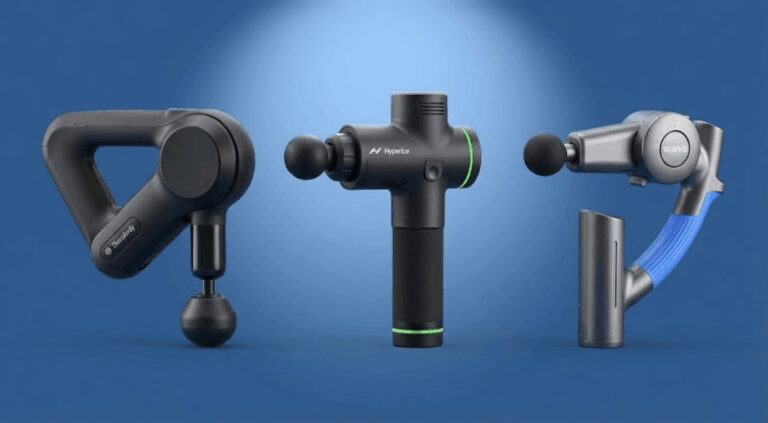
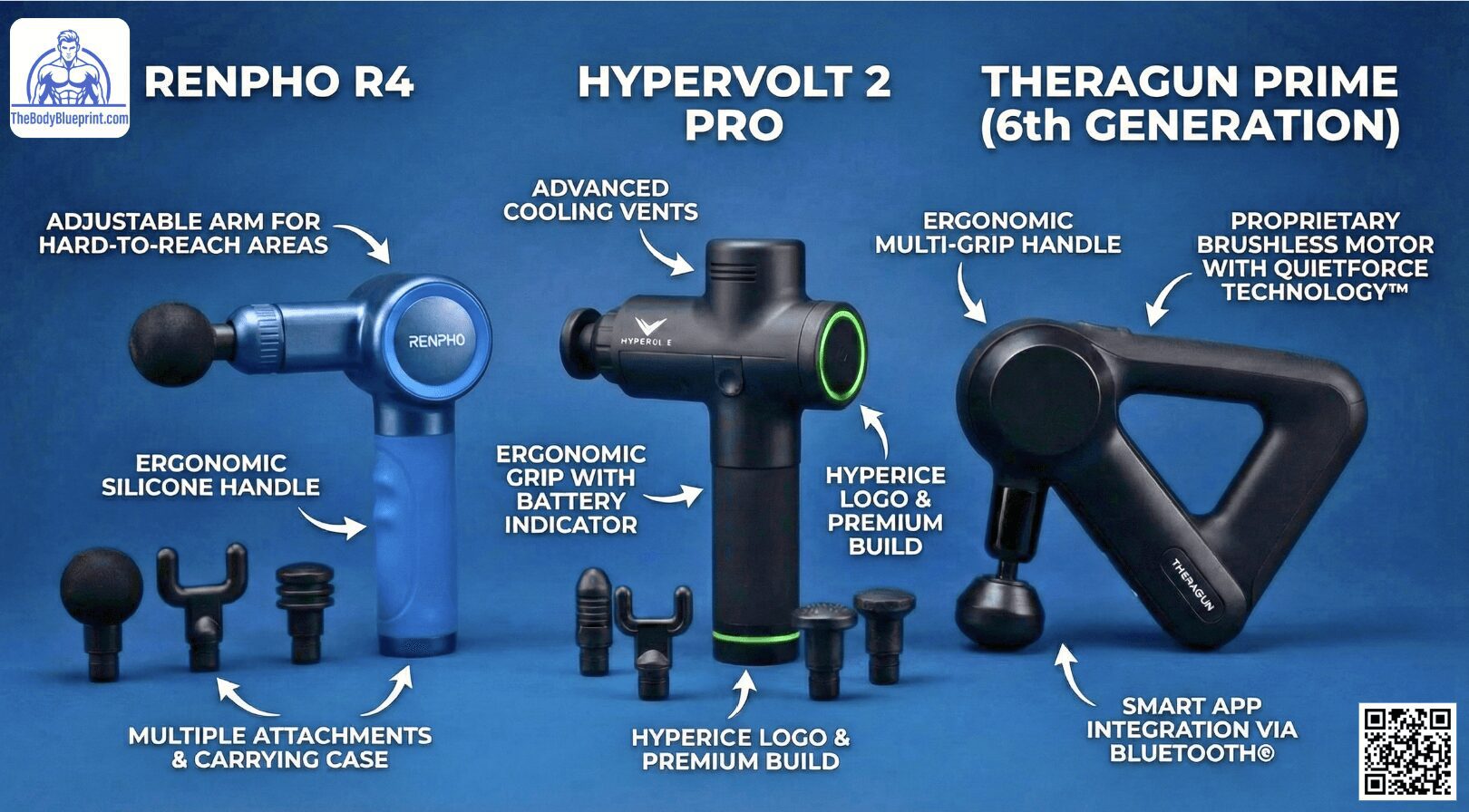
The Theragun Prime, Hypervolt 2 Pro, and Renpho R4 are the three percussion therapy guns that dominate the conversation—but they represent three entirely different philosophies on recovery, build quality, and value.
This 2026 Head-to-Head breaks down the core physics (amplitude vs. stall force), the real-world ergonomics for solo use, and which of these tools is a legitimate investment versus a marketing-powered placebo for your specific aches.
Disclaimer: You’re here to find a product that’ll get you results, and I’m here to help. Just a heads-up: As an Amazon Associate, I earn from qualifying purchases. If you buy through my links, I get a small commission at no added cost to you. It’s like I get a little something for doing the heavy lifting on research. Fair deal? Now, let’s get into the good stuff.
The Core Physics: Amplitude vs. Stall Force
This is the non-negotiable starting point. You cannot maximize both depth and raw power in a single consumer device. Your primary need dictates which spec matters more.
- Amplitude (Stroke Length): How deep the percussion head travels (in mm). This determines if you’re treating surface fascia or deep muscle belly.
- Stall Force: How much pressure (in lbs) you can apply before the motor bogs down and stops. This determines if you can lean into it.
This table isn’t about “better”—it’s about engineering priorities.
| Specification | Theragun Prime (6th Gen) | Hypervolt 2 Pro | Renpho R4 |
|---|---|---|---|
| Amplitude | 16 mm (Deepest) | ~14 mm (Estimated) | 10 mm |
| Stall Force | ~35 lbs | 60-70 lbs (Est.) | ~50 lbs (Claimed) |
| Key Design | Triangular Multi-Grip | Traditional L-Handle | L-Handle + Adjustable Arm |
| Smart App | Therabody (Guided Routines) | Hyperice (Basic Control) | None (LED Interface) |
| Battery | Built-in, ~120 min | Removable, ~180 min | Built-in, ~150 min |
“Most people chase stall force because it feels impressive, but amplitude is your depth charge. A high-stall, low-amplitude gun vibrates the surface. For resetting deep quad or glute tissue after heavy lifting, you need that 16mm punch.”
— Eugene Thong, CSCS
Performance Deep Dive: Feel, Force, and Flaws
Theragun Prime: The Deep Tissue Specialist
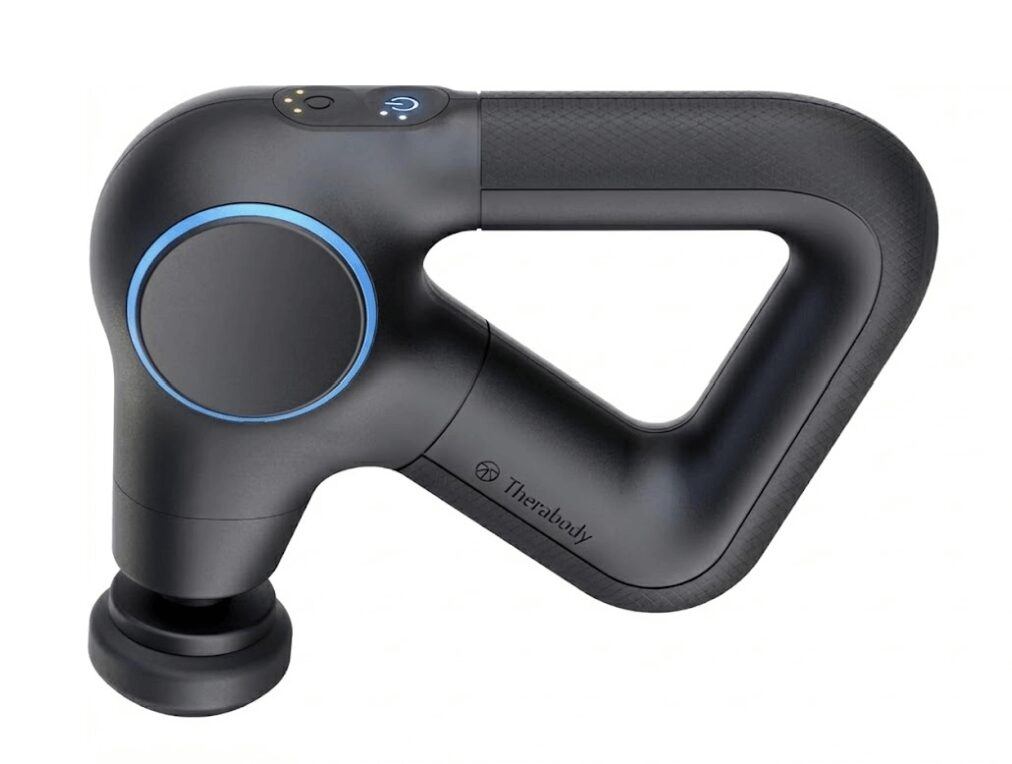
The Sensation: A distinct, rhythmic “thump.” The 16mm amplitude delivers a focused, deep punch—not a surface buzz.
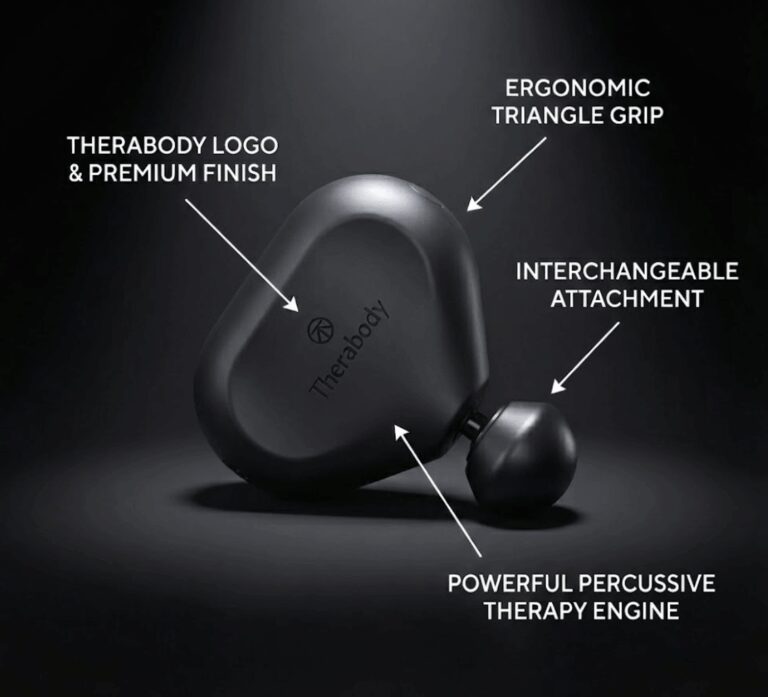
Ergonomics (The Win): The triangular handle is a legitimate innovation for solo use. It enables multiple grips to reach your own back, traps, and glutes without wrist strain.
The Smart Edge: The Therabody App provides guided, AI-driven routines (e.g., “Post-Leg Day”), removing the guesswork from recovery timing and placement.
The Limitation: At ~35 lbs of stall force, it’s the easiest to stall if you aggressively lean into dense muscle. It’s built for depth, not for a fight.
Hypervolt 2 Pro: The Powerhouse Contender
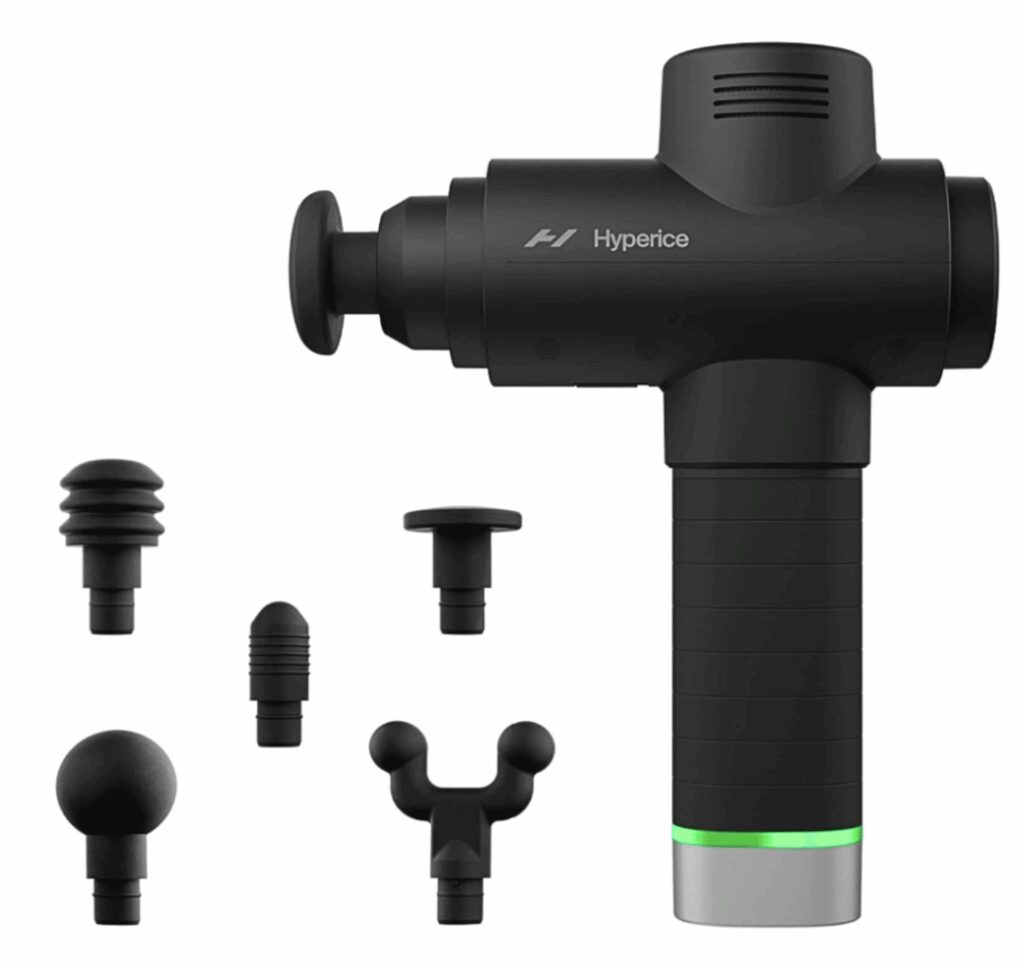
The Sensation: A rapid-fire, fluid, and relentless percussion. Feels smooth and powerful, like a premium power tool.
Build & Unique Feature: The removable battery is its killer feature for pros, teams, or long sessions. The digital dial and QuietGlide tech feel premium.
The Ergonomics (The Catch): The traditional L-shaped handle is tiring on the wrist for solo back work. At 2.6 lbs, it’s the heaviest. Best with a partner or for legs/arms.
The Limitation: Less “smart” integration than Theragun. You’re paying for raw, smooth power, not guided recovery.
Renpho R4: The Budget Wildcard
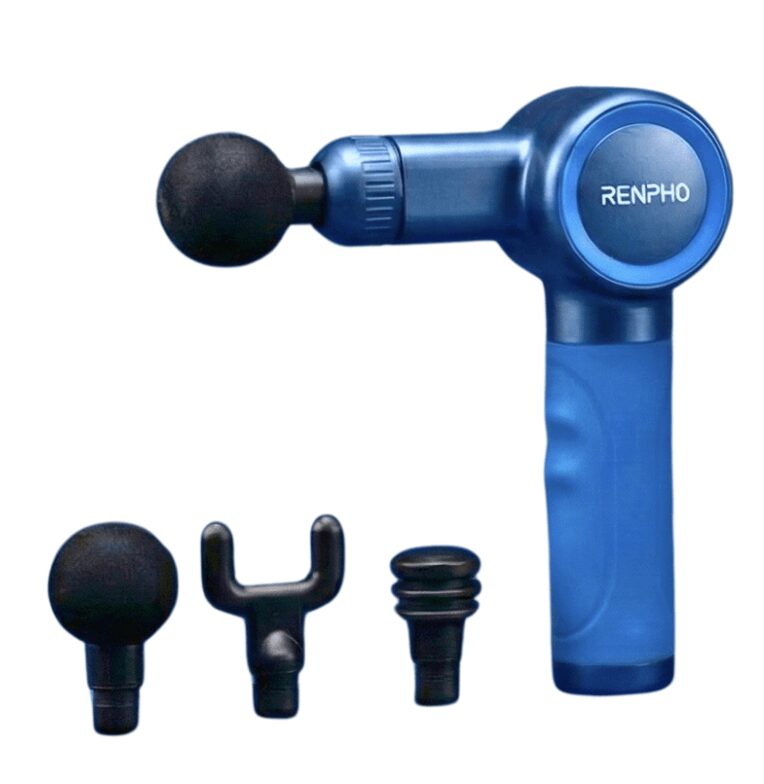
The Sensation: A surface-level vibration. The 10mm amplitude feels more like a vigorous buzz than deep tissue treatment.
The Clever Hack: The adjustable rotating arm mimics a key feature of high-end models, making solo back and glute work surprisingly easy. This is its best value proposition.
The Build Reality: You feel the cost savings. More plastic, louder operation, and a rattlier sound at top speeds. Functional, not luxurious.
The Limitation: Struggles with dense, large muscle groups. For major knots from heavy lifting, the amplitude may not be sufficient.
“This is like buying your first serious supplement. The Renpho is the starter kit to see what you’ll use. The Theragun is your daily whey isolate—the workhorse for real results. The Hypervolt is that premium fat-burner: hyper-specific for targeted, powerful effects.”
— Charles Damiano, B.S. Clinical Nutrition
Buyer’s Decision Matrix: Who Wins, Who Should Walk Away
| Your Profile | The Winner & Why | Avoid This One |
|---|---|---|
| The Heavy Lifter / Bodybuilder (Dense quads, hams, glutes) |
Theragun Prime. The 16mm amplitude is non-negotiable for reaching deep into hypertrophied muscle. | Renpho R4. The 10mm amplitude will feel superficial. You’ll press harder and get nowhere. |
| The Athlete / Runner (Needs pre-game activation, fast recovery) |
Hypervolt 2 Pro. Smooth, high-speed percussion is perfect for warming up calves and shoulders. Removable battery is gold for tournament days. | Theragun Prime. The deep “thump” can be too aggressive on sensitive, lean muscle pre-activity. |
| The Desk Worker (Chronic upper back, neck, trap tension) |
Theragun Prime. The triangular handle lets you self-treat your rhomboids and traps while sitting. The app’s “Desk Reset” routines are built for you. | Hypervolt 2 Pro. The heavy, straight handle makes solo upper back work awkward and tiring. |
| The Student / First-Time Buyer (Wants utility on a tight budget) |
Renpho R4. The adjustable arm delivers 70% of the convenience for 30% of the price. Proves you’ll use a gun before investing in luxury. | Hypervolt 2 Pro. The premium is for power and smoothness you don’t yet need. Don’t buy a Formula 1 car for your driver’s test. |
| The Partnered Athlete or Coach (Treating others, long sessions) |
Hypervolt 2 Pro. High stall force lets you apply serious pressure. The removable battery guarantees no downtime. | Renpho R4. Lower build quality and inconsistent power won’t withstand professional or frequent multi-person use. |
Key Drawbacks & Dealbreakers
- Theragun Prime: Lowest stall force of the three (~35 lbs). Can bog down if you’re overly aggressive. The app is a value-add, but the subscription for advanced features is a continued cost.
- Hypervolt 2 Pro: Worst ergonomics for solo use. The straight handle is a wrist-killer for reaching your own back. The premium price is for power and a removable battery you may not need.
- Renpho R4: Shallow amplitude (10mm) struggles with deep tissue. Build quality feels budget—louder, more plastic, less refined damping. It’s an entry tool, not a lifetime investment.
“Stop crowd-sourcing your pain relief. Your buddy’s Hypervolt feels great on his runner’s calves but will disappoint you on your glued-up quads. Match the tool to your dominant tissue type. Otherwise, you’ve bought a very expensive back scratcher.”
— Eugene Thong, CSCS
Final Takeaways: The Non-Negotiable Truths
- Choose by anatomy, not hype. Depth (Amplitude) for large, dense muscles (Theragun). Power & Speed (Stall Force) for surface tension and treating others (Hypervolt). Budget & Versatility for general use and hard-to-reach spots (Renpho).
- Ergonomics determine actual use. If you live alone, the Theragun’s triangle grip or the Renpho’s adjustable arm are mandatory for back access. The Hypervolt’s straight handle is a partner-dependent design.
- Your first gun shouldn’t be your last gun. If you’re unsure, the Renpho R4 is a low-risk entry that proves the concept. If you know your needs, buy the tool that matches them—even if it costs more.
The Iron Lexicon: Percussive Therapy Edition
- Amplitude (Stroke Length)
- The distance (in millimeters) the massage gun’s head travels back and forth. A higher amplitude (e.g., 16mm) allows the percussion to reach deeper muscle layers and fascia.
- Stall Force
- The amount of pressure (in pounds) you can apply to the treatment area before the gun’s motor “stalls” or bogs down, losing effectiveness. Higher stall force allows for more aggressive treatment.
- Percussions Per Minute (PPM)
- The speed of the motor, measured in cycles per minute. Typical range is 1800-3200 PPM. Higher speeds are often used for warming up; lower speeds for deep, focused work.
- QuietGlide / QuietForce Technology
- Proprietary motor and internal damping systems (from Hyperice and Therabody, respectively) designed to reduce operational noise while maintaining power and smoothness.
- Ergonomic Multi-Grip
- A handle design (like the Theragun’s triangle) that allows the user to hold the device in multiple positions to comfortably reach different muscle groups without wrist strain.
- Removable Battery System
- A feature (like on the Hypervolt 2 Pro) that allows the battery pack to be detached for charging or swapping, enabling continuous, uninterrupted use.
- Adjustable Articulating Arm
- A hinged neck (like on the Renpho R4) that allows the gun’s head to be angled independently of the handle, improving access to hard-to-reach areas like the mid-back.