You know that look—the one hardened lifters carry after a set that feels like their soul left, checked the weather outside, and decided to come back only if they survive the next rep. That’s High-Intensity Training (HIT). The stripped-down, no-fluff system that forged the sinew of Dorian Yates, shaped the efficiency of Nautilus-founder Arthur Jones, and still stalks the corners of hardcore gyms where people go to transform, not to pass time.
HIT isn’t about “grinding.” It’s about one set, done so brutally well that two things happen simultaneously:
1️⃣ Your muscles send a distress signal.
2️⃣ Your mind learns what genuine effort feels like.
But most lifters never taste the real thing. They stop when the set gets uncomfortable—long before the work begins.
Let’s tear the concept down and rebuild it with the same precision your body demands.
The Premise: Maximum Stimulus, Minimum Time
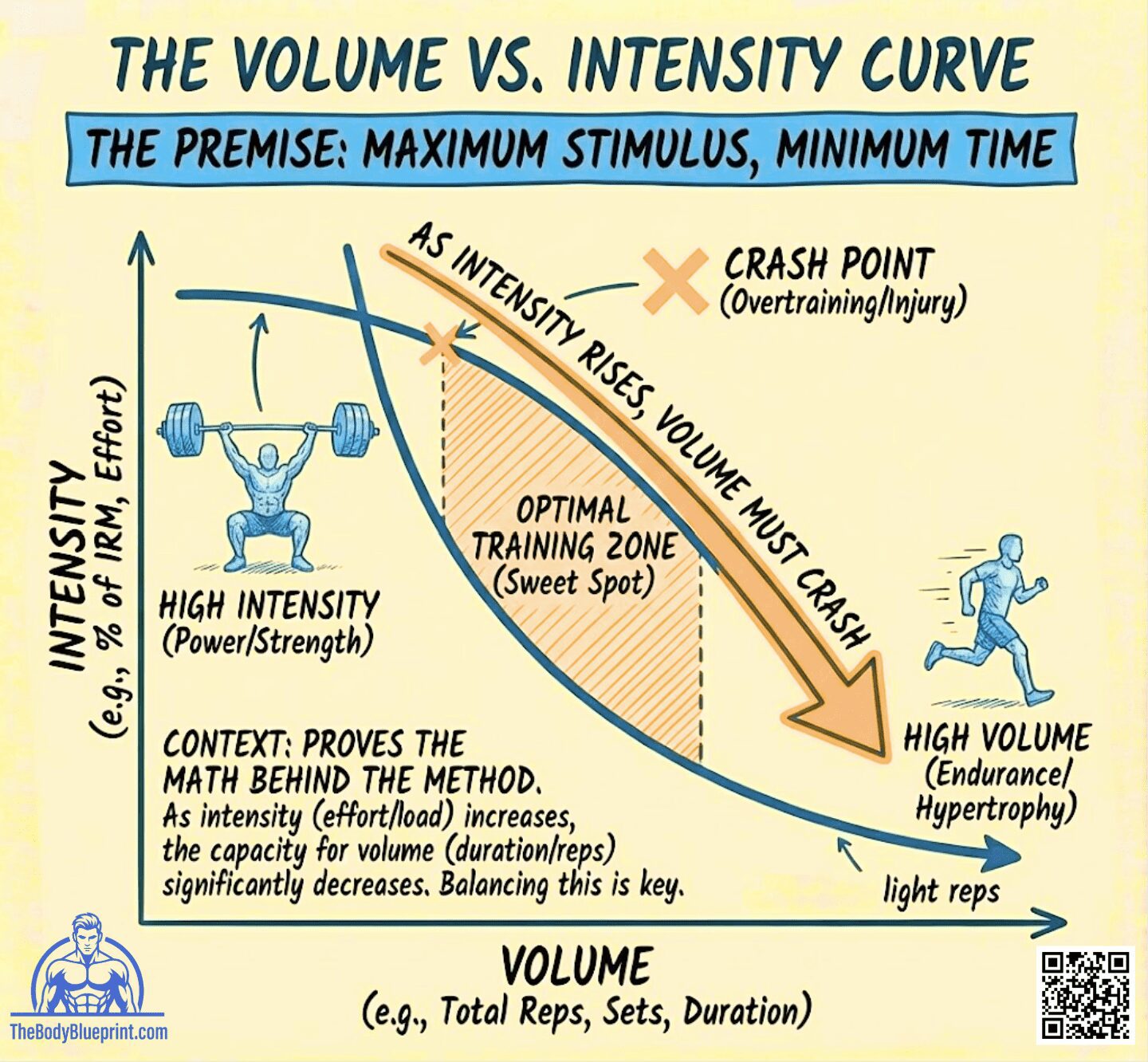
High-Intensity Training lives on a simple equation:
Stimulus ↑ while Volume ↓ = Hypertrophy and Strength ↑
Fewer sets. Slower tempo. Longer tension. Iron discipline.
As Eugene Thong, CSCS notes, “Muscular adaptations correlate more strongly with effort than with volume alone.”
A truth as old as iron—delivered with scientific clarity.
Mechanics of a True HIT Set — The Non-Negotiables
You don’t wander into a HIT set. You engineer it.
- Steady Eccentric — A 4–6 second lowering phase that rips the brakes off momentum.
- Explosive but Controlled Concentric — Driving with intent but never with chaos.
- Continuous Tension — No resting, shaking, wiggling, or resetting.
- Slow the Final Reps — When form starts to slip, tempo slows.
- One Set to Absolute Technical Failure — The rep where quality collapses is the rep after the last real rep.
“Intensity is not shouting or sweating. Intensity is the moment your fibers and your willpower break at the exact same second.” — Fred “Dr. Squat” Hatfield, Muscle & Fitness
The Physiology: Why Less Becomes More
Your body reacts to stress, not activity.
Inside a HIT set:
- Motor unit recruitment spikes, pulling in high-threshold fibers you can’t reach with lightweight fluff work.
- Metabolic stress accumulates, triggering intracellular swelling.
- Myofibrillar damage increases, prompting hypertrophic repair.
- CNS output peaks, because you’re pushing to the brink.
It’s minimalism sharpened into a weapon.
Muscle Groups and Moment-of-Truth Patterns
Below is a quick-hit table outlining how HIT impacts different movements at peak intensity:
| Exercise | Primary Stress Point | Intensity Cue | Common Breakdown |
|---|---|---|---|
| Leg Press | Deep knee flexion | 4-sec eccentric + pause at bottom | Resting at lockout |
| Chest Press | Mid-range tension | Constant force path | Shoulders rolling forward |
| Pull-Down | Elbow drive + scapular depression | Slow negative to top | Using biceps to cheat workload |
| Overhead Press | Last 1/3 of concentric | Torso locked, zero sway | Lumbar hyperextension |
Who HIT Is Perfect For
✔ The Time-Strapped Lifter — Maximum stimulus in 20–30 minutes.
✔ The Overtrained Veteran — Repairs fatigue debt and CNS sluggishness.
✔ The Precision Athlete — Values controlled, efficient force production.
✔ The Low-Volume High-Focus Personality — Those who thrive on intensity instead of quantity.
Who HIT Is Not For (Yet)
✖ Beginners With No Form Foundation
✖ Athletes Recovering From Acute Tendon Injury
✖ Anyone Without the Ability to Self-Regulate Effort
The HIT Protocol: Your Weekly Blueprint
Below is your one required list, structured for clarity:
- Warm Up Microscopically
A couple light sets to groove the motion. No fatigue allowed. - One All-Out Set
Slow tempo. Zero momentum. Stop only when the rep truly dies. - Rest 90–120 Seconds Between Exercises
HIT is not a race. It’s a controlled demolition. - Work Each Body Part 1–2x Per Week
Recovery is the religion of HIT. Respect the doctrine. - Logbook Your Sessions
The data doesn’t lie. Only your ego does.
Programming Structure: The 3-Day Split
Day 1 — Push
Chest Press, Overhead Press, Pec Deck, Triceps Extension
Day 2 — Pull
Pull-Down, Row Machine, Rear Delt Fly, Biceps Curl
Day 3 — Legs
Leg Press, Hamstring Curl, Calf Raise, Abdominal Crunch
Each movement: 1 set to catastrophic, technical failure.
The Two Enemies of HIT
❌ Speed — Momentum steals muscular tension.
❌ Ego — Weight means nothing if tension is absent.
In the words of IronMan Magazine:
“HIT exposes lifters who have never truly trained before. The intensity becomes the teacher.”
The Payoff: Strength, Simplicity, and Density
Within weeks you’ll feel:
- Deeper muscle exhaustion from slower tempos
- Faster strength increases from neurological recruitment
- Denser tissue quality, that “thicker” look seen in HIT veterans
- Shorter workouts, with more meaningful output
A training style that strips away everything unnecessary until only effort remains.
Final Word
HIT is not glamorous.
HIT is not loud.
HIT doesn’t care about your playlists, your pump, or your preworkout buzz.
HIT is the scientific art of demanding everything from one set—then walking away and letting biology finish the job.
If you want more by doing less, you must be willing to give everything to the only set that counts.