
Let’s be honest. You’re reading this because you feel a twinge of guilt even considering it. The question “Should I take a break from the gym?” feels like heresy. You’re wondering: “Will I lose all my gains, turn to mush, and betray the grind?” Good. You’re dedicated. Now let’s shatter that mindset with the truth.
Prescribed for athletes who are facing plateauing strength, lingering joint pain, or the feeling that every workout is a slog, a strategic deload isn’t for the lazy. It’s for lifters who understand that growth happens during recovery, not destruction. But if you believe “more is always better” and you’d rather overtrain than undershoot? Skip this article.
Who a Gym Vacation Will Transform (And Who It Will Terrify)
| FOR YOU IF… | NOT FOR YOU IF… |
|---|---|
| Your last 3 PR attempts have stalled or regressed. | You’ve been consistently hitting new PRs every week. |
| You have nagging aches (knees, shoulders, elbows) that won’t quit. | You’re in the middle of a perfectly structured 12-week program. |
| The thought of the gym elicits dread, not excitement. | You genuinely get anxious after 2 rest days. |
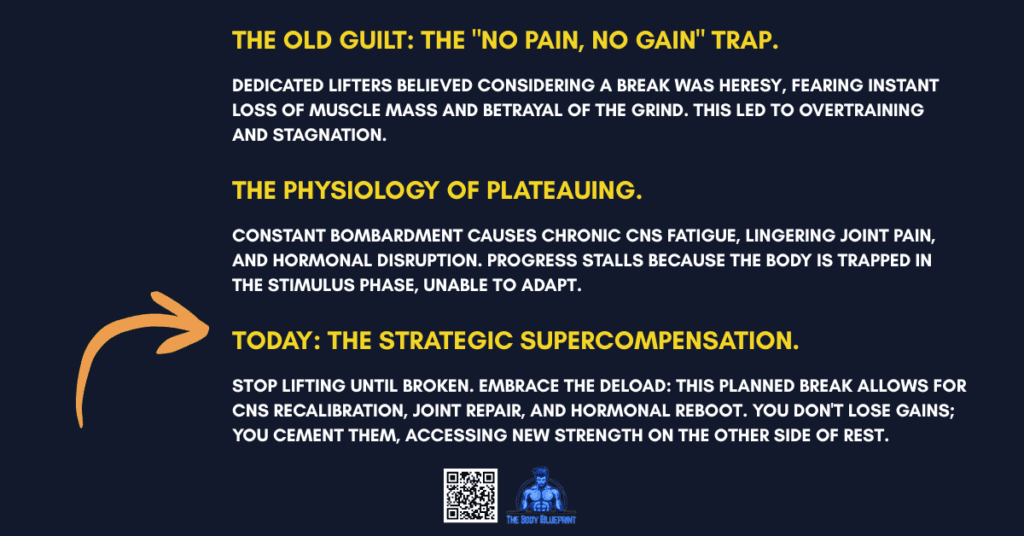
The Physiology of Progress: Why Strength is Built in the Valley, Not on the Mountain
Training is the stimulus. Growth is the adaptation. When you constantly bombard your body without a break, you live in the stimulus phase. A strategic break—a planned deload—is what finally allows the adaptation to cement itself. You’re not losing muscle; you’re allowing the blueprint to solidify.
“We see a phenomenon called ‘supercompensation.’ The body doesn’t just recover to its previous baseline after stress; it overcompensates, building back slightly stronger. But if you never let the recovery happen, you never access that supercompensation effect.” says Dr. Sarah Jenkins, PhD in Exercise Physiology. “Stagnation isn’t a sign you need to work harder. It’s a sign you need to recover smarter.”
This isn’t about lying on the couch for a week. It’s about strategic decompression for your central nervous system, joints, and mind. The gains you’ve been chasing are waiting on the other side of a proper reset.
Pros vs. Cons: The Real Trade-Offs of a Break
👍 THE UPSIDE (What You Actually Gain):
- CNS Recalibration: Your nervous system “resets,” leading to better muscle recruitment and newfound strength.
- Joint and Tissue Repair: Chronic inflammation goes down. Those nagging pains finally have a chance to heal.
- Mental Reboot: You return with genuine passion, killing the monotony and preventing burnout.
- Hormonal Rebalance: Cortisol (the stress hormone) drops, while testosterone and growth hormone optimize.
👎 THE DOWNSIDE (The Managed Risks):
- You might feel a bit “soft” after 7-10 days (it’s water/glycogen, not lost muscle).
- You’ll need to be disciplined to ease back in (don’t go for your 1RM on day one back).
- It requires trusting the process, which is psychologically hard for dedicated lifters.
How to Do It Right: The “Anti-Sabotage” Protocol
| Strategy | Why It Works |
|---|---|
| Total Rest (3-5 Days) | Full system shutdown. Ideal for extreme fatigue or mental burnout. |
| Active Recovery (7-10 Days) | Light walks, yoga, mobility. Maintains blood flow without stress. |
| Deload Week (1 Week) | Cut volume and weight by 50-60%. Practice form, grease the groove. |
5 Uncommon (But Critical) Q&A: Your Gym Break Deep Dive
A: It takes about 3 weeks of complete detraining for significant muscle loss to occur in a trained individual. A 7-10 day break? You might even look fuller due to reduced systemic inflammation and replenished glycogen stores. The muscle memory phenomenon is also very real—you’ll regain any slight loss shockingly fast.
A: Intent and structure. Laziness is avoidance. A strategic break is a planned part of your programming with a defined end date and a purpose (healing, supercompensation, mental reset). You’re not skipping workouts; you’re executing the recovery phase of your training.
A: Reframe your metric for success. For this one week, your “win” isn’t calories burned or weight lifted. Your win is lowering your resting heart rate getting 8+ hours of sleep, and feeling excited to train again. Track your sleep and mood instead of your lifts. You’re still working—just on a different part of the machine.
A: The opposite. After a true deload, most lifters come back stronger. Your body is fully recovered and supercompensated. That sticking point you had on your bench? There’s a high chance you’ll blow past it. Pro Tip: Your first week back, aim for 80% of your previous working weight to re-acclimate and avoid injury.
A: A good rule of thumb is to schedule a deload or active recovery week every 8-12 weeks of consistent, intense training. Listen to your body. If you’re feeling run down, getting sick often, or your sleep is suffering, it’s time—no matter what the calendar says.
Final Thought: The weakest mindset is the one that can’t stop. The strongest lifters understand that periodization applies to the mind as much as the muscles. Sometimes, the most productive thing you can do for your gains is absolutely nothing.