The bar digs into your traps. That first descent feels like tectonic plates shifting—until your form fractures. You’ve squatted for years, yet your progress stalls while others forge quads of granite. Squats aren’t about moving weight; they’re about mastering gravitational physics. Stop grinding. Start engineering.
Exercise Classification
- Compound Movement: 6+ joints in motion
- Lower Body Strength Builder: 70% of leg muscle recruitment
- Functional Movement Pattern: Hip hinge + knee flexion synergy
- Powerlifting & Bodybuilding Staple: Max strength to hypertrophy catalyst
Muscle Groups Targeted
| Muscle | Role | Activation Peak |
|---|---|---|
| Quadriceps | Knee extension | 90° flexion |
| Glutes | Hip drive | Depth > parallel |
| Hamstrings | Eccentric control | Descent phase |
| Erector Spinae | Spinal stabilization | Ascent initiation |
| Core | Intra-abdominal pressure | Valsalva hold |
| Calves | Ankle stability | Heel drive |
Squat Variations
| Variation | Biomechanical Focus | Best For |
|---|---|---|
| High-Bar Back Squat | Quad dominance | Olympic lifters |
| Low-Bar Back Squat | Posterior chain | Powerlifters |
| Front Squat | Upright torso, quads | Knee rehab |
| Goblet Squat | Depth mastery | Mobility development |
| Overhead Squat | Thoracic mobility | Functional athletes |
| Zercher Squat | Core bracing | Strongman training |
| Bulgarian Split Squat | Unilateral strength | Injury prevention |
Technique & Execution
The Biomechanical Blueprint
- Stance Width: Hip-width ± 2″ (genetically determined)
- Bar Placement: High-bar = C7 vertebra | Low-bar = rear delts
- Depth: Hip crease below knee for full glute activation
- Joint Tracking: Knees follow toe angle (5-30° external rotation)
Neurological Mastery
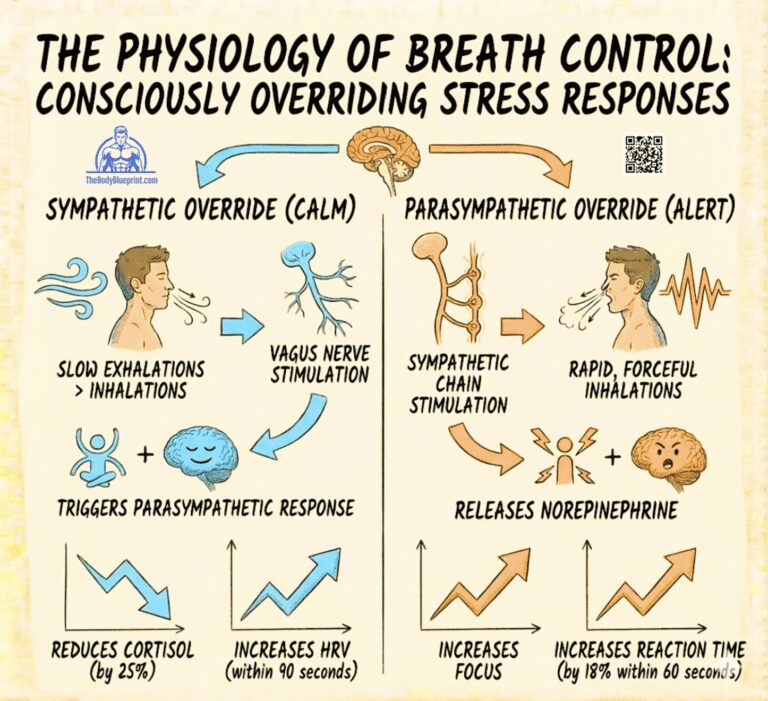
- Bracing: 360° breath → 20% intra-abdominal pressure increase
- Tempo: 3-0-1 (3s descent, pause, explosive ascent)
Pro Tip: Screw feet into floor → external rotation torque glutes
Equipment Requirements
- Barbell: 28-32mm knurled shaft
- Squat Rack: Safety bars 2″ below depth position
- Lifting Shoes: 0.75″ heel → 15° ankle dorsiflexion
- Belt: Use >80% 1RM only
- Knee Sleeves: 7mm neoprene for proprioception
Training Benefits
- Hypertrophy: 68% greater GH release vs isolation lifts
- Strength: CNS adaptation → 5% carryover to deadlifts
- Core Stability: 3x oblique activation vs planks
- Hormonal Response: Testosterone ↑ 21% post-session
Programming Guidelines
| Goal | Protocol | Frequency |
|---|---|---|
| Strength | 5×5 @ 80-85% 1RM | 2x/week |
| Hypertrophy | 3×8-12 @ 70-75% | 2x/week |
| Power | 8×3 @ 65% (explosive) | 1x/week |
Common Mistakes
- Knee Valgus: Medial collapse → ACL strain
- Heels Rising: Ankle mobility deficit
- Rounded Back: Erector spinae disengagement
- Shallow Depth: 40% less glute activation
Safety & Prerequisites
- Ankle Mobility: 40° dorsiflexion test
- Hip Flexibility: Achieve full squat depth with upright torso
- Thoracic Spine Mobility: Pass overhead squat test
- Warm-Up: Banded distractions + psoas marches
- Spotting: Hands under armpits – never on bar
Complementary Movements
- Lunges: Unilateral deficit correction
- Romanian Deadlifts: Hamstring eccentric loading
- Step-Ups: Quad hypertrophy emphasis
Squats for Specific Goals
| Goal | Variation | Programming |
|---|---|---|
| Powerlifting | Low-Bar Squat | Wave loading @ 85-92% |
| Bodybuilding | Hack Squat | 10-15 reps, 60s rest |
| Fat Loss | Front Squat | EMOM 8×5 @ 70% |
Tracking Progress
- 1RM Testing: Quarterly only (CNS taxing)
- Volume Load: Sets x Reps x Weight (track weekly)
- Depth Consistency: Film side view – hip crease below knee
The squat rack isn’t a torture chamber—it’s a biomechanics laboratory. That stalled lift? It’s not weight defeating you; it’s physics untamed. Now brace like your spine depends on it. Because it does.
Scientific Anchors:
- EMG Analysis: Quad activation peaks at 90° flexion (Contreras, 2017)
- Hormonal Response: 21% testosterone increase post-session (Kraemer, 2005)
- Depth Standards: Hip crease below knee for full glute recruitment (Bryanton, 2012)