
Compound Exercises: The Foundational 5 for Maximum Mass
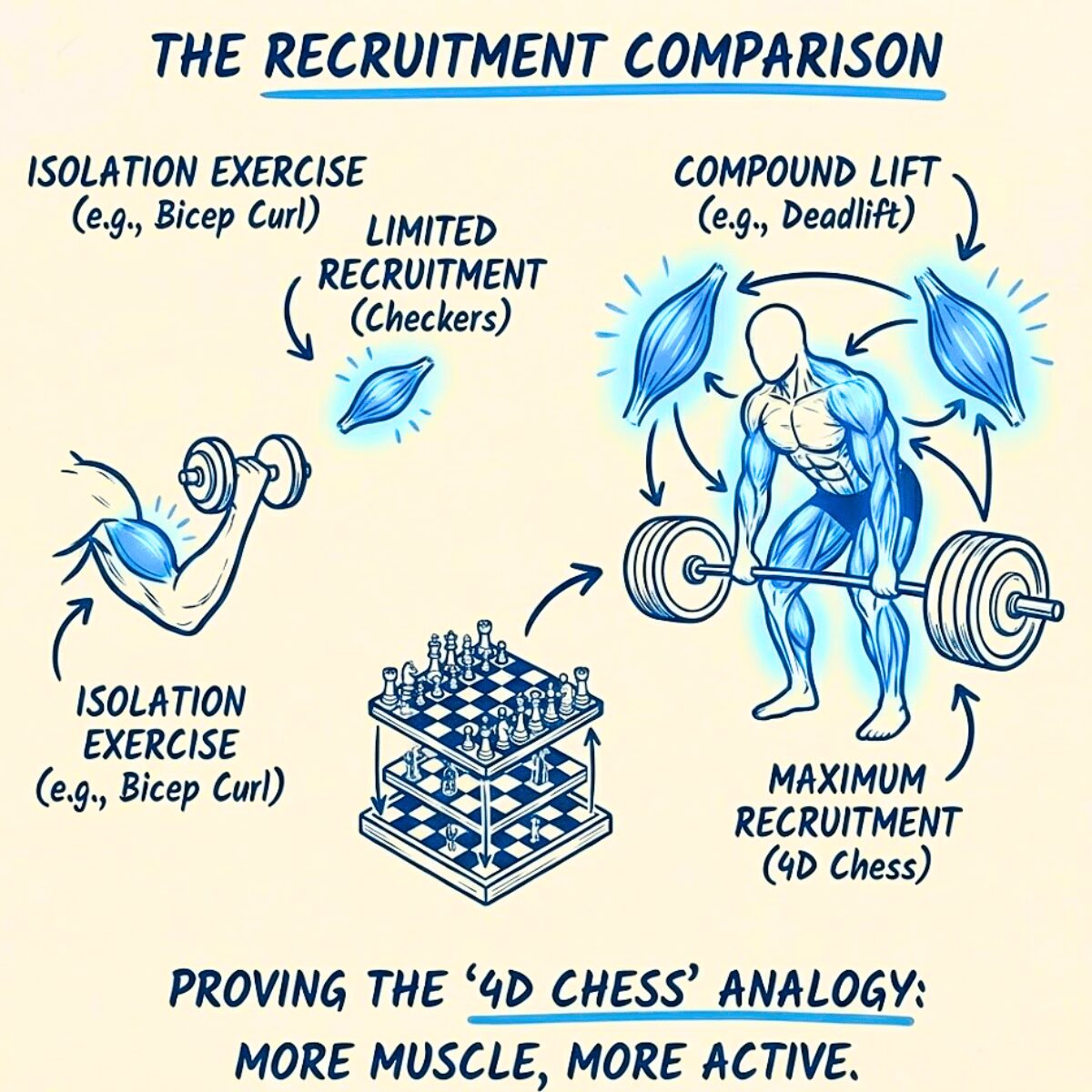
You grind through endless arm curls and leg extensions. Yet, the scale moves, not the tape. That gap between effort and anatomy? It’s not your genetics. It’s your exercise economy. Compound lifts aren’t gym-bro dogma—they’re anabolic leverage. Isolate all you want; you’re playing checkers while compounds play 4D chess. Let’s build a real frame.
Core Concepts
The science of multi-joint mass:
Compound Exercises Defined
Movements that span multiple joints and muscle groups simultaneously. Not just “working a muscle”—but maximizing mechanical tension across your entire frame.
The Efficiency Multiplier
- Mechanical Tension: The #1 driver of growth. Compounds allow you to load muscles with heavy weight, creating maximal tension.
- Systemic Stress: This high-tension environment triggers a greater anabolic hormone response (Testosterone, GH), creating a growth-friendly environment.
- Metabolic Torch: Recruiting more muscle = more calories burned during and after the workout (EPOC).
- Functional Strength: Builds a body that works as one unit, not a collection of parts.
The Time vs. Growth Equation
Reality: In the time it takes to do three isolation exercises, one compound movement stimulates more total muscle growth through superior mechanical loading.
Compound vs. Isolation Impact
| Metric | Compound Lifts | Isolation Lifts |
|---|---|---|
| Mechanical Tension | Maximal | Localized |
| Muscle Fibers Recruited | High (100s of grams) | Low (10s of grams) |
| Time Efficiency | Maximal | Low |
| Carryover to Real World | Direct | Minimal |
The Foundational Five
The non-negotiable mass builders:
1. The Barbell Back Squat
- Primary Muscles: Quads, Glutes, Hamstrings, Adductors, Erectors
- Why It’s King: The highest systemic demand of any lift. Creates unparalleled mechanical tension for lower body and core growth.
- Key Cue: “Break at the hips and knees simultaneously.” “Drive your back into the bar.”
- Programming: 3-5 sets of 5-8 reps.
2. The Deadlift
- Primary Muscles: Hamstrings, Glutes, Lats, Erectors, Forearms, Traps
- Why It’s Essential: The ultimate test of total-body strength. Builds a monstrous back and grip through high-tension loading.
- Key Cue: “Brace your core and maintain a neutral spine.” “Push the floor away.” “Chest up, lats tight.”
- Avoid: Rounding your lower back. Jerking the bar off the floor.
- Programming: 1-3 sets of 3-5 reps (high CNS fatigue).
3. The Bench Press
- Primary Muscles: Pectorals, Anterior Deltoids, Triceps
- Why It’s Iconic: The premier upper-body mass builder. Allows for the greatest mechanical overload for the pressing muscles.
- Key Cue: “Pull the bar apart.” “Retract your scapula.”
- Programming: 3-5 sets of 5-10 reps.
4. The Overhead Press (OHP)
- Primary Muscles: Anterior/Mid Deltoids, Triceps, Upper Chest, Traps
- Why It’s Critical: Builds imposing, functional shoulders and core stability like no other. Pure axial loading for the upper body.
- Key Cue: “Brace your glutes and abs.” “Push your head through at the top.”
- Programming: 3-4 sets of 5-8 reps.
5. The Pull-Up / Bent-Over Row
- Primary Muscles: Lats, Rhomboids, Rear Delts, Biceps, Forearms
- Why They’re Paired: These are the yin and yang of back development. Rows for thickness, Pull-Ups for width, both creating massive tension.
- Key Cues: Row – “Pull the bar to your sternum.” Pull-Up – “Drive your elbows down.”
- Programming: 3-5 sets of 5-12 reps.
Exercise Hierarchy
Prioritize movements, not muscles:
| Movement Pattern | Primary Exercise | Secondary Exercise |
|---|---|---|
| Horizontal Push | Barbell Bench Press | Dumbbell Bench Press, Push-Ups |
| Horizontal Pull | Barbell Bent-Over Row | Seated Cable Row, Chest-Supported Row |
| Vertical Push | Overhead Press | Dumbbell Shoulder Press, Landmine Press |
| Vertical Pull | Pull-Up / Chin-Up | Lat Pulldown |
| Knee-Dominant | Barbell Back Squat | Front Squat, Lunges |
| Hip-Dominant | Barbell Deadlift | Romanian Deadlift (RDL), Hip Thrusts |
Programming for Growth
How to structure your training:
- Frequency: Hit each movement pattern 2-3x per week for optimal MPS frequency.
- Progressive Overload: The non-negotiable rule. Add weight, reps, or sets over time.
- Exercise Order: Perform compounds FIRST in your workout when you are strongest.
- Volume Sweet Spot: 10-20 hard sets per muscle group per week (Schoenfeld, 2016).
Individualization Factors
Adjust for your body and goals:
| Factor | Strategy |
|---|---|
| Beginner (0-6 mos) | Master the Foundational Five. Use a full-body 3x/week program. |
| Mobility Limitations | Substitute: Goblet Squat for Back Squat, DB Press for OHP. |
| Low Back Issues | Substitute: Front Squat for Back Squat, Rack Pulls or RDLs for Deadlifts. |
| Time-Crunched | Focus on Squat, Bench, Row. The minimalist’s mass trifecta. |
Scientific Evidence
What research confirms:
- Mechanical Tension is King: Hypertrophy is primarily driven by high levels of mechanical tension, best achieved with heavy compound lifts (Schoenfeld, 2010).
- Greater Functional Hypertrophy: Multi-joint exercises lead to better strength and coordination gains.
- Time Efficiency: A program built around compounds produces more muscle growth in less time than a body-part split (Gentil, 2015).
Common Mistakes
Growth saboteurs:
- Ego Lifting: Sacrificing form (especially a rounded spine on deadlifts) for weight guarantees injury and stunts long-term growth.
- Neglecting the Back: For every push, you need a pull. A 2:1 pull-to-push ratio builds a balanced, injury-resistant physique.
- Program Hopping: Sticking with the basic compounds for 6+ months beats a new “optimized” program every month.
- Sacrificing Range of Motion: Half-reps build half-muscles. Full ROM is non-negotiable for hypertrophy.
Progress Tracking
Data-driven adjustments:
- Strength Markers: Are your 5-rep maxes on the Big 5 going up over 3-6 months?
- Body Measurements: Monthly tape measure on chest, arms, thighs, and waist.
- Form Checks: Film your sets. Is your depth consistent? Is your back flat?
- Recovery Metrics: Are you able to maintain or improve performance session to session?
Psychological & Behavioral Factors
The adherence advantage:
- Tangible Progress: Adding 5lbs to your squat is a concrete win that fuels motivation.
- Simplified Focus: Worrying about 5 lifts is easier than 25. Decision fatigue is eliminated.
- Confidence Compound: Moving significant weight with proper form builds a resilient, capable mindset.
Compound exercises aren’t a preference—they’re the foundation of functional mass. That stubborn plateau? It’s not your ceiling—it’s your program missing the pillars. Build your foundation. Your frame is waiting to be forged.
Key Studies:
- Schoenfeld (2010): The mechanisms of muscle hypertrophy and their application to resistance training
- Schoenfeld et al. (2016): Dose-response relationship between weekly volume and muscle growth
- Gentil et al. (2015): Review of resistance training program design